
Revision summary
Lakhudiyar near Almora is the type painted shelter of Uttarakhand. Other Kumaon overhangs include Lwethap, Petshal, and Falsima. Motifs are humans, animals, dancers, and geometric signs in red, white, and black. Yashodhar Mathpal and K. P. Nautiyal documented the province. Chronology is mainly relative, from Mesolithic-like to later Holocene overlays.
Model answer
Copper italics in this answer — like this — are the key facts. Each one is unpacked in the Facts & figures rail.
Introduction
Uttarakhand holds painted rock shelters in the Kumaon hills. They are a Himalayan province of Indian rock art, smaller than the Vindhyan belt, but important for settlement in the mid-altitude valleys.
Body
Localities
- Lakhudiyar (also written Lakhu Udyar) near Almora is the best-known painted shelter, with humans, animals, and geometric signs in red, white, and black.
- Other Kumaon clusters include shelters reported from Lwethap, Petshal, Falsima, and related Almora–Nainital scarps, documented by Yashodhar Mathpal, K. P. Nautiyal, and later surveys of the Uttar Pradesh (now Uttarakhand) state archaeology wing.
- The paintings sit in quartzite and sandstone overhangs above river terraces, not in high glacial caves.
Motifs and date
- Stick-like human groups, hunting scenes, cattle or caprids, hand-linked dancers, and dots or comb signs are typical.
- Superimposition and pigment fade suggest more than one episode. A Mesolithic to late Holocene span is usually argued by analogy with Bhimbetka and Central Indian styles, not by many direct dates.
- Mathpal compared Kumaon figures with Central Indian hunter-gatherer art, while noting a thinner large-animal repertoire.
Meaning for prehistory
- The art records mid-hill occupation, hunting, and group ritual in a zone later known for terraced farming.
- It should not be collapsed into historic Garhwali temple art. It is prehistoric picture-making on living rock.
Flow diagram
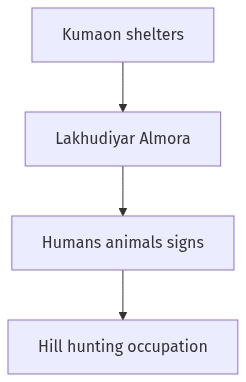
Conclusion
Uttarakhand rock art is a Kumaon shelter tradition centred on Lakhudiyar and nearby Almora sites. Humans, animals, and signs in red and white record hill hunting and gathering. Dates remain mostly relative, so the note must stay cautious.
Quick related
Students also ask
-
"Indus Valley was the first settlement of the big civilization." Comment critically.
Next question on this syllabus topic (2023 · Q2(b)). View answer →
-
Are these the same as historic Pahari miniature painting?
No. Rock shelter paintings are prehistoric or early Holocene picture-making on stone. Pahari miniatures are later court and temple art on paper.
-
Is every Uttarakhand painting Mesolithic?
No. Superimposition suggests several periods. Direct dates are few, so Mesolithic is a working comparison, not a sealed date for every figure.
Same topic · past papers
UPSC has asked this before
These previous-year questions sit on the same topic. Open one to practise the earlier ask.
-
2015 · Q5(a) · Anthropology GS 2 · 10 marks
Prehistoric Rock Art of Central India
More from this topic
Q6(a) · UPSC Mains 2026 · Anthropology GS 2 · 20 marks · Solution
Make a critical appraisal of the mesolithic culture of Ganga basin with reference to artifacts, faunal and human skeletal remains excavated from different sites
Evolution of the Indian Culture and Civilization
• Ganga basin Mesolithic sites like Sarai Nahar Rai, Mahadaha, and Damd
Q5(e) · UPSC Mains 2026 · Anthropology GS 2 · 10 marks · Solution
Contribution of L. K. Ananthakrishna Iyer in Anthropology.
Evolution of the Indian Culture and Civilization
L. K. Ananthakrishna Iyer is a pioneering figure in Indian anthropology, known for his monumental ethnographic surveys like The Cochin Tribes and Castes and The Mysore Tribes and Castes. Working during the colonial era, he bridged western anthropological methods with indigenous scholarship. His documentation of social stratification, material culture, and folklore laid the empirical foundation for Indian sociology and anthropology. Iyer also established the first department of anthropology in India at the University of Calcutta, shaping institutional teaching and research.
Q5(c) · UPSC Mains 2026 · Anthropology GS 2 · 10 marks · Solution
Article 371A of the Indian Constitution.
Evolution of the Indian Culture and Civilization
Article 371A of the Indian Constitution grants special autonomous status to Nagaland, protecting its traditional socio-religious practices, customary laws, and land ownership rights. Enacted via the 13th Constitutional Amendment Act, 1962, following the 16-point Agreement, it reflects the asymmetrical federal framework of India. The article places a special responsibility on the Governor regarding law and order and regional financial allocations. It balances tribal autonomy with national integration, though it faces implementation challenges in modern governance.