
Revision summary
Purushartha is dharma, artha, kama, and moksha. Ashrama is student, householder, forest-dweller, and renouncer. The householder is the stage that must hold artha and kama under dharma. Dumont and Kane treat the pairing as a civilisational ideal. Karve’s ethnography shows that most lives remain in the household stage.
Model answer
Copper italics in this answer — like this — are the key facts. Each one is unpacked in the Facts & figures rail.
Introduction
Purushartha names the four aims of a human life in classical Hindu thought. Ashrama names the four stages through which those aims are supposed to be pursued. The interface is the timetable that links aim to age and duty.
Body
The two schemes
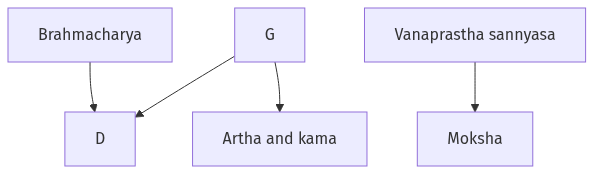
- The four purusharthas are dharma (right duty), artha (livelihood and power), kama (desire), and moksha (release).
- The four ashramas are brahmacharya (student), grihastha (householder), vanaprastha (forest-dweller), and sannyasa (renouncer).
- P. V. Kane and other Indologists show that the pairing is a later shastric ideal, not a census of every Vedic household.
- Louis Dumont read the householder and the renouncer as the two poles of Indian civilisation, with grihastha carrying artha and kama under dharma.
How they interface
- Brahmacharya is ordered toward dharma through study and celibacy.
- Grihastha is the only stage that is told to pursue artha and kama inside dharma, which is why Manu calls the householder the support of the other three.
- Vanaprastha and sannyasa shift the weight toward moksha and away from household production.
- Irawati Karve and kinship ethnography show that most people live as householders; the last two ashramas are elite or late-life options, not a mass timetable.
Strain
- Women, Shudras, and tribal groups were never fully inside the four-stage map, so the interface is a twice-born male model.
- Bhakti, Jain, and Buddhist paths offer moksha without waiting for vanaprastha.
Flow diagram
Conclusion
Purushartha states what a life should aim at. Ashrama states when those aims should dominate. The householder stage is the working hinge. The map is an Indological ideal, not a description of every Indian life.
Quick related
Students also ask
-
Prehistoric rock arts from Uttarakhand
Next question on this syllabus topic (2023 · Q1(d)). View answer →
-
Must every Hindu pass through all four ashramas?
No. The scheme is a textual ideal. Most people remain householders. Vanaprastha and sannyasa are optional and historically restricted.
-
Can moksha be sought in the household?
Bhakti and some Upanishadic lines allow it. Strict ashrama order delays moksha until withdrawal from artha and kama.
Same topic · past papers
UPSC has asked this before
These previous-year questions sit on the same topic. Open one to practise the earlier ask.
-
2021 · Q1(a) · Anthropology GS 2 · 10 marks
Purushartha and righteous living today
More from this topic
Q6(a) · UPSC Mains 2026 · Anthropology GS 2 · 20 marks · Solution
Make a critical appraisal of the mesolithic culture of Ganga basin with reference to artifacts, faunal and human skeletal remains excavated from different sites
Evolution of the Indian Culture and Civilization
• Ganga basin Mesolithic sites like Sarai Nahar Rai, Mahadaha, and Damd
Q5(e) · UPSC Mains 2026 · Anthropology GS 2 · 10 marks · Solution
Contribution of L. K. Ananthakrishna Iyer in Anthropology.
Evolution of the Indian Culture and Civilization
L. K. Ananthakrishna Iyer is a pioneering figure in Indian anthropology, known for his monumental ethnographic surveys like The Cochin Tribes and Castes and The Mysore Tribes and Castes. Working during the colonial era, he bridged western anthropological methods with indigenous scholarship. His documentation of social stratification, material culture, and folklore laid the empirical foundation for Indian sociology and anthropology. Iyer also established the first department of anthropology in India at the University of Calcutta, shaping institutional teaching and research.
Q5(c) · UPSC Mains 2026 · Anthropology GS 2 · 10 marks · Solution
Article 371A of the Indian Constitution.
Evolution of the Indian Culture and Civilization
Article 371A of the Indian Constitution grants special autonomous status to Nagaland, protecting its traditional socio-religious practices, customary laws, and land ownership rights. Enacted via the 13th Constitutional Amendment Act, 1962, following the 16-point Agreement, it reflects the asymmetrical federal framework of India. The article places a special responsibility on the Governor regarding law and order and regional financial allocations. It balances tribal autonomy with national integration, though it faces implementation challenges in modern governance.