
Revision summary
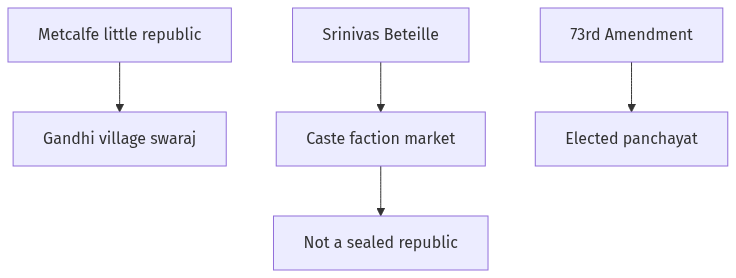
Metcalfe called Indian villages little republics that outlasted kingdoms. Maine and Gandhi reused the image for custom and swaraj. Srinivas, Lewis, Marriott, and Béteille showed caste, jajmani, and markets. Dumont placed caste civilisation above the village isolate. The 73rd Amendment created elected local government, not Metcalfe’s timeless hamlet.
Model answer
Copper italics in this answer — like this — are the key facts. Each one is unpacked in the Facts & figures rail.
Introduction
- Charles Metcalfe called the Indian village a little republic: a self-sufficient, enduring community of cultivators that survived the fall of kingdoms. The phrase shaped colonial policy and later nationalist praise. Anthropology treats it as a partial myth.
Body
The phrase and its heirs
- Sir Charles Metcalfe (1830) described village communities as little republics with hereditary officers, common land ideas, and continuity through war.
- Henry Maine and some revenue officers used the same picture for custom and joint property.
- M. K. Gandhi turned the village into the moral unit of swaraj. Jawaharlal Nehru and planners later mixed praise with a need to modernise the same village.
What ethnography found
- M. N. Srinivas showed dominant caste, faction, and outside markets. Rampura was not a sealed republic.
- Oscar Lewis, McKim Marriott, and André Béteille showed jajmani inequality, caste rank, and land conflict.
- Villages paid revenue, sent labour, and took caste law from wider kingdoms. Dumont argued that caste civilisation, not the village isolate, is the true unit.
What remains useful
- Local officers, common irrigation, and panchayat memory are real.
- Calling that a republic hides landlords, women, and Dalits who did not vote in any ancient assembly.
After 1992
- The 73rd Amendment made an elected gram panchayat a constitutional local government. That is a republic in a new legal sense, still not Metcalfe’s timeless isolate.
Flow diagram
Conclusion
The little-republic phrase names local continuity. It is false as autarky and equality. Srinivas and Béteille replaced it with caste, faction, and the wider state. Panchayati Raj is a modern republic of a different kind.
Quick related
Students also ask
-
Dravidian language and their subgroups
Next question on this syllabus topic (2023 · Q5(d)). View answer →
-
Did Indian villages have no contact with the state?
No. They paid revenue and supplied soldiers and labour. The republic image hid that dependence.
-
Is the gram panchayat Metcalfe’s republic?
No. It is a constitutional elected body with reserved seats. It is modern local government.
Same topic · past papers
UPSC has asked this before
These previous-year questions sit on the same topic. Open one to practise the earlier ask.
-
2025 · Q1(e) · Anthropology GS 2 · 10 marks
Characteristics and communication between Little and Great Traditions. -
2016 · Q6(b) · Anthropology GS 2 · 15 marks
Examine the nature of interplay of little and great traditions in the context of globalization
More from this topic
Q6(a) · UPSC Mains 2026 · Anthropology GS 2 · 20 marks · Solution
Make a critical appraisal of the mesolithic culture of Ganga basin with reference to artifacts, faunal and human skeletal remains excavated from different sites
Evolution of the Indian Culture and Civilization
• Ganga basin Mesolithic sites like Sarai Nahar Rai, Mahadaha, and Damd
Q5(e) · UPSC Mains 2026 · Anthropology GS 2 · 10 marks · Solution
Contribution of L. K. Ananthakrishna Iyer in Anthropology.
Evolution of the Indian Culture and Civilization
L. K. Ananthakrishna Iyer is a pioneering figure in Indian anthropology, known for his monumental ethnographic surveys like The Cochin Tribes and Castes and The Mysore Tribes and Castes. Working during the colonial era, he bridged western anthropological methods with indigenous scholarship. His documentation of social stratification, material culture, and folklore laid the empirical foundation for Indian sociology and anthropology. Iyer also established the first department of anthropology in India at the University of Calcutta, shaping institutional teaching and research.
Q5(c) · UPSC Mains 2026 · Anthropology GS 2 · 10 marks · Solution
Article 371A of the Indian Constitution.
Evolution of the Indian Culture and Civilization
Article 371A of the Indian Constitution grants special autonomous status to Nagaland, protecting its traditional socio-religious practices, customary laws, and land ownership rights. Enacted via the 13th Constitutional Amendment Act, 1962, following the 16-point Agreement, it reflects the asymmetrical federal framework of India. The article places a special responsibility on the Governor regarding law and order and regional financial allocations. It balances tribal autonomy with national integration, though it faces implementation challenges in modern governance.