
Revision summary
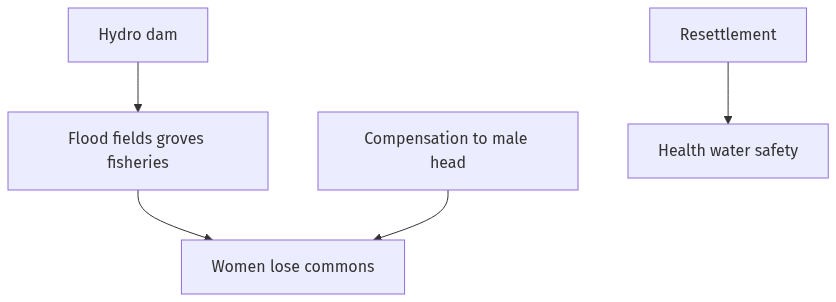
Hydro dams submerge the river commons that tribal women use for fish, fodder, fuel, and flood-recession farming. Compensation usually follows the male household head, so women lose title and natal networks. Baviskar and NBA work on Sardar Sarovar document Bhilala, Tadvi, and Vasava women’s losses and resistance. Lower Subansiri affects Mising and Arunachal hill women through flood pulse, safety, and labour camps. Polavaram, Hirakud, Tehri, and Mapithel show the same gendered pattern beyond one river.
Model answer
Copper italics in this answer — like this — are the key facts. Each one is unpacked in the Facts & figures rail.
Introduction
Large hydroelectric dams flood fields, groves, and river fisheries. Tribal women in those valleys lose the resources they actually use — water, minor forest produce, and kin networks — faster than compensation lists record. The local context is gendered even when the project speaks of “project-affected families” in the male head’s name.
Body
What dams do to a tribal household
- Submergence removes jal, jungle, jameen. Women who collected fuel, fodder, fish, and mahua or tendu lose daily income that never appeared as a patta.
- Resettlement sites are often upland, treeless, and far from kin. MGNREGA or wage work may increase, but it is not the same as a river commons.
- Compensation and house plots are usually titled to men. Women become dependents in a new village without natal or marital grove rights.
Sardar Sarovar and the Narmada
- Sardar Sarovar on the Narmada displaced Bhil, Bhilala, Tadvi, Vasava, and related groups in Gujarat, Maharashtra, and Madhya Pradesh.
- Amita Baviskar (In the Belly of the River) described Bhilala life at the river and the moral economy that the reservoir broke.
- Narmada Bachao Andolan (Medha Patkar and local women satyagrahis) made women’s bodies the public face of resistance — water rising in the satyagraha at the dam site — because women stayed when men migrated.
- Health: more distance to water, more vector disease in some colonies, and loss of river protein. Girls’ labour rose as fuel walks lengthened before the move and then as new-site domestic scarcity.
- Bina Srinivasan and NBA documentation recorded that “land for land” often failed women because they were not recorded as cultivators.
Subansiri and the eastern Himalaya
- The Lower Subansiri project (Assam–Arunachal) sits in Mising, Galo, Nyishi, and other downstream and hill catchments. Women in Mising riverine villages depend on the flood pulse for fishing and paddy.
- Fear of dam-break, changed flooding, and outsider labour camps affects women’s safety and mobility. Local protests (including after the 2011 earthquake debates on dam safety) were not only male student unions.
- Elwin’s NEFA worry returns: a road and a dam arrive faster than a woman’s say in Gram Sabha or village council.
Other real cases
- Tehri (Garhwal) displaced hill Hindu and some tribal-adjacent cultivators; women lost terraced fields and walked farther for water in New Tehri’s early years.
- Hirakud (Odisha) and later Polavaram (Andhra–Odisha–Chhattisgarh) hit Gond, Koya, Konda Reddi and others; women’s forest collection was rarely compensated.
- Mapithel / Thoubal (Manipur) and Tipaimukh debates show hill women opposing dams that drown jhum and village graves.
- Indira Sagar and Omkareshwar (Narmada cascade) repeated Sardar Sarovar’s gendered title problem.
Critical point
- Hydroelectricity is framed as national clean power. Locally it is a gendered dispossession. Anthropology should count women’s commons, not only the male acre on the award list.
- PESA and FRA require consent; many dam clearances still treat women as family members, not as rights-holders.
Flow diagram
Conclusion
Dam displacement hits tribal women through lost commons, male-titled compensation, longer water and fuel work, and broken kin support. Sardar Sarovar’s Bhilala and Tadvi women, Mising riverine households below Subansiri, and Koya women at Polavaram are the ethnographic record. A project that does not title women and replace the river commons fails them even when a house is built.
Quick related
Students also ask
-
Discuss the objectives of Integrated Tribal Development Projects (ITDPs). How far have these objectives been achieved?
Next question on this syllabus topic (2022 · Q6(a)). View answer →
-
If a family gets a house, is the woman rehabilitated?
Not if she lost unrecorded commons, kin support, and independent income. A house in a male name can increase dependence.
-
Why are dams harder on women than on men in these valleys?
Men more often hold the patta and can migrate for wages. Women stay with children and depend on the river and forest that the reservoir erases.
Same topic · past papers
UPSC has asked this before
These previous-year questions sit on the same topic. Open one to practise the earlier ask.
-
2026 · Q8(b) · Anthropology GS 2 · 15 marks
What are the major challenges tribal communities are facing in contemporary India? -
2025 · Q5(a) · Anthropology GS 2 · 10 marks
Impact of urbanization and industrialization on tribal communities of India. -
2024 · Q3(c) · Anthropology GS 2 · 15 marks
Examine the impact of Forest Policies from 1878 to 2006 on land alienation and deprivation of rights of tribal communities in India. -
2024 · Q8(c) · Anthropology GS 2 · 15 marks
Discuss the economic, social, and developmental impacts on tribal communities with special reference to mining. -
2023 · Q3(c) · Anthropology GS 2 · 15 marks
Critically examine the impact of modern democratic institutions on contemporary tribal societies. Illustrate with suitable ethnographic examples.
More from this topic
Q6(a) · UPSC Mains 2022 · Anthropology GS 2 · 20 marks · Solution
Discuss the objectives of Integrated Tribal Development Projects (ITDPs). How far have these objectives been achieved?
Developmental projects and their impact on tribal displacement and problems of rehabilitation. Development of forest policy and tribals. Impact of…
ITDPs are Tribal Sub-Plan area projects, often called ITDAs. Objectives were integrated poverty reduction, services, and resource protection. Schools, roads, and clinics expanded in many blocks. Xaxa recorded leakage and weak control over land and mining. FRA and PESA had to carry the resource objective that projects missed.
Q7(b) · UPSC Mains 2021 · Anthropology GS 2 · 15 marks · Solution
Discuss the problems involved in rehabilitation and resettlement of tribals displaced due to development projects in India
Developmental projects and their impact on tribal displacement and problems of rehabilitation. Development of forest policy and tribals. Impact of…
Development displacement breaks tribal land, kin, and commons together. Sardar Sarovar on the Narmada is the teaching case. LARR 2013 lists land, house, and jobs; older 1894 awards were mostly cash. Colonies rarely restore nistar, council, or grove. Consent under PESA and FRA is the missing procedural core.
Q6(a) · UPSC Mains 2021 · Anthropology GS 2 · 20 marks · Solution
Discuss the impact of the Forest Rights Act (2006) on the livelihood and culture of tribal people in India
Developmental projects and their impact on tribal displacement and problems of rehabilitation. Development of forest policy and tribals. Impact of…
FRA 2006 recognises individual and community forest rights. Livelihood gains when nistar and minor forest produce are legal. Culture gains when groves sit under community title. Weak gram sabha and rejected community claims blunt the Act. Mining after a thin FRA process repeats dispossession.