
Revision summary
Impacts are in the resource belt and in migrant cities, not only one story of loss. Samata, Niyamgiri, FRA and the 2013 land Act are the legal brakes on dispossession. Urban STs face certificate portability and informal work. Kinship stretches; identity is restaged in unions, churches and student bodies. Xaxa’s theme: development without consent produces cash beside a broken commons.
Model answer
Copper italics in this answer — like this — are the key facts. Each one is unpacked in the Facts & figures rail.
Introduction
Urbanisation and industrialisation do not wait for a tribe to “arrive” in a city. Mines, steel towns, dams, highways and labour markets move into the hills, and young people move out. The impact is both in situ (Jharkhand coal, Odisha bauxite, Chhattisgarh plants) and in the city (Bastar in Raipur, Santhal in Mumbai, North-East in Delhi).
Body
In the resource belt
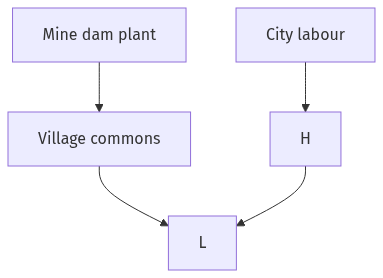
Factories and mines buy land, water and quiet. Samata (1997) tried to stop easy transfer of Scheduled Area land to non-tribals for mining. Niyamgiri (2013) put Gram Sabha in the path of bauxite. Land Acquisition Act, 2013 (RFCTLARR) requires consent and R&R; practice still produces kaccha colonies beside plants. Industrialisation here means a wage next to a broken commons, not a full proletariat with a union clinic.
Urbanisation of the tahsil town brings PDS shops, coaching, and also liquor, land brokers and a thana that speaks Hindi. Kinship stretches: a brother in the plant, a sister in a hostel, elders on residual jhum or tendu.
In the metropolis
Circular migration — brick kilns, construction, domestic work, security — urbanises the household without urbanising rights. Slum STs often cannot use the ST certificate of the home state for local jobs (portability limits). Churches, dhumkuria associations and WhatsApp kin groups recreate a little village. Health follows the pattern of Q3(b): TB, anaemia, unsafe abortions.
Political and cultural
Industrial belts produce both trade-union STs and sarpanch contractors. Ethnic student unions in cities (NSUI is not the point; Naga and Adivasi student bodies are) keep identity hot. Sanskritisation in town and revival of dance festivals on Republic Day can happen in one family.
CAMPA plantations and PESA paper-compliance often fail when a municipal or industrial authority sits on the same land. Xaxa called this development without community consent. The gain is cash, school and a wider marriage market. The loss is grove, language density and a generation that is informal labour, not “tribal beneficiary”.
Flow diagram
Conclusion
Industry and the city enter tribal life as mine, migrant room and tahsil town. Law (Samata, Niyamgiri, FRA, 2013 acquisition) can slow dispossession; it has not equalised urban citizenship. The community becomes a split household, not a vanished tribe.
Quick related
Students also ask
-
Discuss the rising ethnic conflicts in India and propose their possible remedial measures
Next question on this syllabus topic (2025 · Q7(b)). View answer →
-
Does urbanisation abolish tribe?
It changes it. Associations, churches and certificates carry tribe into the city, while land law still points at the village.
-
Is industrialisation always displacement?
Displacement is the sharp form. There is also in-situ casual work, pollution and a town growing into the village.
Same topic · past papers
UPSC has asked this before
These previous-year questions sit on the same topic. Open one to practise the earlier ask.
-
2016 · Q5(c) · Anthropology GS 2 · 10 marks
Impact of industrialization on scheduled tribe population of Jharkhand -
2026 · Q8(b) · Anthropology GS 2 · 15 marks
What are the major challenges tribal communities are facing in contemporary India? -
2024 · Q8(c) · Anthropology GS 2 · 15 marks
Discuss the economic, social, and developmental impacts on tribal communities with special reference to mining. -
2024 · Q3(c) · Anthropology GS 2 · 15 marks
Examine the impact of Forest Policies from 1878 to 2006 on land alienation and deprivation of rights of tribal communities in India. -
2023 · Q7(b) · Anthropology GS 2 · 15 marks
Critically examine how the displacement of tribal communities due to hydroelectric river dam projects has affected the women in local context. Illustrate with suitable ethnographic examples.
More from this topic
Q8(b) · UPSC Mains 2026 · Anthropology GS 2 · 15 marks · Solution
What are the major challenges tribal communities are facing in contemporary India?
The concept of ethnicity
• Tribal communities face severe displacement from ancestral lands due to large-scale mining, dams, and industrial projects. • Protective laws like the CNT and SPT Acts often fail to prevent illegal land transfer to non-tribals and corporations. • Delays in implementing the Forest Rights Act (FRA) restrict access to minor forest produce and disrupt traditional livelihoods. • State restrictions and ecological pressures are forcing a decline in traditional Jhum (shifting cultivation) practices. • Mainstreaming pressures, market forces, and religious conversions are eroding indigenous languages, beliefs, and customary governance. • Remote tribal areas suffer from acute health deficits—like malnutrition and sickle cell anaemia—and high educational dropout rates. • Sustainable solutions require moving past paternalistic welfare toward self-determination and strictly enforcing PESA and FRA.
Q5(a) · UPSC Mains 2026 · Anthropology GS 2 · 10 marks · Solution
Buddhist tribes of India.
The concept of ethnicity
• Major Buddhist tribes include the Monpa, Sherdukpen, Khampti, Singpho, Chakma, and Bhutia. • They are geographically concentrated in the Himalayan belt and Northeast India, specifically across Arunachal Pradesh, Assam, Sikkim, Mizoram, Tripura, and West Bengal. • Their religious practice is a syncretism of canonical Buddhism (Mahayana, Theravada, or Tibetan) and indigenous animism or Bon beliefs. • Rituals frequently honor local mountain deities and spirits alongside formal monastic practices led by lamas or bhikthus. • Unlike rigid caste systems, their societies remain relatively egalitarian, guided by clan ties and customary village councils. • They primarily speak Tibeto-Burman or Tai dialects, maintaining oral traditions alongside written scriptures in Tibetan or Tai scripts. • Preserving their unique identity requires balancing modernization with constitutional protections under the Scheduled Tribes framework.
Q4(a) · UPSC Mains 2026 · Anthropology GS 2 · 20 marks · Solution
Write an account on the contribution of Verrier Elwin in developing policies for the tribal populations in post-independent India
The concept of ethnicity
Verrier Elwin played a foundational role in shaping post-independent India's tribal policy by advocating for cultural autonomy, protection of land rights, and cautious assimilation. Influenced by his anthropological work in Central India and NEFA, his ideas directly shaped Jawaharlal Nehru's Tribal Panchsheel. While critiqued for encouraging isolationism, his emphasis on tribal heritage ensured a distinct administrative framework under the Sixth Schedule.