
Revision summary
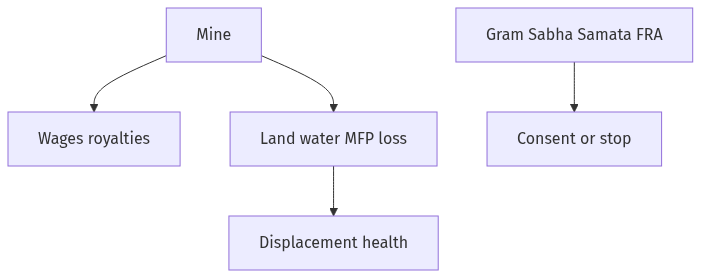
Mining brings wages and state royalties and destroys subsistence forests, water and sacred hills. Samata 1997 and Niyamgiri 2013 are the legal brakes in Scheduled Areas. Social impacts include displacement, in-migration, gendered loss of MFP, and police conflict. Developmental roads and CSR do not automatically compensate a broken commons. Legitimate mining in tribal areas requires Gram Sabha consent and FRA title, not only a lease map.
Model answer
Copper italics in this answer — like this — are the key facts. Each one is unpacked in the Facts & figures rail.
Introduction
Mining is the sharpest meeting of the Indian development state with tribal land. Coal, iron, bauxite, uranium and limestone sit under Fifth Schedule and other Adivasi tracts. The economic ledger shows wages and royalties; the social ledger shows displacement, illness and a broken commons. Anthropology counts both, then asks who owns the surplus.
Body
Economic impacts
Mines create cash wages, contract work, petty shops and some skilled jobs. They also destroy MFP, jhum, grazing and stream fisheries that women and PVTGs actually live on. Royalties accrue to states; district mineral foundations (after the MMDR amendment) are meant to return money locally. Capture by contractors is common. Samata (1997) restricted transfer of Scheduled Area land to non-tribal mining lessees unless law clearly allows it. Practice still uses state corporations and private partners. Land Acquisition / RFCTLARR 2013 promises consent and R&R in Scheduled Areas; many older leases predate it.
Net economic effect for most households is a short wage and a permanent loss of the subsistence base — the pattern Xaxa called development without inclusion. A small tribal elite of sarpanch-contractors may gain. That is class inside the tribe.
Social impacts
Displacement splits kin (Vidyarthi’s nature–man–spirit collapses when the hill is a pit). In-migration of non-tribal labour changes language, liquor markets and sexual risk. Women lose MFP cash and face camp-follower violence; some gain mine-canteen work. Sacred sites (Niyamgiri, groves, burial hills) are desecrated, which is a social fact, not a private hobby. Youth drop out into truck driving or leave for cities. Police camps and FIRs against protesters militarise the village. Birsa’s land memory is often the language of resistance in Jharkhand.
- Health: silicosis, dust, contaminated water, malaria in pits, and stunting when forest food goes. This links to question 1(e) and 6(a).
Developmental impacts
Roads, electricity and mobile towers follow mines. Schools and PHCs may appear on paper for CSR. Developmental here means both infrastructure and the official idea of progress. The anthropological critique (Elwin, Roy Burman buffer, Padel on Odisha bauxite, Niyamgiri judgment) is that infrastructure without Gram Sabha consent is a corridor for extraction. PESA consultation and FRA community rights are the lawful developmental sequence; mining-first is the usual sequence.
Positive developmental impact exists where a titled community bargains a share, where DMF actually builds a working PHC, and where closed mines are restored. These cases are fewer than the coal and bauxite belts of Jharkhand, Odisha, Chhattisgarh, Telangana and parts of Rajasthan and Madhya Pradesh.
Synthesis
Mining can be development for the treasury and deprivation for the custodian. A WRAP answer should not deny jobs; it should refuse to call a wasteland a trade-off already paid. Climate (6a) will add heat and water stress on the same pits. The ethical line is the same as ILO 169 consultation, which India has not signed, and Niyamgiri, which Indian law has: no pit without a free Gram Sabha.
Flow diagram
Conclusion
On tribal communities, mining pays some wages and royalties and takes land, water, health and sacred geography. Socially it splits kin and invites a non-tribal labour regime. Developmentally it brings roads and a model of progress that is extractive unless PESA, FRA and Samata actually govern the lease.
Quick related
Students also ask
-
Distinguishing between ethnic identity and ethnicity, discuss the factors responsible for ethnic conflict in tribal areas.
Next question on this syllabus topic (2023 · Q6(b)). View answer →
-
Do all tribals oppose mining?
No. Some want jobs and a share of royalties. Opposition is strongest where the hill is livelihood and sacred geography and where past compensation failed.
-
Is CSR the same as development?
CSR is company spending. Development in the constitutional sense requires rights, services and consent, which CSR cannot substitute.
Same topic · past papers
UPSC has asked this before
These previous-year questions sit on the same topic. Open one to practise the earlier ask.
-
2015 · Q7(a) · Anthropology GS 2 · 20 marks
Recently non-government organizations have been critiqued for interfering with developmental process in tribal heartland ! Critically comment -
2015 · Q7(b) · Anthropology GS 2 · 15 marks
Discuss the nature of social change in tribal India under the impact of developmental programmes -
2026 · Q8(b) · Anthropology GS 2 · 15 marks
What are the major challenges tribal communities are facing in contemporary India? -
2025 · Q5(a) · Anthropology GS 2 · 10 marks
Impact of urbanization and industrialization on tribal communities of India. -
2024 · Q3(c) · Anthropology GS 2 · 15 marks
Examine the impact of Forest Policies from 1878 to 2006 on land alienation and deprivation of rights of tribal communities in India.
More from this topic
Q8(b) · UPSC Mains 2026 · Anthropology GS 2 · 15 marks · Solution
What are the major challenges tribal communities are facing in contemporary India?
The concept of ethnicity
• Tribal communities face severe displacement from ancestral lands due to large-scale mining, dams, and industrial projects. • Protective laws like the CNT and SPT Acts often fail to prevent illegal land transfer to non-tribals and corporations. • Delays in implementing the Forest Rights Act (FRA) restrict access to minor forest produce and disrupt traditional livelihoods. • State restrictions and ecological pressures are forcing a decline in traditional Jhum (shifting cultivation) practices. • Mainstreaming pressures, market forces, and religious conversions are eroding indigenous languages, beliefs, and customary governance. • Remote tribal areas suffer from acute health deficits—like malnutrition and sickle cell anaemia—and high educational dropout rates. • Sustainable solutions require moving past paternalistic welfare toward self-determination and strictly enforcing PESA and FRA.
Q5(a) · UPSC Mains 2026 · Anthropology GS 2 · 10 marks · Solution
Buddhist tribes of India.
The concept of ethnicity
• Major Buddhist tribes include the Monpa, Sherdukpen, Khampti, Singpho, Chakma, and Bhutia. • They are geographically concentrated in the Himalayan belt and Northeast India, specifically across Arunachal Pradesh, Assam, Sikkim, Mizoram, Tripura, and West Bengal. • Their religious practice is a syncretism of canonical Buddhism (Mahayana, Theravada, or Tibetan) and indigenous animism or Bon beliefs. • Rituals frequently honor local mountain deities and spirits alongside formal monastic practices led by lamas or bhikthus. • Unlike rigid caste systems, their societies remain relatively egalitarian, guided by clan ties and customary village councils. • They primarily speak Tibeto-Burman or Tai dialects, maintaining oral traditions alongside written scriptures in Tibetan or Tai scripts. • Preserving their unique identity requires balancing modernization with constitutional protections under the Scheduled Tribes framework.
Q4(a) · UPSC Mains 2026 · Anthropology GS 2 · 20 marks · Solution
Write an account on the contribution of Verrier Elwin in developing policies for the tribal populations in post-independent India
The concept of ethnicity
Verrier Elwin played a foundational role in shaping post-independent India's tribal policy by advocating for cultural autonomy, protection of land rights, and cautious assimilation. Influenced by his anthropological work in Central India and NEFA, his ideas directly shaped Jawaharlal Nehru's Tribal Panchsheel. While critiqued for encouraging isolationism, his emphasis on tribal heritage ensured a distinct administrative framework under the Sixth Schedule.