
Revision summary
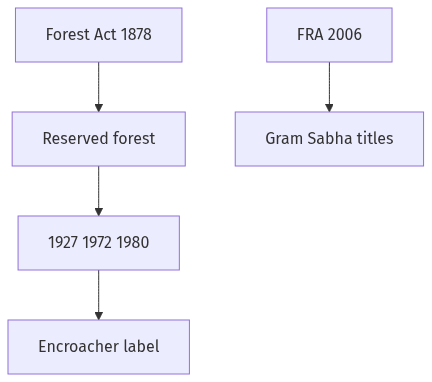
The 1878 Forest Act created reserved forests and criminalised much customary tribal use. 1927 consolidated state ownership; 1972 wildlife law and 1980 conservation law added exclusion. Godavarman and evictions treated dwellers as encroachers. FRA 2006 recognises individual, community, MFP and PVTG habitat rights through the Gram Sabha. Xaxa and field reports show titles still lag; 1878 logic survives in the department.
Model answer
Copper italics in this answer — like this — are the key facts. Each one is unpacked in the Facts & figures rail.
Introduction
From the Indian Forest Act, 1878 to the Scheduled Tribes and Other Traditional Forest Dwellers (Recognition of Forest Rights) Act, 2006, the forest was legally converted from a lived commons into state property, then partly returned as recorded rights. Tribal land alienation in this period is often forest alienation: loss of jal, jungle, jameen without a sale deed.
Body
1878 and the colonial forest state
The 1865 Act had already asserted state interest. 1878 classified forests as reserved, protected and village, criminalised unauthorised felling, grazing and shifting cultivation, and made the Forest Department the owner-manager. Dietrich Brandis’s scientific forestry treated teak, sal and deodar as revenue crops. Adivasi nistar (household use), jhum / podu / bewar, hunting and sacred groves became concessions or offences.
B. H. Baden-Powell and settlement officers mapped “waste”. Verrier Elwin and later Ramachandra Guha (as historian of the forest) showed that this was a conquest of the woodland, not a neutral conservation. Chotanagpur, Bastar, the Central Provinces and the Western Ghats produced mulkhi unrest: Birsa Munda’s struggle is also a forest-and-land struggle against diku and against reservation that fed the sardari and forest contractor.
1927 consolidation
The Indian Forest Act, 1927 still in force in much of India, restated reserved-forest offences, forest courts, and the state’s presumption of ownership. After Independence, the same Act served national parks, wildlife sanctuaries and industrial leases. Wildlife (Protection) Act, 1972 added another layer of exclusion, often without recording who already lived inside. Joint Forest Management in the 1990s shared some produce but kept title with the department.
- Alienation here is legal: a family that farmed a patta-less plot inside a reserved forest became an “encroacher”. Contractors and mines then used the same reserved land. Fifth Schedule and Samata (1997) tried to brake transfer to non-tribals; practice still produced police cases against podu cultivators.
1980 to 2006
The Forest (Conservation) Act, 1980 stopped state governments from dereserving forest without Central approval — good against reckless diversion, harsh against regularising tribal occupation. The 1988 Forest Policy spoke of tribals’ needs, still without a rights law. Supreme Court Godavarman (from 1996) expanded “forest” and froze many occupations. Evictions in the early 2000s triggered the campaign that became FRA 2006.
FRA 2006 as a turning point
FRA recognises individual occupation, community forest rights, MFP ownership, habitat rights for PVTGs, and Gram Sabha as the authority to initiate claims. It is the first Union statute that treats forest dwellers as rights-holders, not thieves. Xaxa Committee found slow titles, rejection of community claims, and conflict with forest bureaucracies and with Compensatory Afforestation on community land.
- From 1878 to 2006 the structure is: criminalise customary use → concentrate title in the state → lease to industry or fortress conservation → attempt statutory restoration. Deprivation was not only lost acres. It was lost jurisdiction: who may decide a tendu leaf rate, a burial grove, a jhum cycle. PESA (1996) and FRA (2006) try to return that jurisdiction. Implementation, not the 2006 text, is now the site of struggle.
Flow diagram
Conclusion
The 1878 and 1927 Acts made the state the forest owner and the tribal user a suspect. Parks, Godavarman and industrial diversion deepened deprivation. FRA 2006 recognises rights that custom had always practised. Until community titles and Gram Sabha power are real, the 1878 structure still governs the ground.
Quick related
Students also ask
-
Discuss how constitutional provisions in India have built-in mechanisms for dealing with the problem of land alienation in tribal areas
Next question on this syllabus topic (2015 · Q3(a)). View answer →
-
Did Independence repeal the 1927 Act?
No. It remains the basic forest offence and reservation statute unless a state has a parallel law. FRA is an overlay of rights, not a full repeal.
-
Is jhum legal after FRA?
FRA can recognise conversion of forest villages and some cultivation, but jhum remains contested where departments still treat it as encroachment.
Same topic · past papers
UPSC has asked this before
These previous-year questions sit on the same topic. Open one to practise the earlier ask.
-
2021 · Q5(e) · Anthropology GS 2 · 10 marks
Politics of recognition and deprivation. -
2026 · Q8(b) · Anthropology GS 2 · 15 marks
What are the major challenges tribal communities are facing in contemporary India? -
2025 · Q5(a) · Anthropology GS 2 · 10 marks
Impact of urbanization and industrialization on tribal communities of India. -
2024 · Q8(c) · Anthropology GS 2 · 15 marks
Discuss the economic, social, and developmental impacts on tribal communities with special reference to mining. -
2023 · Q7(b) · Anthropology GS 2 · 15 marks
Critically examine how the displacement of tribal communities due to hydroelectric river dam projects has affected the women in local context. Illustrate with suitable ethnographic examples.
More from this topic
Q3(a) · UPSC Mains 2015 · Anthropology GS 2 · 20 marks · Solution
Discuss how constitutional provisions in India have built-in mechanisms for dealing with the problem of land alienation in tribal areas
Problems of the tribal Communities
Article 244 and the Fifth Schedule restrict land transfer in Scheduled Areas. The Governor and Tribes Advisory Council are the administrative brake. Sixth Schedule councils control land in listed North-Eastern areas. PESA and FRA add gram sabha and forest-title tools. Samata showed courts can enforce the Schedule against mining leases.