
Revision summary
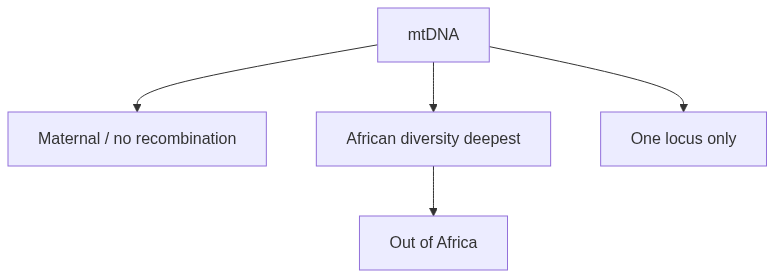
mtDNA is inherited from the mother and does not recombine like nuclear DNA. Cann, Stoneking and Wilson used it to place the common maternal ancestor of living humans in Africa. Mitochondrial Eve is a node in a tree, not the only woman of her generation. Haplogroups map later dispersals. They are not races. Neanderthal mtDNA and nuclear admixture show that one locus is not the whole story. Join mtDNA to Y-chromosome and autosomal evidence.
Model answer
Copper italics in this answer — like this — are the key facts. Each one is unpacked in the Facts & figures rail.
Introduction
Mitochondrial DNA is a small circular genome inside mitochondria. It is inherited almost only from the mother and does not recombine in the way nuclear chromosomes do. Those two facts made it an early clock and tree for human evolution.
Body
Why mtDNA is useful
Because it comes down the maternal line, a tree of mtDNA types is a tree of mothers. Mutation accumulates fast enough, relative to many nuclear regions, to separate human groups on a recent timescale. Allan Wilson’s laboratory used this logic. In 1987 Rebecca Cann, Mark Stoneking and Wilson published the famous mitochondrial work that placed the common maternal ancestor of living humans in Africa.
Popular writing called her “mitochondrial Eve”. That name misleads if it sounds like the only woman of her time. She is the most recent woman from whom all living mtDNA lines descend. Many other women lived then; their mtDNA lines later died out.
What it showed about evolution
- Recent African origin: Living human mtDNA diversity is greatest in Africa, and non-African lineages sit inside African variation. This supported an Out-of-Africa model against a simple multiregional story of separate ancient origins.
- Haplogroups: Later work labelled maternal haplogroups that map dispersal into Eurasia, Australia and the Americas. They are tools for migration history, not races.
- Archaic cousins: Neanderthal and Denisovan mtDNA, when recovered, did not match living human mtDNA as a simple continuation. Nuclear DNA later showed some interbreeding. One locus is not the whole species tree.
Svante Pääbo’s ancient-DNA programme sits beside this note even though much of it is nuclear. It is the next chapter, not a substitute for the 1987 argument.
Limits
mtDNA is one locus. Selection, population size and drift can warp the tree. Time estimates depend on mutation-rate assumptions. Paternal leakage is rare. The bigger caution is that a maternal tree is not the full history of peoples. Y-chromosome and autosomal DNA must join it.
Commercial “maternal ancestry” tests report a haplogroup, not a caste or a civilisation.
Flow diagram
Conclusion
Mitochondrial DNA gave anthropology a maternal clock and a strong African-origin argument. Cann, Stoneking and Wilson established the maternal African-origin case. Eve is a node in a tree, not a lone first woman, and mtDNA is one line beside nuclear genomes.
Quick related
Students also ask
-
Gene expression.
Next question on this syllabus topic (2023 · Q1(e)). View answer →
-
Did mtDNA prove that no mixing occurred outside Africa?
No. It supported a recent African origin of living mtDNA lines. Nuclear ancient DNA later showed limited mixing with Neanderthals and Denisovans.
-
Is mtDNA enough for a full peopling history?
No. It is one maternal locus. Autosomal and Y-chromosome data are needed for a fuller picture.
Same topic · past papers
UPSC has asked this before
These previous-year questions sit on the same topic. Open one to practise the earlier ask.
-
2026 · Q5(b) · Anthropology GS 1 · 10 marks
Distinguishing features of nuclear and mitochondrial DNA. -
2026 · Q4(a) · Anthropology GS 1 · 15 marks
Human evolution is a product of both biological and cultural factors. Elaborate -
2025 · Q7(c) · Anthropology GS 1 · 15 marks
Critically discuss the centrality of the African continent in the narrative of human evolution -
2024 · Q6(a) · Anthropology GS 1 · 20 marks
Discuss the geographical distribution of Homo erectus. Taking into account its physical features, where does it fit in human evolutionary line? -
2024 · Q8(c) · Anthropology GS 1 · 15 marks
Critically discuss the synergistic effect of biological and cultural factors in human evolution.
More from this topic
Q5(b) · UPSC Mains 2026 · Anthropology GS 1 · 10 marks · Solution
Distinguishing features of nuclear and mitochondrial DNA.
The biological basis of Life
• Nuclear DNA has 3 billion base pairs in linear chromosomes, while mitochondrial DNA is a small, circular molecule of 16,569 base pairs. • Somatic cells carry diploid nuclear DNA, whereas mitochondria contain multiple copies of their own circular genome. • Nuclear DNA undergoes biparental inheritance and frequent genetic recombination, ensuring high diversity. • Mitochondrial DNA is inherited strictly from the mother and lacks recombination, making it ideal for tracking maternal lineages. • Nuclear DNA is protected by histones and has robust repair mechanisms, resulting in a low mutation rate. • Mitochondrial DNA lacks strong repair systems and histone protection, leading to a much higher mutation rate. • Nuclear DNA controls overall organismal traits, while mitochondrial DNA focuses on cellular energy via oxidative phosphorylation.
Q2(c) · UPSC Mains 2023 · Anthropology GS 1 · 15 marks · Solution
Elucidate the different forms of malnutrition. Describe protein-calorie malnutrition with suitable examples.
The biological basis of Life
Forms of malnutrition are undernutrition, micronutrient shortage, overnutrition, and imbalance with infection. PCM is protein-energy shortage, classically marasmus and kwashiorkor. Cicely Williams named kwashiorkor from West African weaning oedema. Jelliffe and Waterlow indices remain the teaching toolkit beside WHO standards. Indian examples include NFHS stunting, drought wasting, and starchy weaning. Policy response includes ICDS and POSHAN, but household inequality still sorts who is malnourished.
Q1(e) · UPSC Mains 2023 · Anthropology GS 1 · 10 marks · Solution
Gene expression.
The biological basis of Life
Expression is transcription plus translation under regulatory control. Crick’s central dogma names the default flow from DNA to protein. Enhancers, chromatin, and splicing decide cell-specific products. Lactase persistence and Tibetan EPAS1 are anthropological examples of regulatory change. Epigenetic marks link environment to expression without rewriting the DNA code.