
Revision summary
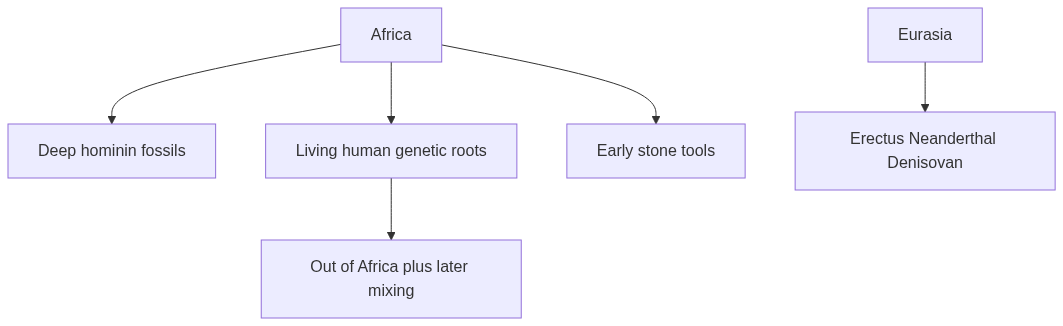
Darwin predicted an African origin from living great apes. Dart, the Leakeys and Johanson built the fossil case; Oldowan tools sit in that African early record. mtDNA and autosomal diversity place living humans’ deepest roots in Africa, as in Stringer’s recent African origin model. Eurasia still holds erectus, Neanderthals, Denisovans and later symbolic cultures. Ancient DNA shows limited mixing after exit, not a separate living origin. Centrality means the trunk of the story, not that only one gorge matters or that Asia is empty.
Model answer
Copper italics in this answer — like this — are the key facts. Each one is unpacked in the Facts & figures rail.
Introduction
Africa is central to the story of human evolution because the deepest hominin fossils, the earliest stone tools in current consensus, and the genetic roots of living people are African. Charles Darwin already guessed an African origin from living apes. The last century of fieldwork turned that guess into a dated record. Centrality is an evidence claim, not a political compliment.
Body
African centrality in human evolution
The African continent occupies a central position in human evolution, supported by fossil, archaeological, and genetic evidence. However, modern evidence suggests that human evolution was a complex, pan-African process, rather than a single linear sequence from one African locality.
I. Africa as the cradle of hominization
- Late Miocene beginnings: The earliest evidence of possible bipedalism comes from Africa. Example: Sahelanthropus tchadensis (~7–6 mya) from Chad has an anteriorly positioned foramen magnum, suggesting an upright posture.
- Australopithecine radiation: Between ~4–2 mya, Australopithecus diversified across Africa. Example: Lucy (A. afarensis) from Ethiopia and A. africanus from South Africa demonstrate major stages of early hominin evolution.
- Evidence of habitual bipedalism: Example: The Laetoli footprints in Tanzania (~3.6 mya) provide strong evidence of habitual bipedal walking and show that bipedalism preceded major brain expansion.
II. Africa as the developmental centre of Homo
- Homo habilis: Example: Fossils from Olduvai Gorge and Koobi Fora are associated with the Oldowan tool tradition, marking an important stage in early technological behaviour.
- Homo erectus / Homo ergaster: Early African Homo shows major changes in body proportions, brain size, mobility, and technology. Example: The Turkana Boy (~1.6 mya) from Kenya had long, human-like lower limbs and a relatively large brain.
- Out-of-Africa dispersal: Africa acted as the major launchpad for early Homo expansion into Eurasia. Example: Homo erectus spread beyond Africa and is associated with the widespread Acheulean handaxe tradition.
III. African archaic hominins and modern human ancestry
- Homo heidelbergensis: African Middle Pleistocene fossils show a combination of primitive and more modern features and are important for understanding the ancestry of later humans. Example: The Bodo cranium from Ethiopia and Kabwe skull from Zambia represent important African archaic populations.
- Evolutionary significance: These populations are commonly placed close to the evolutionary divergence leading towards modern humans and Neanderthals, although their exact taxonomic classification remains debated.
IV. Africa as the origin of Homo sapiens
- Oldest Homo sapiens fossils: Africa contains some of the earliest fossils showing anatomically modern human characteristics. Example: Omo I and Herto from Ethiopia provide major evidence for early Homo sapiens.
- Genetic evidence: Modern genetic studies show that African populations contain the greatest genetic diversity, consistent with a deeper population history within Africa.
- Mitochondrial Eve: Example: mtDNA studies associated with Rebecca Cann and colleagues identified a most recent common maternal ancestor, popularly called Mitochondrial Eve, who lived in Africa. She was not the first woman or the only woman alive at the time.
- Out-of-Africa model: Genetic and fossil evidence strongly supports the view that Homo sapiens evolved in Africa and later dispersed across the world, with major dispersals occurring roughly 60–70 kya.
V. Critical perspectives and debates
- Regional Continuity model: Milford Wolpoff argued that Homo erectus populations outside Africa contributed to the evolution of modern humans through regional continuity and gene flow. However, genetic evidence strongly supports a substantial African origin of modern humans.
- Partial Replacement model: Svante Pääbo’s ancient-DNA research showed that modern humans interbred with archaic Eurasian populations. Example: Most present-day non-African populations possess roughly 1–2% Neanderthal ancestry, demonstrating that dispersal involved both replacement and admixture.
- Asian Miocene apes: Earlier researchers proposed Ramapithecus from the Siwaliks as an early human ancestor. Later fossil and molecular evidence showed that Ramapithecus is part of the Sivapithecus lineage related to orangutans, not a direct human ancestor.
- Taphonomic bias: Africa’s apparent dominance may partly reflect preservation and research biases. Example: East African volcanic deposits provide favourable conditions for fossil preservation and radiometric dating, whereas regions such as the Indian subcontinent have fewer well-preserved hominin fossils.
- Pan-African model: Modern research increasingly suggests that Homo sapiens emerged through interaction among several African populations, rather than from one isolated “Garden of Eden”. This modifies, but does not weaken, Africa’s centrality.
Flow diagram
Conclusion
Africa remains the primary geographical anchor of human evolution, from early bipedal hominins and Australopithecines to early Homo and Homo sapiens. However, the modern view is not a simple linear “African origin” story. Evidence increasingly supports a pan-African and partially reticulate evolution, followed by dispersal and admixture with archaic populations. Thus, Africa was not merely the cradle of humanity but the major evolutionary arena in which the human lineage emerged and diversified.
Quick related
Students also ask
-
Does centrality deny Asian fossils?
No. It ranks Africa as the source and early theatre. Asian and European fossils remain essential for later chapters.
-
Is ‘cradle of mankind’ enough?
No. Fossils, tools and genes must be named, then qualified with Eurasian archaic humans and admixture.
Same topic · past papers
UPSC has asked this before
These previous-year questions sit on the same topic. Open one to practise the earlier ask.
-
2026 · Q4(a) · Anthropology GS 1 · 15 marks
Human evolution is a product of both biological and cultural factors. Elaborate -
2025 · Q5(d) · Anthropology GS 1 · 10 marks
Mitochondrial DNA and human evolution. -
2024 · Q8(c) · Anthropology GS 1 · 15 marks
Critically discuss the synergistic effect of biological and cultural factors in human evolution. -
2023 · Q3(a) · Anthropology GS 1 · 20 marks
What is hominization process? Discuss the major trends in human evolution with the help of suitable examples and illustrations. -
2022 · Q3(c) · Anthropology GS 1 · 15 marks
Should we still distinguish between 'classic' and 'progressive' Neanderthals? Discuss the controversy surrounding Neanderthal's position in human evolution