
Revision summary
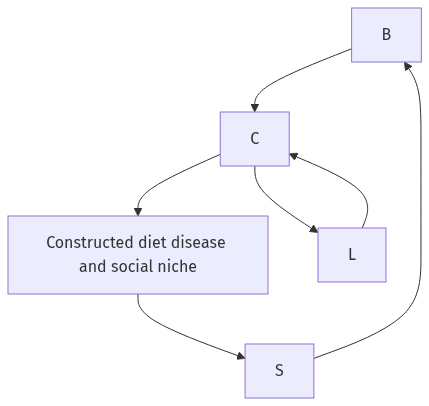
Biocultural evolution is reciprocal feedback among genes, development, behaviour and constructed environments. Bipedalism enabled new carrying and tool behaviours; technology then changed foraging and cooperation. Cooking may raise energy return, but its chronology cannot alone explain early Homo. Dairying/lactase persistence and malaria/HbS are gene–culture–ecology examples. Yajnik's thin-fat phenotype shows developmental mismatch in India. Hrdy, Hawkes and niche-construction theory connect cooperative care, long childhood and cumulative culture.
Model answer
Copper italics in this answer — like this — are the key facts. Each one is unpacked in the Facts & figures rail.
Introduction
- Human evolution is biocultural: inherited bodies create cultural possibilities, while learned behaviour modifies diet, disease, mating and ecology, thereby altering development and natural selection. The relationship is recursive, not biology first and culture later.
Body
Feedbacks that made humans
Bipedalism and technology: Mosaic habitats selected habitual bipedalism before large brains, as Laetoli footprints show. Freed hands could carry food and infants and later make tools; tool-assisted foraging then favoured learning and cooperation. This is feedback, not the discarded claim that tools alone caused upright posture.
Diet, fire and brains: Stone cutting expanded access to meat and marrow. Richard Wrangham's cooking hypothesis argues that fire increased digestibility and reduced chewing and gut costs, supporting an energy-expensive brain. Yet secure habitual cooking is later than the earliest Homo, so cooking cannot alone explain initial encephalisation. Teeth, isotopes and Oldowan cut marks provide independent evidence.
Gene–culture coevolution: Dairying created selection for adult lactase persistence in several pastoral populations through different regulatory variants. Starch-rich diets are associated at population level with higher AMY1 copy numbers, though causality and effect size are debated. Agriculture increased population density and infectious exposure; malaria ecology plus settlement helped maintain HbS in some regions. Allison's sickle-cell case links gene, pathogen and subsistence landscape.
Developmental plasticity: Culture changes bodies within a lifetime. Childhood nutrition, workload and disease affect stature and pelvic growth. Barker's developmental-origins work and C. S. Yajnik's Indian thin-fat phenotype show how foetal constraint can meet later urban abundance to raise metabolic risk.
Social brain and life history: Long childhood, alloparenting, language and cumulative learning form a cooperative package. Sarah Hrdy's cooperative-breeding model and Kristen Hawkes's grandmother hypothesis connect care networks to survival and longevity. Culture supplies information beyond one genome; biology supplies plastic brains and prolonged dependence.
- Niche-construction theorists such as F. John Odling-Smee formalise this reciprocity: organisms modify selective environments. But not every cultural practice is adaptive, and genetic stories require population evidence. Cultural diffusion can outpace genes, while inequality distributes biological costs unevenly.
Flow diagram
Conclusion
Humans did not escape evolution through culture; culture became a major evolutionary environment. Tools, cooking, dairying, farming and cooperative care repeatedly changed selection and development. A biocultural model explains the feedback without reducing culture to genes or biology to custom.
Quick related
Students also ask
-
What is hominization process? Discuss the major trends in human evolution with the help of suitable examples and illustrations.
Next question on this syllabus topic (2023 · Q3(a)). View answer →
-
Is every gene–environment interaction gene–culture coevolution?
No. Culture must systematically alter the selective environment, and genetic change must be demonstrated across generations.
-
Did culture stop natural selection?
No. Culture redirects selection, buffers some pressures and creates new ones, while also producing rapid non-genetic adaptation.
Same topic · past papers
UPSC has asked this before
These previous-year questions sit on the same topic. Open one to practise the earlier ask.
-
2026 · Q4(a) · Anthropology GS 1 · 15 marks
Human evolution is a product of both biological and cultural factors. Elaborate -
2016 · Q6(a) · Anthropology GS 1 · 20 marks
Elucidate the biological and cultural factors in Human evolution. -
2015 · Q2(a) · Anthropology GS 1 · 15 marks
Elucidate the biological and cultural factors in Human Evolution -
2023 · Q3(a) · Anthropology GS 1 · 20 marks
What is hominization process? Discuss the major trends in human evolution with the help of suitable examples and illustrations. -
2025 · Q5(d) · Anthropology GS 1 · 10 marks
Mitochondrial DNA and human evolution.
More from this topic
Q4(a) · UPSC Mains 2026 · Anthropology GS 1 · 15 marks · Solution
Human evolution is a product of both biological and cultural factors. Elaborate
Biological and Cultural factors in human evolution.
* Human evolution relies on a continuous feedback loop between biology and culture. * Bipedalism involved skeletal changes in the pelvis and limbs that freed the hands. * Encephalisation led to neocortex expansion, driven by dietary shifts and foraging needs. * Neoteny retained juvenile traits into adulthood, prolonging learning and plasticity. * Cultural innovations like toolmaking and symbolic thought accelerated physical shifts. * Culture acts as a primary adaptive mechanism, altering selective pressures on the human genome. * Physical anthropology and archaeology merge because neither biology nor culture operates in isolation.
Q3(a) · UPSC Mains 2023 · Anthropology GS 1 · 20 marks · Solution
What is hominization process? Discuss the major trends in human evolution with the help of suitable examples and illustrations.
Biological and Cultural factors in human evolution.
Hominization is the process of becoming human by mosaic anatomical and behavioural change. Dart showed bipedalism before a large brain. Major trends are upright walking, canine reduction, brain growth, delayed childhood, tools, fire, and symbolism. Laetoli, Lucy, Taung, Olduvai, Gona, and Dmanisi illustrate those trends. Side branches such as Paranthropus show that not every hominin became Homo. Draw a branching process, not a racial ladder.
Q6(a) · UPSC Mains 2016 · Anthropology GS 1 · 20 marks · Solution
Elucidate the biological and cultural factors in Human evolution.
Biological and Cultural factors in human evolution.
Bipedalism and a large, slow-growing brain are biological platforms. Stone tools, fire, and sharing are cultural forces. Washburn treated tools as a cause of further anatomy. Hrdy’s alloparents help explain childhood. Lactase persistence shows the loop continuing.