
Revision summary
Smell is chemical communication through glands, urine and body odour. Strepsirrhines keep a rhinarium and vomeronasal organ and mark heavily, as in ring-tailed lemur stink fights. Callitrichids such as marmosets and tamarins mark range with glands. Haplorhine monkeys and apes rely more on vision, though some inspection behaviour remains. Functions include territory, reproductive status, kin recognition and alarm. Human pheromone claims are a separate and contested literature.
Model answer
Copper italics in this answer — like this — are the key facts. Each one is unpacked in the Facts & figures rail.
Introduction
Among non-human primates, smell is a social signal, not a leftover sense. Chemical cues on the body and in the environment tell others who is here, who is ready to mate, and whose range this is. The channel is stronger in some lineages than in others.
Body
How the signal works
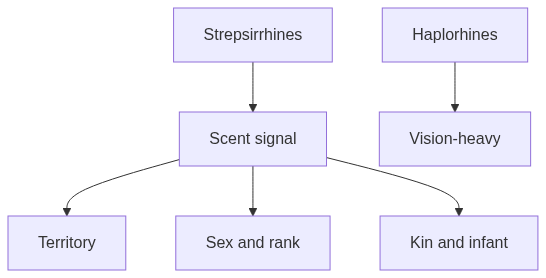
Smell travels as urine, faeces, gland secretions and whole-body odour. Many strepsirrhines (lemurs, lorises, galagos) keep a moist nose and a working vomeronasal organ (Jacobson’s organ). They are olfactory specialists. Haplorhines (tarsiers, monkeys, apes) reduced that hardware as colour vision and facial signalling expanded. This is a phylogenetic contrast, not a ladder. A lemur is not a failed monkey.
Field primatology by workers such as Alison Jolly on ring-tailed lemurs made scent-marking visible to anthropology students who otherwise notice only calls and faces.
Functions of the signal
- Territory and range: Ring-tailed lemurs (Lemur catta) mark with wrist and upper-arm glands. Males even waft marked tails in ritual “stink fights” over space and status. Marmosets and tamarins (callitrichids) use circumgenital and chest glands to label a home range, as A. F. Dixson and field studies of New World monkeys have described.
- Sex and rank: Odour can advertise oestrus, individual identity and dominance. In many strepsirrhines, chemical cues help decide who may approach whom. In catarrhine monkeys and apes the same work is done more by vision and behaviour, though residual sniffing and genital inspection still occur, for example in some macaques.
- Kin and infant: Mothers and infants recognise one another partly by smell. Nocturnal mouse lemurs and lorises lean on nest and body odour more than diurnal monkeys do.
- Alarm and spacing: A volatile cue can draw a group together or, conversely, warn that a predator or a rival troop has passed.
Comparative yield
Primate communication is multimodal. Smell is the quiet channel that human observers under-record because our own noses are weak. Strepsirrhine marking, New World glandular marking, and the haplorhine shift toward vision together define the contrast. Contested human pheromone claims belong to a different question.
Flow diagram
Conclusion
- Smell among non-human primates is a full signal system with senders, receivers and contexts: territory, mating and kinship. It is richest where the vomeronasal organ and scent glands still work. Treat it as comparative primate behaviour, not as a story about human attraction.
Quick related
Students also ask
-
Discuss the Miocene hominoid remains and their significance in evolution
Next question on this syllabus topic (2025 · Q2(a)). View answer →
-
Do apes use smell socially?
Less as a primary channel than lemurs. Some inspection remains, but vision and gesture dominate.
-
Is this the same as human pheromones?
No. The question is about non-human primate signalling. Human pheromone literature is contested and is not required here.
More from this topic
Q6(c) · UPSC Mains 2026 · Anthropology GS 1 · 15 marks · Solution
What are Strepsirhini Primates? Describe their geographical distribution and mention the characteristics that distinguish them from Haplorhini Primates
Characteristics of Primates
Strepsirhini represents a suborder of primates characterized by primitive mammalian traits such as a rhinarium, tooth comb, and grooming claw. Geographically, they are primarily restricted to Madagascar, with other populations found in sub-Saharan Africa and tropical Asia. They are distinguished from Haplorhini primates by features like unfused mandibular symphysis, postorbital bar instead of a closed plate, and a reflective tapetum lucidum. Understanding their taxonomy provides crucial insights into early primate evolution and divergence patterns. This answer outlines their definition, distribution, and critical anatomical distinctions from haplorhines.
Q2(a) · UPSC Mains 2025 · Anthropology GS 1 · 20 marks · Solution
Discuss the Miocene hominoid remains and their significance in evolution
Characteristics of Primates
The Miocene, about 23 to 5.3 million years ago, was the main radiation of fossil apes, followed by late-Miocene decline. Africa gives Proconsul as a stem hominoid that was not yet a specialised hanging ape. Europe gives Dryopithecus and related forms, which matter for biogeography. Asia gives Sivapithecus on the orangutan line. Ramapithecus is not a hominin. Gigantopithecus is a giant pongine side branch. Significance lies in mosaic traits, an African last-common-ancestor setting, and climate winnowing of apes. There is no single missing link.
Q2(b) · UPSC Mains 2022 · Anthropology GS 1 · 15 marks · Solution
Discuss different forms of primate social organisation
Characteristics of Primates
Primates are not all troop animals. Orangutans disperse, gibbons pair, gorillas often keep one-male groups. Macaques and baboons live in ranked multi-male troops. Chimpanzees use fission–fusion parties, as at Gombe. Ecology, predation, and kinship explain the spread.