
Revision summary
Hominization is the process of becoming human by mosaic anatomical and behavioural change. Dart showed bipedalism before a large brain. Major trends are upright walking, canine reduction, brain growth, delayed childhood, tools, fire, and symbolism. Laetoli, Lucy, Taung, Olduvai, Gona, and Dmanisi illustrate those trends. Side branches such as Paranthropus show that not every hominin became Homo. Draw a branching process, not a racial ladder.
Model answer
Copper italics in this answer — like this — are the key facts. Each one is unpacked in the Facts & figures rail.
Introduction
Hominization is the process by which a Miocene ape lineage became bipedal, small-canined, large-brained, tool-using, and cultural. The major trends are those anatomical and behavioural shifts, documented by fossils and archaeology rather than by a single missing link.
Body
What hominization means
- The term names a mosaic process, not one mutation that made a human.
- Raymond Dart used the African australopiths to argue that upright walking preceded a large brain, against the Piltdown preference for brain-first.
- Sherwood Washburn and Kenneth Oakley tied tools, hunting, and a feedback loop of hand, brain, and culture; later work kept the loop but added scavenging, sharing, and long childhood.
Bipedalism
- The earliest clear trend is habitual upright walking, seen in A. afarensis pelvis and knee, in the Laetoli prints, and already hinted in A. anamensis tibia.
- Owen Lovejoy argued that bipedalism freed the hands and fitted a provisioning social life; other models stress thermoregulation or feeding in mixed woodland.
- The foramen magnum under the Taung skull is the old illustration of this trend.
Dentition and face
- Canines reduce, the diastema closes, and thick-enamelled chewing teeth expand in australopiths, then reduce again in later Homo as tools and cooking take over processing.
- Prognathism declines from afarensis through Homo erectus to Homo sapiens.
Brain, childhood, and birth
- Encephalization rises sharply in Homo habilis / early Homo and Homo erectus, which Phillip Tobias stressed at Olduvai, and again in later Homo.
- A larger brain with a narrower bipedal pelvis implies more helpless infants and longer learning, which is a social as well as a neural trend.
Tools, fire, and ranging
- Oldowan flakes at Gona and Olduvai, then Acheulean handaxes with Homo erectus at Olorgesailie and in India at Attirampakkam and Hunsgi, show extra-somatic processing.
- Fire, camps, and long-distance ranging appear more clearly with Homo erectus, including Dmanisi out of Africa and later Asian sites.
- Language and symbolic culture are the last major trend, illustrated rather than proved by Broca-area endocasts, hyoid fossils, and Upper Paleolithic art such as Chauvet and Indian later prehistoric painting at Bhimbetka.
Mosaic, not a ladder
- Paranthropus specialised in chewing and did not become Homo.
- Homo naledi and Homo floresiensis show that brain size and culture do not always move in lockstep.
- The illustration to draw in an answer is a flowchart from bipedal ape to tool-using Homo, with side branches, not a straight staircase of races.
Flow diagram
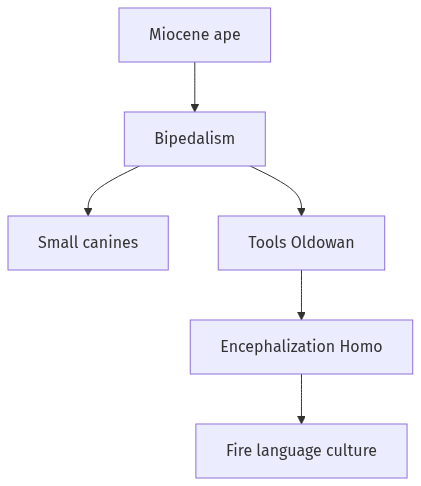
Conclusion
Hominization is the mosaic of bipedalism, dental change, brain growth, tools, and culture. Fossils from Taung, Hadar, Olduvai, and Dmanisi, and tools from Gona to the Acheulean, are the illustrations, not a single transformation.
Quick related
Students also ask
-
Elucidate the biological and cultural factors in Human evolution.
Next question on this syllabus topic (2016 · Q6(a)). View answer →
-
Did the brain expand first?
The African australopith record says no. Bipedalism and reduced canines come before the large Homo brain.
-
Is tool use enough to define hominization?
It is a major trend, but bipedalism, life history, and social learning belong in the same process.
Same topic · past papers
UPSC has asked this before
These previous-year questions sit on the same topic. Open one to practise the earlier ask.
-
2024 · Q4(b) · Anthropology GS 1 · 15 marks
Discuss the Acheulian and Oldowan traditions of Indian Paleolithic cultures with suitable illustrations. -
2026 · Q4(a) · Anthropology GS 1 · 15 marks
Human evolution is a product of both biological and cultural factors. Elaborate -
2024 · Q8(c) · Anthropology GS 1 · 15 marks
Critically discuss the synergistic effect of biological and cultural factors in human evolution. -
2016 · Q6(a) · Anthropology GS 1 · 20 marks
Elucidate the biological and cultural factors in Human evolution. -
2015 · Q2(a) · Anthropology GS 1 · 15 marks
Elucidate the biological and cultural factors in Human Evolution
More from this topic
Q4(a) · UPSC Mains 2026 · Anthropology GS 1 · 15 marks · Solution
Human evolution is a product of both biological and cultural factors. Elaborate
Biological and Cultural factors in human evolution.
* Human evolution relies on a continuous feedback loop between biology and culture. * Bipedalism involved skeletal changes in the pelvis and limbs that freed the hands. * Encephalisation led to neocortex expansion, driven by dietary shifts and foraging needs. * Neoteny retained juvenile traits into adulthood, prolonging learning and plasticity. * Cultural innovations like toolmaking and symbolic thought accelerated physical shifts. * Culture acts as a primary adaptive mechanism, altering selective pressures on the human genome. * Physical anthropology and archaeology merge because neither biology nor culture operates in isolation.
Q8(c) · UPSC Mains 2024 · Anthropology GS 1 · 15 marks · Solution
Critically discuss the synergistic effect of biological and cultural factors in human evolution.
Biological and Cultural factors in human evolution.
Biocultural evolution is reciprocal feedback among genes, development, behaviour and constructed environments. Bipedalism enabled new carrying and tool behaviours; technology then changed foraging and cooperation. Cooking may raise energy return, but its chronology cannot alone explain early Homo. Dairying/lactase persistence and malaria/HbS are gene–culture–ecology examples. Yajnik's thin-fat phenotype shows developmental mismatch in India. Hrdy, Hawkes and niche-construction theory connect cooperative care, long childhood and cumulative culture.
Q6(a) · UPSC Mains 2016 · Anthropology GS 1 · 20 marks · Solution
Elucidate the biological and cultural factors in Human evolution.
Biological and Cultural factors in human evolution.
Bipedalism and a large, slow-growing brain are biological platforms. Stone tools, fire, and sharing are cultural forces. Washburn treated tools as a cause of further anatomy. Hrdy’s alloparents help explain childhood. Lactase persistence shows the loop continuing.