
Revision summary
GWAS tests common SNPs across the genome for association with a trait or disease. It showed that many adult diseases are polygenic and pointed to biological pathways. Polygenic scores are research tools, not fate. Limits include European-ancestry bias, missing heritability, and misuse as race biology. Environment, foetal programming and inequality still explain a large share of health. GWAS belongs with genetic markers and with non-Mendelian inheritance.
Model answer
Copper italics in this answer — like this — are the key facts. Each one is unpacked in the Facts & figures rail.
Introduction
Genome-Wide Association Studies (GWAS) scan hundreds of thousands of common genetic markers, especially SNPs, across the genome and compare their frequency between people with and without a disease or trait. They have shifted the understanding of disease from a single-gene model towards a complex, polygenic and biocultural model.
Body
1. Improved Understanding of the Genetic Basis of Disease
- Polygenic architecture: GWAS identified numerous variants associated with complex diseases and traits such as Type-2 diabetes, schizophrenia, autoimmune diseases and height, showing that many diseases are influenced by multiple variants of small effect.
- Genome-wide mapping: It expanded the use of genetic markers from individual loci to genome-wide analysis.
- Example: Wellcome Trust case-control studies demonstrated the usefulness of GWAS in identifying genetic associations with complex diseases.
2. Revealed Gene–Environment Interaction
- Genetic susceptibility: GWAS identifies inherited susceptibility but also shows that genes do not operate in isolation.
- Biocultural influence: Nutrition, lifestyle, infection and socioeconomic conditions can modify disease outcomes.
- Example: GWAS complements Barker’s foetal programming hypothesis, which explains how early nutritional conditions influence later-life disease.
3. Identified Biological Pathways
- Pathway discovery: Multiple associated SNPs can point towards biological pathways involved in disease.
- Mechanistic understanding: Associations involving lipid metabolism and immune signalling provide clues about disease mechanisms.
- Significance: GWAS can therefore move research beyond statistical association towards understanding underlying biological processes.
4. Enabled Genetic Risk Prediction and Personalised Medicine
- Polygenic Risk Scores: Effects of multiple variants can be combined to estimate an individual's relative genetic susceptibility.
- Pharmacogenomics: Genetic variation can help explain differences in drug response and adverse reactions.
- Limitation: Genetic risk is not destiny, as environmental and social factors remain important.
5. Improved Understanding of Infectious Diseases
- Host-genetic variation: GWAS can identify genetic factors associated with differences in susceptibility and disease severity.
- Example: GWAS during COVID-19 investigated genetic variants associated with differences in disease severity.
6. Contribution to Population and Biological Anthropology
- Human variation: GWAS has expanded knowledge of genetic variation, population diversity and disease susceptibility.
- Example: Genome India can improve representation of Indian populations and reduce dependence on predominantly European genomic datasets.
7. Limitations and Anthropological Concerns
- European ancestry bias: Early GWAS disproportionately sampled European populations, limiting the applicability of findings to other populations.
- Missing heritability: Identified variants explain only part of the genetic contribution suggested by family studies; rare variants, gene–gene interactions and environment also matter.
- Race misuse: Genetic associations should not be interpreted as evidence of fixed biological racial categories.
- Ethical concerns: Genomic research raises issues of privacy, discrimination, informed consent and extractive research, particularly among small or tribal communities.
Flow diagram
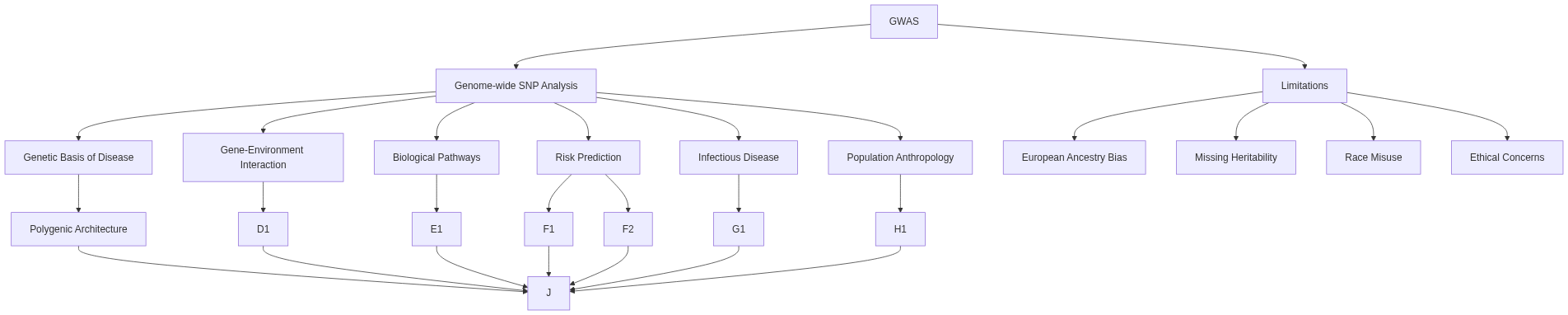
Conclusion
GWAS has transformed the study of health and disease by revealing the polygenic architecture of complex diseases, genetic susceptibility and disease-related biological pathways. However, an anthropological understanding requires a biocultural approach, recognising that genes interact with environment, culture, population history and social inequality. Thus, genetics should complement rather than replace environmental and social explanations of health.
Quick related
Students also ask
-
What is genetic counseling? Briefly discuss various steps involved in it.
Next question on this syllabus topic (2024 · Q4(c)). View answer →
-
Did GWAS find the gene for diabetes?
No. It found many loci of small effect and some pathways. Diet, weight, womb constraint and inequality remain central.
-
Why does European sample bias matter in India?
Scores and hits trained on European samples transfer poorly. That is both a method limit and a justice issue for Indian populations.
Same topic · past papers
UPSC has asked this before
These previous-year questions sit on the same topic. Open one to practise the earlier ask.
-
2025 · Q6(a) · Anthropology GS 1 · 20 marks
What are genetic markers? Discuss their applications in understanding population variation, disease association and forensics
More from this topic
Q6(a) · UPSC Mains 2026 · Anthropology GS 1 · 20 marks · Solution
How would you find out that a particular disease/disorder is inherited and, if so, in which manner? Elaborate with suitable examples
Genetic imprints in human disease, genetic screening, genetic counseling, human DNA profiling, gene mapping and genome study.
• Trace family health histories across generations using standardized pedigree charts to spot inheritance patterns. • Compare concordance rates between identical and fraternal twins to separate genetic traits from environmental effects. • Use adoption studies to isolate biological lineage from shared home environments and confirm innate vulnerability. • Run laboratory diagnostics like karyotyping to spot gross chromosomal anomalies and numerical aberrations. • Employ DNA sequencing, such as PCR and next-gen methods, to detect specific point mutations or deletions. • Identify autosomal recessive disorders like sickle cell anaemia, which typically appear with consanguineous parents. • Track X-linked traits like haemophilia to demonstrate skewed transmission patterns across different sexes.
Q4(c) · UPSC Mains 2024 · Anthropology GS 1 · 15 marks · Solution
What is genetic counseling? Briefly discuss various steps involved in it.
Genetic imprints in human disease, genetic screening, genetic counseling, human DNA profiling, gene mapping and genome study.
Genetic counselling helps families understand hereditary and psychosocial implications and choose voluntarily. The sequence is referral, pedigree, diagnosis, risk assessment, consented testing, communication, options and follow-up. Screening estimates risk; a positive screen is not automatically a diagnosis. Risk explanations must include penetrance, variable expression and uncertainty. Thalassaemia and sickle-cell programmes require confirmatory tests and non-stigmatising counselling. Privacy, coercion, sex selection and unequal access are central ethical concerns.
Q1(d) · UPSC Mains 2022 · Anthropology GS 1 · 10 marks · Solution
Pedigree analysis in genetic counselling
Genetic imprints in human disease, genetic screening, genetic counseling, human DNA profiling, gene mapping and genome study.
A pedigree uses standard symbols to show how a trait runs in a family. Dominant, recessive, and X-linked patterns can be read from the chart. Garrod linked such patterns to inborn errors of metabolism. Counselling uses the chart for recurrence risk, especially with consanguinity. Molecular tests refine, they do not replace, the family drawing.