
Revision summary
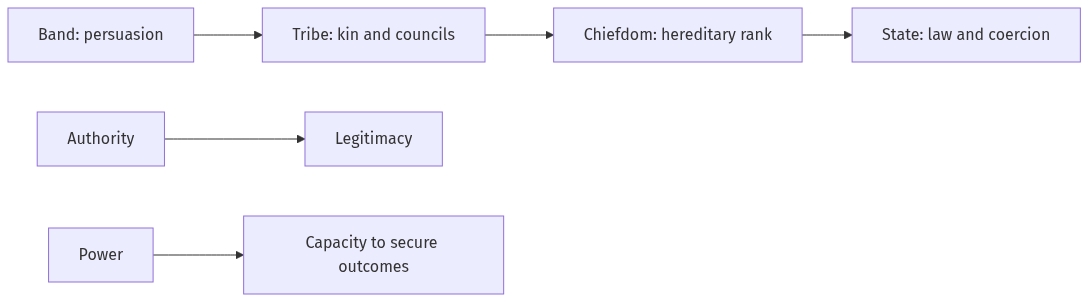
Authority is legitimate command; power is capacity to produce outcomes. Weber distinguished traditional, charismatic and legal-rational authority. Bands rely mainly on persuasive, situational leaders. Nuer segmentary lineages coordinate without a central ruler. Chiefdoms join hereditary rank, redistribution and ritual. States centralise territory, law, tax and coercion; Service's sequence is typology, not destiny.
Model answer
Copper italics in this answer — like this — are the key facts. Each one is unpacked in the Facts & figures rail.
Introduction
Authority is socially recognised legitimacy to command; power is the capacity to secure an outcome even without consent. Political anthropology asks how both are organised where no formal government exists as well as in states.
Body
Authority and political scale
Max Weber distinguished traditional, charismatic and legal-rational authority. Anthropologists add that legitimacy may rest in kinship, ritual knowledge, age, generosity or control of coercion.
- Band: small, mobile and egalitarian; leadership is situational and persuasive. Among Ju/'hoansi foragers, skilled persons influence but cannot routinely compel. Richard Lee's “insulting the meat” shows levelling against boastful hunters.
- Tribe or segmentary system: dispersed communities coordinate through kin groups, councils, age sets and ritual offices. In E. E. Evans-Pritchard's Nuer, balanced lineage opposition supplies order without a central sovereign; the leopard-skin chief mediates rather than rules.
- Chiefdom: hereditary rank and an office of chief integrate several communities through redistribution, tribute and ritual. Polynesian chiefdoms illustrate ranked descent and mana, though Elman Service's evolutionary sequence should not be treated as inevitable.
- State: central government claims territory, taxation, law and specialised coercion. Fortes and Evans-Pritchard contrasted centralised African kingdoms such as the Zulu with stateless lineage systems.
Indian examples range from village councils and Naga customary institutions to the constitutionally sovereign state. Colonial indirect rule often hardened fluid chiefs into offices. Gender, class and dissent also reveal that proclaimed legitimacy never eliminates contested power.
Flow diagram
Conclusion
Authority varies from earned influence to hereditary office and bureaucratic law. Bands, segmentary lineages, chiefdoms and states are comparative types, not a ladder every society must climb. Legitimacy, material control and resistance must be studied together.
Quick related
Students also ask
-
Discuss the mechanism of social control in different kinds of political systems
Next question on this syllabus topic (2022 · Q6(a)). View answer →
-
Are stateless societies without politics?
No. Kinship, ritual, feud settlement and councils organise public order without a central state.
-
Is every influential person an authority?
Not necessarily. Influence becomes authority when followers recognise a legitimate right to direct or decide.
Same topic · past papers
UPSC has asked this before
These previous-year questions sit on the same topic. Open one to practise the earlier ask.
-
2026 · Q3(a) · Anthropology GS 1 · 20 marks
How do the concepts of power, authority, legitimacy and social control change with changing political organization? Discuss in detail giving suitable examples -
2021 · Q3(a) · Anthropology GS 1 · 20 marks
How do political organisations of simple societies establish power, authority and legitimacy?
More from this topic
Q3(a) · UPSC Mains 2026 · Anthropology GS 1 · 20 marks · Solution
How do the concepts of power, authority, legitimacy and social control change with changing political organization? Discuss in detail giving suitable examples
Political Organization and Social Control
Political evolution shifts human societies from decentralized kinship networks to centralized state structures. In egalitarian bands and tribes, power is
Q6(a) · UPSC Mains 2022 · Anthropology GS 1 · 20 marks · Solution
Discuss the mechanism of social control in different kinds of political systems
Political Organization and Social Control
Social control matches political scale. Foragers use gossip and fission. Nuer feud and peacemakers show tribal control. Chiefs add tabu and tribute. States add law and legitimate force, while custom and caste still operate.
Q3(a) · UPSC Mains 2021 · Anthropology GS 1 · 20 marks · Solution
How do political organisations of simple societies establish power, authority and legitimacy?
Political Organization and Social Control
Power is capacity; authority is recognised right; legitimacy is accepted ground. Bands use consensus and fission; Nuer segments mediate without a king. Trobriand chiefs and Kachin gumsa convert food and marriage into rank. Melanesian big-men build personal followings that do not outlive the giver. Weber’s traditional and charismatic types explain legitimacy better than statute.