
Revision summary
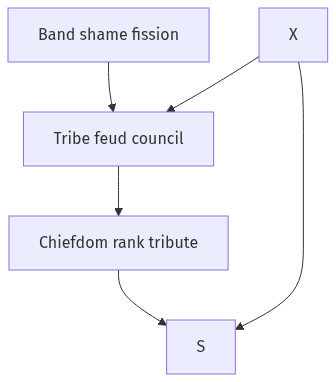
Social control matches political scale. Foragers use gossip and fission. Nuer feud and peacemakers show tribal control. Chiefs add tabu and tribute. States add law and legitimate force, while custom and caste still operate.
Model answer
Copper italics in this answer — like this — are the key facts. Each one is unpacked in the Facts & figures rail.
Introduction
Social control is how a public makes people keep rules. The mechanism changes with scale: band, tribe, chiefdom, and state do not use the same mix of shame, feud, and law.
Body
Uncentralised systems
- In bands, gossip, ridicule, and fission work. Turnbull’s Mbuti and many forager ethnographies show walking away as a sanction.
- Tribal segmentary systems use feud and the leopard-skin peacemaker, as Evans-Pritchard showed for the Nuer. Age-sets and lineage councils, as among the Maasai or Indian Naga village morungs, bind youth.
- Radcliffe-Brown called this the maintenance of social structure. Malinowski stressed reciprocal obligation in the Trobriands more than a court.
Centralised systems
- Chiefdoms add ranked offices and tribute. Hawaiian and African chiefships used ritual tabu and redistribution.
- States add written law, police, and tax. Weber’s monopoly of legitimate force is the extreme. Customary law may still sit under the code, as in Indian panchayats beside the IPC.
Cross-cutting tools
- Religion, witchcraft accusation, and caste ostracism control without a policeman. Durkheim’s sanction and Foucault’s discipline name two later readings of the same field.
- Modern NGOs and social media add new shame, but they do not erase kinship control in the village.
Flow diagram
Conclusion
Bands control by exit and shame, tribes by feud and council, chiefdoms by rank and rite, states by law and force. Anthropology studies the mix, not a single ladder of progress.
Quick related
Students also ask
-
How do political organisations of simple societies establish power, authority and legitimacy?
Next question on this syllabus topic (2021 · Q3(a)). View answer →
-
Is a stateless society lawless?
No. It is rich in sanction. It lacks a specialised police monopoly.
-
Does caste replace the state in India?
No. It is a parallel control. The Constitution and courts remain the public law.
Same topic · past papers
UPSC has asked this before
These previous-year questions sit on the same topic. Open one to practise the earlier ask.
-
2026 · Q3(a) · Anthropology GS 1 · 20 marks
How do the concepts of power, authority, legitimacy and social control change with changing political organization? Discuss in detail giving suitable examples -
2016 · Q3(b) · Anthropology GS 1 · 15 marks
Discuss different social control mechanisms in simple societies.
More from this topic
Q3(a) · UPSC Mains 2026 · Anthropology GS 1 · 20 marks · Solution
How do the concepts of power, authority, legitimacy and social control change with changing political organization? Discuss in detail giving suitable examples
Political Organization and Social Control
Political evolution shifts human societies from decentralized kinship networks to centralized state structures. In egalitarian bands and tribes, power is
Q5(d) · UPSC Mains 2024 · Anthropology GS 1 · 10 marks · Solution
Authority and forms of political organization
Political Organization and Social Control
Authority is legitimate command; power is capacity to produce outcomes. Weber distinguished traditional, charismatic and legal-rational authority. Bands rely mainly on persuasive, situational leaders. Nuer segmentary lineages coordinate without a central ruler. Chiefdoms join hereditary rank, redistribution and ritual. States centralise territory, law, tax and coercion; Service's sequence is typology, not destiny.
Q3(a) · UPSC Mains 2021 · Anthropology GS 1 · 20 marks · Solution
How do political organisations of simple societies establish power, authority and legitimacy?
Political Organization and Social Control
Power is capacity; authority is recognised right; legitimacy is accepted ground. Bands use consensus and fission; Nuer segments mediate without a king. Trobriand chiefs and Kachin gumsa convert food and marriage into rank. Melanesian big-men build personal followings that do not outlive the giver. Weber’s traditional and charismatic types explain legitimacy better than statute.