
Revision summary
Menopause ends cycles after follicular exhaustion. Core symptoms are flushes, night sweats, urogenital atrophy, and bone loss. Mood and sleep complaints are common in clinics. Lock showed that Japanese aging did not copy American flush medicine. Symptoms are biology read through culture and the older woman’s social place.
Model answer
Copper italics in this answer — like this — are the key facts. Each one is unpacked in the Facts & figures rail.
Introduction
Menopause is the permanent end of menstruation after ovarian follicles are exhausted. Symptoms are biological, but culture decides which of them count as an illness.
Body
Common symptoms
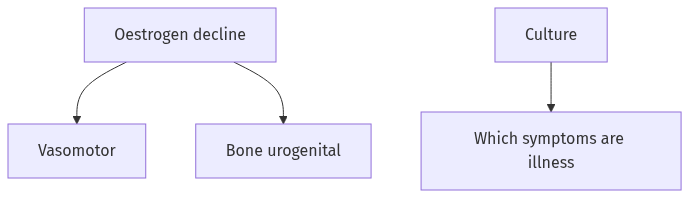
- Vasomotor symptoms include hot flushes and night sweats, tied to oestrogen decline and thermoregulatory change.
- Urogenital change, vaginal dryness, and urinary complaints follow mucosal atrophy.
- Bone loss raises osteoporosis risk, and sleep, mood, and sexual difficulty are often reported in clinics.
- Timing is commonly around 45–55 years, with earlier menopause after some surgeries or in some undernourished populations.
Biocultural reading
- Margaret Lock in Encounters with Aging showed that Japanese konenki did not match North American hot-flush medicine, so symptom lists are not a universal script.
- Indian mid-life ethnography likewise finds joint pain, weakness, and social role change beside, or instead of, flush talk.
- Hormone therapy, calcium, and exercise are biomedical answers; anthropology adds household status of the older woman, as Nancy Scheper-Hughes and medical anthropology would insist for any embodied change.
Flow diagram
Conclusion
Menopausal symptoms include flushes, urogenital change, bone loss, and mood or sleep disturbance. Their meaning and intensity are biocultural, as Lock’s Japan comparison still teaches.
Quick related
Students also ask
-
Critically evaluate the reasons of reduction in age at menarche in human females over the successive generations
Next question on this syllabus topic (2022 · Q6(c)). View answer →
-
Are hot flushes universal?
Physiology is widespread. Reporting, severity, and medicalisation vary, as Lock showed for Japan.
-
Is menopause a disease?
It is a normal life-history event. Some symptoms need care; the whole event is not an illness by definition.
More from this topic
Q5(b) · UPSC Mains 2025 · Anthropology GS 1 · 10 marks · Solution
Evolutionary significance of menopause.
Relevance of menarche, menopause and other bioevents to fertility. Fertility patterns and differentials.
Menopause ends fertility well before death and creates a long post-reproductive span in humans. That is a puzzle because selection usually favours more births. Hawkes’s grandmother hypothesis uses Hadza and other foraging data: older women feed grandchildren. The mother hypothesis says stopping late births protects children already born. Chimpanzees rarely match this human pattern. Significance is cooperative breeding and life history, not a clinic essay.
Q6(c) · UPSC Mains 2022 · Anthropology GS 1 · 15 marks · Solution
Critically evaluate the reasons of reduction in age at menarche in human females over the successive generations
Relevance of menarche, menopause and other bioevents to fertility. Fertility patterns and differentials.
Many populations show a secular fall in age at menarche. Tanner placed it with taller, earlier-maturing children. Nutrition and fewer childhood infections are the main engines. Genes cannot explain a century-scale drop. The trend is uneven by class and has health costs when too early.
Q5(d) · UPSC Mains 2015 · Anthropology GS 1 · 10 marks · Solution
Menopause and its impact.
Relevance of menarche, menopause and other bioevents to fertility. Fertility patterns and differentials.
Menopause is the permanent end of menses after follicular depletion. Oestrogen fall drives flush, bone, and some heart risk. Hawkes’s grandmother hypothesis reads long post-reproductive life as adaptive. Social impact includes household role and care work. Treat complications, not the event itself as a disease.