
Revision summary
Many populations show a secular fall in age at menarche. Tanner placed it with taller, earlier-maturing children. Nutrition and fewer childhood infections are the main engines. Genes cannot explain a century-scale drop. The trend is uneven by class and has health costs when too early.
Model answer
Copper italics in this answer — like this — are the key facts. Each one is unpacked in the Facts & figures rail.
Introduction
Age at first menstruation has fallen across many industrial and urbanising populations. The trend is real, but the causes are mixed and the floor is not zero.
Body
The trend
- European historical series, and later Japanese and Indian urban data, show menarche moving from about 16–17 toward 12–13 years over a century.
- Tanner treated this as part of the secular trend in growth.
Reasons offered
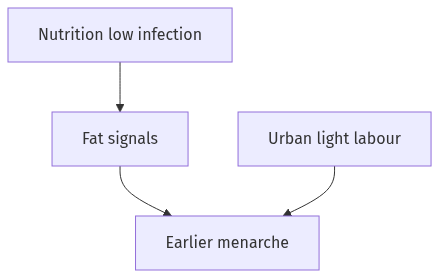
- Better childhood nutrition and lower infection raise body fat and leptin signals that permit ovulation. This is the strongest bio-cultural case.
- Urban light, less heavy labour, and smaller family size travel with the same trend.
- Endocrine-disrupting chemicals are a hypothesis, not yet the whole story.
- Genetic change across three generations is too slow to explain the shift. Plasticity is the point.
Critique
- Rural and undernourished groups may not show the same fall. Indian ICMR and NFHS patterns still vary by wealth and caste.
- Very early menarche has costs: anaemia, school exit, and later metabolic risk. A falling mean is not an unqualified gain.
- Reporting error and school samples can exaggerate smoothness.
Flow diagram
Conclusion
Falling menarche is mainly a nutrition and infection story of the secular trend. Chemicals and lifestyle may add, but genes do not sprint in a century.
Quick related
Students also ask
-
Menopause and its impact.
Next question on this syllabus topic (2015 · Q5(d)). View answer →
-
Will menarche keep falling forever?
No. Well-nourished populations approach a plateau around the early teens.
-
Is earlier menarche only Western?
Urban Asia, including India, shows similar movement where child health improves.
Same topic · past papers
UPSC has asked this before
These previous-year questions sit on the same topic. Open one to practise the earlier ask.
-
2021 · Q6(c) · Anthropology GS 1 · 15 marks
Critically evaluate Lewis Morgan's classification of family -
2021 · Q7(a) · Anthropology GS 1 · 20 marks
Critically evaluate different types of social stratifications with suitable examples
More from this topic
Q5(b) · UPSC Mains 2025 · Anthropology GS 1 · 10 marks · Solution
Evolutionary significance of menopause.
Relevance of menarche, menopause and other bioevents to fertility. Fertility patterns and differentials.
Menopause ends fertility well before death and creates a long post-reproductive span in humans. That is a puzzle because selection usually favours more births. Hawkes’s grandmother hypothesis uses Hadza and other foraging data: older women feed grandchildren. The mother hypothesis says stopping late births protects children already born. Chimpanzees rarely match this human pattern. Significance is cooperative breeding and life history, not a clinic essay.
Q5(d) · UPSC Mains 2023 · Anthropology GS 1 · 10 marks · Solution
Menopausal symptoms
Relevance of menarche, menopause and other bioevents to fertility. Fertility patterns and differentials.
Menopause ends cycles after follicular exhaustion. Core symptoms are flushes, night sweats, urogenital atrophy, and bone loss. Mood and sleep complaints are common in clinics. Lock showed that Japanese aging did not copy American flush medicine. Symptoms are biology read through culture and the older woman’s social place.
Q5(d) · UPSC Mains 2015 · Anthropology GS 1 · 10 marks · Solution
Menopause and its impact.
Relevance of menarche, menopause and other bioevents to fertility. Fertility patterns and differentials.
Menopause is the permanent end of menses after follicular depletion. Oestrogen fall drives flush, bone, and some heart risk. Hawkes’s grandmother hypothesis reads long post-reproductive life as adaptive. Social impact includes household role and care work. Treat complications, not the event itself as a disease.