
Revision summary
Menopause ends fertility well before death and creates a long post-reproductive span in humans. That is a puzzle because selection usually favours more births. Hawkes’s grandmother hypothesis uses Hadza and other foraging data: older women feed grandchildren. The mother hypothesis says stopping late births protects children already born. Chimpanzees rarely match this human pattern. Significance is cooperative breeding and life history, not a clinic essay.
Model answer
Copper italics in this answer — like this — are the key facts. Each one is unpacked in the Facts & figures rail.
Introduction
Menopause is the permanent end of fertility well before the end of life. In humans this leaves a long post-reproductive span, especially for women who survive mid-life. That is an evolutionary puzzle, because natural selection usually favours continued reproduction. The significance lies in life history, not in a clinic note on hormones.
Body
The puzzle
Most mammals reproduce until late in life. Wild chimpanzees rarely show a long, healthy post-reproductive period of the human kind. If genes only “care” about more births, stopping ovulation decades before death looks wasteful. George Williams posed related life-history problems through antagonistic pleiotropy: a trait can be favoured early in life even if it costs later.
Humans also have unusually long childhoods and high-cost children. Menopause belongs with that slow life history.
Main hypotheses
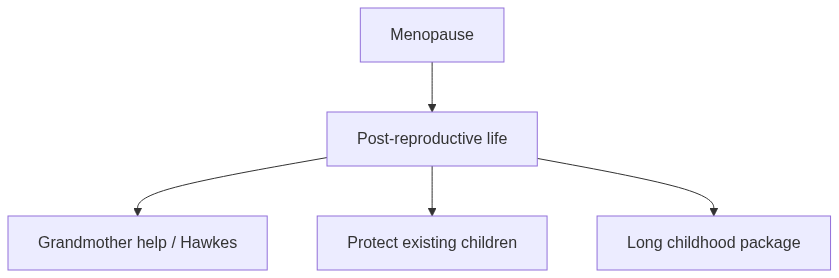
- Grandmother hypothesis (Kristen Hawkes): Among the Hadza and in other foraging data, older women collect food and support grandchildren. Extra calories raise the survival of kin who share the grandmother’s genes. Selection then favours a long healthy life after fertility ends. This is inclusive fitness, not sentiment.
- Mother hypothesis: Stopping further births reduces the risk that a late pregnancy kills a woman who already has dependent children. The existing brood is protected.
- Embodied capital and pairing: Long adult life, male provisioning and pair bonds (as in some models by Hill and Kaplan) make a three-generation economy possible. Menopause is one piece of that package, not a lone mutation.
- What it is not: A simple pathology of ageing. If it were only decay, we would not expect the regular mid-life shift plus decades of useful work.
Killer whales are sometimes cited as another menopause case. They are a comparison, not the human explanation.
Evolutionary significance
Menopause marks humans as cooperative breeders with stacked generations. It helps explain childhood, longevity and female social value after childbearing. It also warns against reading every sex difference as a Victorian “woman’s nature”. The trait is about kin investment and life history.
Flow diagram
Conclusion
The evolutionary significance of menopause is a long post-reproductive life that can still pay, mainly through grandmaternal help and the protection of existing children. Hawkes and the Hadza, and the chimpanzee contrast, keep the argument in life-history theory rather than in gynaecology.
Quick related
Students also ask
-
Menopausal symptoms
Next question on this syllabus topic (2023 · Q5(d)). View answer →
-
Is menopause unique to humans?
It is unusual among primates. Some toothed whales are a comparative case. The human life-history package is the centre of the argument.
-
Is this a clinical question about hormones?
No. The demand is evolutionary significance. Hormone replacement is not the subject.
Same topic · past papers
UPSC has asked this before
These previous-year questions sit on the same topic. Open one to practise the earlier ask.
-
2015 · Q5(d) · Anthropology GS 1 · 10 marks
Menopause and its impact.
More from this topic
Q5(d) · UPSC Mains 2023 · Anthropology GS 1 · 10 marks · Solution
Menopausal symptoms
Relevance of menarche, menopause and other bioevents to fertility. Fertility patterns and differentials.
Menopause ends cycles after follicular exhaustion. Core symptoms are flushes, night sweats, urogenital atrophy, and bone loss. Mood and sleep complaints are common in clinics. Lock showed that Japanese aging did not copy American flush medicine. Symptoms are biology read through culture and the older woman’s social place.
Q6(c) · UPSC Mains 2022 · Anthropology GS 1 · 15 marks · Solution
Critically evaluate the reasons of reduction in age at menarche in human females over the successive generations
Relevance of menarche, menopause and other bioevents to fertility. Fertility patterns and differentials.
Many populations show a secular fall in age at menarche. Tanner placed it with taller, earlier-maturing children. Nutrition and fewer childhood infections are the main engines. Genes cannot explain a century-scale drop. The trend is uneven by class and has health costs when too early.
Q5(d) · UPSC Mains 2015 · Anthropology GS 1 · 10 marks · Solution
Menopause and its impact.
Relevance of menarche, menopause and other bioevents to fertility. Fertility patterns and differentials.
Menopause is the permanent end of menses after follicular depletion. Oestrogen fall drives flush, bone, and some heart risk. Hawkes’s grandmother hypothesis reads long post-reproductive life as adaptive. Social impact includes household role and care work. Treat complications, not the event itself as a disease.