
Revision summary
Expression is transcription plus translation under regulatory control. Crick’s central dogma names the default flow from DNA to protein. Enhancers, chromatin, and splicing decide cell-specific products. Lactase persistence and Tibetan EPAS1 are anthropological examples of regulatory change. Epigenetic marks link environment to expression without rewriting the DNA code.
Model answer
Copper italics in this answer — like this — are the key facts. Each one is unpacked in the Facts & figures rail.
Introduction
Gene expression is the turning of DNA sequence into RNA and protein at the right time and place. A genotype is not a finished trait until this switchboard has worked.
Body
The process
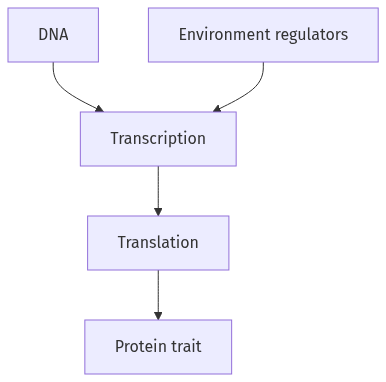
- Transcription copies a gene into messenger RNA, and translation at the ribosome builds a polypeptide, which Francis Crick placed in the central dogma of molecular biology.
- Promoters, enhancers, transcription factors, and chromatin packing decide which loci are on in a liver cell and off in a neuron.
- Alternative splicing and RNA editing can make more than one product from one locus, so one-gene-one-trait talk is too crude for anthropology.
Why anthropologists need it
- Lactase persistence is a regulatory change near the lactase gene, not a new digestive organ, which is why dairying cultures and genotype must be read together, as in European and some African pastoral histories.
- High-altitude EPAS1 regulation in Tibetans, and methylation changes under famine or stress, show expression and epigenetics as part of human adaptation.
- Disease risk, growth, and pigmentation are therefore expression profiles in environments, not a fixed racial essence.
Flow diagram
Conclusion
Gene expression is regulated transcription and translation, not the mere presence of a locus. Human variation in diet, altitude, and disease is often a story of when genes are on.
Quick related
Students also ask
-
Elucidate the different forms of malnutrition. Describe protein-calorie malnutrition with suitable examples.
Next question on this syllabus topic (2023 · Q2(c)). View answer →
-
Is gene expression the same as genotype?
No. Genotype is the sequence. Expression is whether and how that sequence is used in a tissue and an environment.
-
Why does this appear in biological anthropology?
Because adaptation, growth, and disease often sit in regulation, not in a new protein invented from nothing.
More from this topic
Q5(b) · UPSC Mains 2026 · Anthropology GS 1 · 10 marks · Solution
Distinguishing features of nuclear and mitochondrial DNA.
The biological basis of Life
• Nuclear DNA has 3 billion base pairs in linear chromosomes, while mitochondrial DNA is a small, circular molecule of 16,569 base pairs. • Somatic cells carry diploid nuclear DNA, whereas mitochondria contain multiple copies of their own circular genome. • Nuclear DNA undergoes biparental inheritance and frequent genetic recombination, ensuring high diversity. • Mitochondrial DNA is inherited strictly from the mother and lacks recombination, making it ideal for tracking maternal lineages. • Nuclear DNA is protected by histones and has robust repair mechanisms, resulting in a low mutation rate. • Mitochondrial DNA lacks strong repair systems and histone protection, leading to a much higher mutation rate. • Nuclear DNA controls overall organismal traits, while mitochondrial DNA focuses on cellular energy via oxidative phosphorylation.
Q5(d) · UPSC Mains 2025 · Anthropology GS 1 · 10 marks · Solution
Mitochondrial DNA and human evolution.
The biological basis of Life
mtDNA is inherited from the mother and does not recombine like nuclear DNA. Cann, Stoneking and Wilson used it to place the common maternal ancestor of living humans in Africa. Mitochondrial Eve is a node in a tree, not the only woman of her generation. Haplogroups map later dispersals. They are not races. Neanderthal mtDNA and nuclear admixture show that one locus is not the whole story. Join mtDNA to Y-chromosome and autosomal evidence.
Q2(c) · UPSC Mains 2023 · Anthropology GS 1 · 15 marks · Solution
Elucidate the different forms of malnutrition. Describe protein-calorie malnutrition with suitable examples.
The biological basis of Life
Forms of malnutrition are undernutrition, micronutrient shortage, overnutrition, and imbalance with infection. PCM is protein-energy shortage, classically marasmus and kwashiorkor. Cicely Williams named kwashiorkor from West African weaning oedema. Jelliffe and Waterlow indices remain the teaching toolkit beside WHO standards. Indian examples include NFHS stunting, drought wasting, and starchy weaning. Policy response includes ICDS and POSHAN, but household inequality still sorts who is malnourished.