
Revision summary
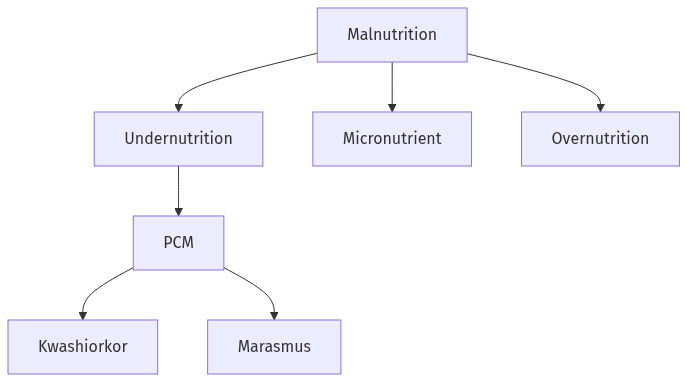
Forms of malnutrition are undernutrition, micronutrient shortage, overnutrition, and imbalance with infection. PCM is protein-energy shortage, classically marasmus and kwashiorkor. Cicely Williams named kwashiorkor from West African weaning oedema. Jelliffe and Waterlow indices remain the teaching toolkit beside WHO standards. Indian examples include NFHS stunting, drought wasting, and starchy weaning. Policy response includes ICDS and POSHAN, but household inequality still sorts who is malnourished.
Model answer
Copper italics in this answer — like this — are the key facts. Each one is unpacked in the Facts & figures rail.
Introduction
Malnutrition is a mismatch between what the body needs and what it receives, including too little, too much, and the wrong mix of nutrients. Protein–calorie malnutrition is the severe energy-and-protein end of that mismatch in children and the sick.
Body
Forms of malnutrition
- Undernutrition is shortage of energy or protein, seen as underweight, wasting, and stunting on Gomez and Waterlow style indices and on current WHO growth standards.
- Micronutrient malnutrition, or hidden hunger, is shortage of iron, iodine, vitamin A, zinc, or folate, which may sit in a child who does not look starved.
- Overnutrition is excess energy, seen as overweight, obesity, and metabolic disease, now common in Indian cities beside persistent rural undernutrition.
- Imbalance includes too little protein with enough bulk starch, or enough calories with infection that wastes the diet, so malnutrition is not only an empty granary.
- D. B. Jelliffe taught field workers to combine anthropometry, diet history, and clinical signs rather than trust one label.
Protein–calorie malnutrition
- Protein–calorie malnutrition, also called protein–energy malnutrition, is combined shortage of energy and protein, often with infection.
- Marasmus is wasting: a very low weight-for-height, old-man face, and hunger, typically in early weaning failure or famine. The child is adapted to starvation by using fat and muscle.
- Kwashiorkor, named by Cicely Williams from the Gold Coast, is oedema, fatty liver, skin and hair change, and often apathy after a starchy weaning diet that is low in protein relative to need.
- Marasmic-kwashiorkor mixes wasting with oedema and is common in real wards, which is why the two poles should not be treated as pure types only.
- Indian examples include severe wasting in drought years, tribal hamlets with high NFHS stunting, and kwashiorkor-type oedema where cassava, maize, or thin cereal gruels replace milk and pulses after weaning.
- ICDS, POSHAN Abhiyaan, and the Public Distribution System are the policy face of the same biology: growth monitoring, supplementary food, and infection control.
Anthropological reading
- Intra-household allocation, caste kitchens, and seasonal lean months turn a national food surplus into a malnourished girl or landless child.
- PCM is therefore ecology plus infection plus inequality, not a single nutrient slogan.
Flow diagram
Conclusion
Malnutrition includes under-, micro-, and over-nutrition. Protein–calorie malnutrition is marasmus, kwashiorkor, and their mix, and Indian field examples still sit in weaning, infection, and unequal households.
Quick related
Students also ask
-
Is kwashiorkor only a protein deficiency?
Protein shortage in a starchy weaning diet is central, but infection, aflatoxin, and energy deficit also shape the syndrome. Treat it as PCM, not as one amino acid.
-
Can overnutrition and undernutrition exist in one country?
Yes. India now shows that double burden: stunting and anaemia beside urban obesity.
Same topic · past papers
UPSC has asked this before
These previous-year questions sit on the same topic. Open one to practise the earlier ask.
-
2025 · Q7(a) · Anthropology GS 1 · 20 marks
How the study of variation in forms of marriage led to rethinking on the concepts of social reproduction, kinship and family? -
2024 · Q5(d) · Anthropology GS 1 · 10 marks
Authority and forms of political organization -
2022 · Q2(b) · Anthropology GS 1 · 15 marks
Discuss different forms of primate social organisation -
2026 · Q3(a) · Anthropology GS 1 · 20 marks
How do the concepts of power, authority, legitimacy and social control change with changing political organization? Discuss in detail giving suitable examples -
2026 · Q3(c) · Anthropology GS 1 · 15 marks
Numerical chromosomal aberrations can be due to abnormalities in autosomes as well as sex chromosomes. Elaborate in terms of the effects these have on human body, giving suitable examples
More from this topic
Q5(b) · UPSC Mains 2026 · Anthropology GS 1 · 10 marks · Solution
Distinguishing features of nuclear and mitochondrial DNA.
The biological basis of Life
• Nuclear DNA has 3 billion base pairs in linear chromosomes, while mitochondrial DNA is a small, circular molecule of 16,569 base pairs. • Somatic cells carry diploid nuclear DNA, whereas mitochondria contain multiple copies of their own circular genome. • Nuclear DNA undergoes biparental inheritance and frequent genetic recombination, ensuring high diversity. • Mitochondrial DNA is inherited strictly from the mother and lacks recombination, making it ideal for tracking maternal lineages. • Nuclear DNA is protected by histones and has robust repair mechanisms, resulting in a low mutation rate. • Mitochondrial DNA lacks strong repair systems and histone protection, leading to a much higher mutation rate. • Nuclear DNA controls overall organismal traits, while mitochondrial DNA focuses on cellular energy via oxidative phosphorylation.
Q5(d) · UPSC Mains 2025 · Anthropology GS 1 · 10 marks · Solution
Mitochondrial DNA and human evolution.
The biological basis of Life
mtDNA is inherited from the mother and does not recombine like nuclear DNA. Cann, Stoneking and Wilson used it to place the common maternal ancestor of living humans in Africa. Mitochondrial Eve is a node in a tree, not the only woman of her generation. Haplogroups map later dispersals. They are not races. Neanderthal mtDNA and nuclear admixture show that one locus is not the whole story. Join mtDNA to Y-chromosome and autosomal evidence.
Q1(e) · UPSC Mains 2023 · Anthropology GS 1 · 10 marks · Solution
Gene expression.
The biological basis of Life
Expression is transcription plus translation under regulatory control. Crick’s central dogma names the default flow from DNA to protein. Enhancers, chromatin, and splicing decide cell-specific products. Lactase persistence and Tibetan EPAS1 are anthropological examples of regulatory change. Epigenetic marks link environment to expression without rewriting the DNA code.