
Revision summary
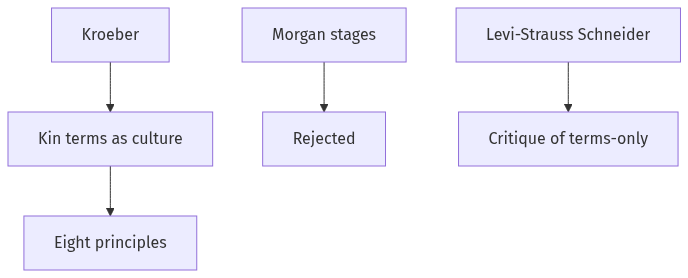
Kroeber’s 1909 paper treated classificatory kinship as linguistic-cultural, not as a primitive stage. Eight principles generate terminological pattern. Kinship sits in the superorganic, not in raw biology or psychology. California ethnography supplied cases inside Boasian culture history. Lévi-Strauss wanted alliance, Schneider wanted to question the genealogical grid. Kroeber remains the terms-as-culture charter, not the whole of kinship theory.
Model answer
Copper italics in this answer — like this — are the key facts. Each one is unpacked in the Facts & figures rail.
Introduction
A. L. Kroeber treated kinship as culture, especially as a language of terms, not as a biological tree that explains itself. His contribution is that shift, and the critique is what a terms-first method can miss.
Body
Kinship as culture
- Against a simple Lewis Henry Morgan reading of classificatory systems as fossil stages, A. L. Kroeber in his 1909 paper on classificatory systems of relationship argued that kin terms are linguistic and cultural classifications.
- Eight principles, including generation, affinity, collaterality, sex of speaker, and relative age, could generate the pattern of a terminology without a unilinear social stage.
- Kinship therefore belongs with the superorganic of culture, the same move Kroeber made against reducing culture to individual psychology.
Ethnographic and comparative work
- California ethnography, including Yurok and other peoples with R. H. Lowie in the wider Boasian set, supplied term lists and marriage practice for a historical-particularist file rather than a world stage.
- Kroeber’s wider Anthropology treated kinship beside art, dress, and language as items of culture history, including diffusion, which later alliance theory would find too shallow.
- He helped make the kinship schedule and the comparison of terminologies a professional tool of American anthropology, beside W. H. R. Rivers’s genealogical method from the British side.
Critical limits
- Claude Lévi-Strauss and later alliance theory said that terms without marriage rules and exchange miss the social structure that the terms serve.
- David Schneider later said that the whole biological grid of kin types was an American folk model; Kroeber had culturalised terms but still used genealogical boxes.
- Descent-group politics, property, and gender are thinner in a principles-of-terminology paper than in Meyer Fortes or Evans-Pritchard.
- Indian joint-family and caste hypergamy need Dumont and Karve as well as Kroeber’s eight principles.
What still stands
- The refusal to treat classificatory kinship as primitive error still stands.
- The idea that terminology is a cultural logic, not a poor biology, still organises the kinship chapter.
- A critical answer therefore keeps Kroeber as the Boasian who made terms cultural, then adds alliance, practice, and critique of the genealogical grid.
Flow diagram
Conclusion
Kroeber’s contribution is to treat kinship terminologies as cultural classifications generated by a few principles, not as Morganic fossils. The limit is a terms-first view that underplays alliance, property, and the folk biology still sitting inside the genealogical chart.
Quick related
Students also ask
-
Descent Groups
Next question on this syllabus topic (2021 · Q5(d)). View answer →
-
Did Kroeber deny that people have biological relatives?
No. He denied that the pattern of terms is explained by biology or by Morganic stages. Terms are cultural.
-
How should Kroeber be paired in an Indian answer?
Use him for terminology as culture, then Karve, Dumont, or Trautmann for Indian marriage rules that terms alone do not exhaust.
Same topic · past papers
UPSC has asked this before
These previous-year questions sit on the same topic. Open one to practise the earlier ask.
-
2025 · Q5(e) · Anthropology GS 1 · 10 marks
Foetal origin of adult diseases and contribution of David Barker.
More from this topic
Q1(b) · UPSC Mains 2025 · Anthropology GS 1 · 10 marks · Solution
Theoretical significance of Purum kinship-system.
Kinship
The Purum are a Kuki-Chin group used by Needham as a test case for alliance theory. The claim was prescriptive marriage to mother’s brother’s daughter, with wife-givers and wife-takers in a cycle. Needham argued against Homans and Schneider: the pattern is structure, not sentiment. The case mattered because it took elementary structures beyond Australia and clarified prescription versus preference. Ackerman and others showed that the tables did not seal the cycle as neatly as the model. The lasting names are Lévi-Strauss, Needham and the model–practice gap.
Q5(d) · UPSC Mains 2021 · Anthropology GS 1 · 10 marks · Solution
Descent Groups
Kinship
A descent group is recruited by a rule of ancestry. Unilineal clans and lineages are corporate; kindreds are often not. They organise exogamy, property, office, and feud. Nuer lineages and Trobriand sub-clans are type cases. Descent is not the same thing as the domestic family.
Q3(a) · UPSC Mains 2016 · Anthropology GS 1 · 20 marks · Solution
Describe the cardinal points of descent and alliance theories.
Kinship
Descent theory centres unilineal groups, property, and segmentation. Fortes and Evans-Pritchard are the African type authors. Alliance theory centres the incest rule and spouse exchange. Lévi-Strauss and Dumont are the type authors. North Indian gotra and south Indian cross-cousin rules show both logics.