
Revision summary
The Purum are a Kuki-Chin group used by Needham as a test case for alliance theory. The claim was prescriptive marriage to mother’s brother’s daughter, with wife-givers and wife-takers in a cycle. Needham argued against Homans and Schneider: the pattern is structure, not sentiment. The case mattered because it took elementary structures beyond Australia and clarified prescription versus preference. Ackerman and others showed that the tables did not seal the cycle as neatly as the model. The lasting names are Lévi-Strauss, Needham and the model–practice gap.
Model answer
Copper italics in this answer — like this — are the key facts. Each one is unpacked in the Facts & figures rail.
Introduction
The Purum are a Kuki-Chin people of the Indo-Burman hills. They became famous in kinship theory because Rodney Needham used their marriage rules as a test of Claude Lévi-Strauss’s alliance theory. The question asks for theoretical significance, not a full ethnography of one group.
Body
Purum Kinship System
- The Purum tribe: The Purums are an Old Kuki tribe of Manipur and occupy an important place in the anthropological study of kinship because of their distinctive prescriptive marriage system.
- T. C. Das: The Purum kinship system was documented in detail by Prof. T. C. Das in his 1945 monograph, The Purums: An Old Kuki Tribe of Manipur. His work provided an important ethnographic foundation for later theoretical debates.
- Theoretical significance: The Purum case became important in the Descent–Alliance debate, particularly because its marriage rules demonstrate how systematic marriage exchanges can connect otherwise separate descent groups.
Empirical foundation for Alliance Theory
- Claude Lévi-Strauss: The Purum system became an important ethnographic reference for Claude Lévi-Strauss, particularly in his work The Elementary Structures of Kinship (1949).
- Marriage as exchange: Lévi-Strauss viewed marriage as a system of reciprocal exchange between social groups. The exchange of women creates enduring relationships of cooperation and reciprocity between groups.
- Marriage as communication: In Alliance Theory, marriage is not merely a relationship between two individuals; it acts as a form of social communication and exchange between groups.
- Elementary structure: The Purum system illustrates an elementary structure of kinship, where society prescribes whom a person should marry rather than merely specifying whom they cannot marry.
Prescriptive asymmetrical alliance
- Five patrilineal sibs: The Purum social system traditionally consists of five major patrilineal sibs — Marrim, Makan, Kheyang, Thao, and Parpa — organised through a systematic cycle of wife-giving and wife-taking.
- Matrilateral cross-cousin marriage: The central feature is the prescription of marriage with the Mother’s Brother’s Daughter (MBD). A man is expected to marry a woman belonging to the appropriate wife-giving group connected through his maternal line.
- Asymmetrical alliance: The system is described as asymmetrical because the direction of wife-giving and wife-taking is not simply reciprocal between the same two groups.
- A → B → C cycle: Group A gives wives to B, B gives wives to C, and the exchange continues through the cycle until the relationship returns to A. This creates a continuous chain of alliance linking the different Purum groups.
- Social integration: The cyclical system ensures that different descent groups remain interconnected through regular and structured marriage exchanges.
- Proscriptive rule: Alongside the prescription to marry within the appropriate category, there is a prohibition against certain relationships. The classic example is the prohibition on marrying the Father’s Sister’s Daughter (FSD).
Descent vs. Alliance debate
- Descent approach: British social anthropologists such as A. R. Radcliffe-Brown emphasised descent groups such as lineages and clans as fundamental units of social organisation.
- Alliance approach: French Structuralists, particularly Claude Lévi-Strauss, emphasised marriage and the exchange relationships created between groups.
- Challenge to descent primacy: The Purum case demonstrated that social organisation cannot be understood only through descent. Marriage alliances can also provide a structural mechanism for connecting and integrating descent groups.
- Binding mechanism: Prescriptive marriage creates an enduring network of obligatory relationships between wife-givers and wife-takers, thereby binding separate descent groups into a larger social system.
Functional significance
- Social integration: The Purum marriage system functions as a mechanism of social integration, because fixed marriage rules create predictable relationships between different groups.
- Stability and equilibrium: By regulating marriage choices, the system reduces uncertainty and helps maintain stable relationships, cooperation, and continuity between groups.
- Social control: Prescriptive rules limit individual choice and therefore act as a mechanism of social control, ensuring that marriage contributes to the wider organisation of society.
- Ritual hierarchy: The relationship between wife-givers and wife-takers creates an asymmetrical status relationship that influences ritual behaviour, obligations, respect, and social interaction.
- W. H. R. Rivers: From a functionalist perspective associated with anthropologists such as W. H. R. Rivers, kinship institutions can be understood in terms of the social relationships and obligations they maintain.
Comparative and mathematical significance
- Elementary vs. complex structures: The Purum case helps distinguish elementary structures, where marriage partners are positively prescribed, from complex structures, where individuals have considerably greater freedom in choosing spouses.
- Structural analysis: The regular cycle of wife-giving and wife-taking makes the Purum system particularly suitable for analysing the formal structure of kinship relationships.
- Algebraic models: The logical pattern of the Purum alliance attracted the attention of mathematical and structural anthropologists, who attempted to represent kinship relations through formal models.
- Limitation of formal models: R. Reid (1967) noted that standard algebraic approaches could not fully capture the complexity of the Purum system, particularly because its combination of prescriptive and proscriptive rules does not fit easily into a simple universal formula.
Enduring significance
- Continuity: Studies of related groups, including work by Cheithou Charles Yuhlung, indicate that prescriptive marriage traditions have shown considerable resilience despite social and economic change.
- Rodney Needham: The persistence of such systems can be understood through Needham’s description of prescriptive alliance as “ideal, stable and adaptive”.
- Anthropological significance: The Purum system demonstrates that kinship is not simply a biological relationship. It is also a social system of rights, duties, exchange, reciprocity, and alliance.
- Theoretical importance: The Purum case provided important empirical evidence for moving kinship studies beyond an exclusive focus on descent and biological relatedness towards a broader understanding of marriage, reciprocity, and structural alliance.
Flow diagram
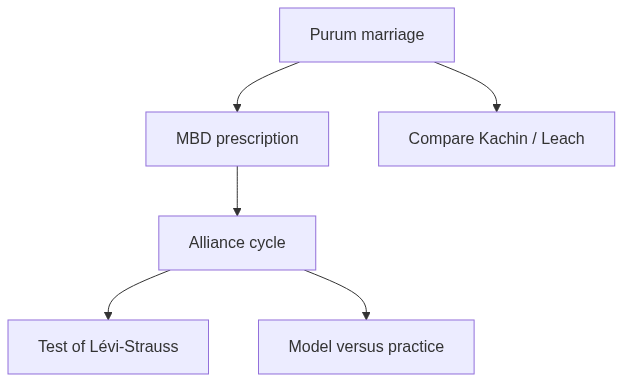
Conclusion
Purum kinship is theoretically famous because it was asked to carry alliance theory. It remains a clear exhibit of matrilateral prescription, and the case that taught students to check a beautiful structure against real marriage counts.
Quick related
Students also ask
-
Critically discuss A.L. Kroeber's contribution to kinship studies.
Next question on this syllabus topic (2023 · Q8(c)). View answer →
-
Why is Purum asked instead of Kachin?
Kachin (Leach) is the other famous asymmetric alliance case. Purum is the Needham file: tables, prescription, and the later empirical challenge.
-
Is the system disproved?
The ideal cycle was overstated. The theoretical yield remains: alliance as a model of relations, and the duty to check models against marriage counts.
Same topic · past papers
UPSC has asked this before
These previous-year questions sit on the same topic. Open one to practise the earlier ask.
-
2025 · Q6(c) · Anthropology GS 1 · 15 marks
Describe briefly the theoretical perspectives in linguistic anthropology to explain the relationship of culture, language and thought
More from this topic
Q8(c) · UPSC Mains 2023 · Anthropology GS 1 · 15 marks · Solution
Critically discuss A.L. Kroeber's contribution to kinship studies.
Kinship
Kroeber’s 1909 paper treated classificatory kinship as linguistic-cultural, not as a primitive stage. Eight principles generate terminological pattern. Kinship sits in the superorganic, not in raw biology or psychology. California ethnography supplied cases inside Boasian culture history. Lévi-Strauss wanted alliance, Schneider wanted to question the genealogical grid. Kroeber remains the terms-as-culture charter, not the whole of kinship theory.
Q5(d) · UPSC Mains 2021 · Anthropology GS 1 · 10 marks · Solution
Descent Groups
Kinship
A descent group is recruited by a rule of ancestry. Unilineal clans and lineages are corporate; kindreds are often not. They organise exogamy, property, office, and feud. Nuer lineages and Trobriand sub-clans are type cases. Descent is not the same thing as the domestic family.
Q3(a) · UPSC Mains 2016 · Anthropology GS 1 · 20 marks · Solution
Describe the cardinal points of descent and alliance theories.
Kinship
Descent theory centres unilineal groups, property, and segmentation. Fortes and Evans-Pritchard are the African type authors. Alliance theory centres the incest rule and spouse exchange. Lévi-Strauss and Dumont are the type authors. North Indian gotra and south Indian cross-cousin rules show both logics.