
Revision summary
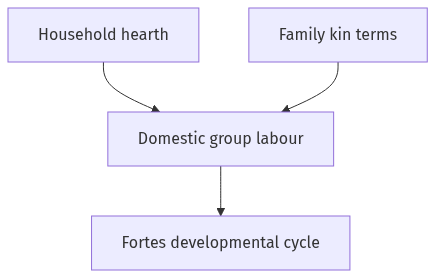
Household names common residence and consumption. Domestic group names who actually cooks, earns, and cares. Fortes showed the house as a cycle, not a fixed type. Goody split production from reproduction. Indian ghar studies include people the nuclear form leaves out.
Model answer
Copper italics in this answer — like this — are the key facts. Each one is unpacked in the Facts & figures rail.
Introduction
A household is a unit of common residence and consumption. A domestic group is the set of people who run that everyday economy. They are close, but they are not the same as a family or a lineage.
Body
Distinctions
- Meyer Fortes treated the domestic group as a developmental cycle: a house expands and splits as children marry.
- Jack Goody separated production, consumption, and reproduction. A joint kitchen may feed people who belong to different lineages.
- Leela Dube and Indian village studies showed that a ghar can include servants, widows, and visiting kin whom a census ‘family’ misses.
Why it matters
- Nayar taravad, Nuer cattle camps, and urban one-room rentals all break the nuclear-family default.
- Policy that counts only the married couple undercounts care and labour.
Flow diagram
Conclusion
Household is residence-plus-hearth. Domestic group is the changing labour unit around that hearth. Family and clan are other maps.
Quick related
Students also ask
-
Marriage Regulations and Alliance Theory
Next question on this syllabus topic (2021 · Q1(b)). View answer →
-
Is a joint family a household?
It may be several hearths in one compound. Count kitchens and purses, not only surnames.
-
Can a household have one person?
Yes. A solitary hearth is still a household in the residence sense.
Same topic · past papers
UPSC has asked this before
These previous-year questions sit on the same topic. Open one to practise the earlier ask.
-
2024 · Q7(c) · Anthropology GS 1 · 15 marks
Discuss the applicability of various sampling techniques in selecting the study group. -
2022 · Q8(b) · Anthropology GS 1 · 15 marks
What do you understand by blood group systems? How is HLA system different from those based on red cell antigens? -
2016 · Q5(a) · Anthropology GS 1 · 10 marks
Rh-Blood Group
More from this topic
Q8(c) · UPSC Mains 2026 · Anthropology GS 1 · 20 marks · Solution
Discuss, with appropriate examples, how basic personality types may contribute towards building up of national character
Family
National character studies link childhood socialisation to a modal personality that shapes wider culture. Kardiner and Linton argued that primary institutions mould a basic personality type, which feeds secondary institutions. Benedict's Japan work (shame culture) and Mead's American individualism are classic culture-at-a-distance examples. The idea helps explain wartime morale and cultural style but risks homogenising a nation and recycling stereotypes. Modern anthropology treats national character as heuristic, not a fixed type for every citizen.
Q5(c) · UPSC Mains 2026 · Anthropology GS 1 · 10 marks · Solution
Feminist movement and family.
Family
* Feminists redefined the family from a natural, harmonious unit to a primary site of gender hierarchy and power struggles. * Early theorists like Friedan and Millett critiqued how the patriarchal nuclear model confines women strictly to the private sphere. * Marxist and radical feminists exposed how unpaid domestic labor and caregiving economically trap women and sustain capitalism. * Hochschild’s 'second shift' revealed that employed women still carry the disproportionate weight of household chores. * Feminist advocacy drives policy shifts toward shared parental leave and more balanced intra-household decision-making. * Critiques have normalized diverse family structures, including single-parent households, cohabitation, and same-sex unions. * Legal reforms in marriage, divorce, and property rights now better protect individual autonomy.
Q7(a) · UPSC Mains 2025 · Anthropology GS 1 · 20 marks · Solution
How the study of variation in forms of marriage led to rethinking on the concepts of social reproduction, kinship and family?
Family
Marriage forms include woman-marriage, ghost marriage, polyandry, visiting unions, same-sex marriage and medically assisted parenthood. Evans-Pritchard’s Nuer and Nayar ethnography already split sex, residence and legitimacy. Schneider and Strathern treated kinship as cultural assignment, not bare biology. Family is not universally the Parsons nuclear unit. Social reproduction is how children, labour and status are placed across generations, as Engels and later feminist anthropologists argued. Living examples include IVF, surrogacy debates and chosen families.