
Revision summary
Urbanization combines population concentration with urban occupations and institutions. Housing and mobility favour smaller households, delayed marriage and lower fertility. Desai distinguishes residence from jointness; Shah highlights the household developmental cycle. Indian families may be residentially nuclear but functionally joint through property, care, ritual and remittance. Women’s paid work can increase autonomy while adding a domestic double burden. Class, caste and migration diversify outcomes, so urbanization does not mechanically destroy the joint family.
Model answer
Copper italics in this answer — like this — are the key facts. Each one is unpacked in the Facts & figures rail.
Introduction
Urbanization is the increasing concentration of population in towns and cities together with the spread of urban occupations, institutions and ways of life. Louis Wirth stressed size, density and heterogeneity; Indian evidence shows that these conditions reorganise family residence and authority without automatically dissolving kinship.
Body
Structural changes
Migration, expensive housing and occupational mobility encourage smaller residential units, delayed marriage and neolocal households. Fertility falls and education lengthens dependence of children. Inter-caste, inter-regional and companionate marriages become more visible, although arranged marriage and caste-matrimonial networks adapt through education, apps and diaspora connections.
The census household must not be confused with the family. A. M. Shah showed that household dimensions expand and contract through a developmental cycle. I. P. Desai’s studies distinguished co-residence from jointness: brothers in different cities may retain shared property, ritual obligations, remittances and decision-making. Urbanization often produces a functionally joint, residentially nuclear family.
Functional and relational changes
- Production moves out of the household, while family remains a unit of consumption, care, inheritance and social capital.
- Women’s education and paid work can increase bargaining power and challenge patriarchal authority, but unpaid domestic work creates a double burden. Feminist movements also make violence and marital rights publicly contestable.
- Children gain school and peer influence; authority becomes more negotiated. At the same time, coaching, housing and employment often intensify parental investment.
- Longer life expectancy and migration create old-age care gaps. Multigenerational homes, paid carers and digital contact are new combinations rather than one replacement form.
- Urban poor and migrant families may be split across village and city. Slum housing can force dense extended residence, while circular migrants depend heavily on rural kin.
M. S. A. Rao emphasised networks and social organisation in Indian urban anthropology; M. N. Srinivas’s ideas of Westernisation and Sanskritisation also show that urban change is mediated by caste and aspiration. Caste associations, regional hostels and neighbourhood communities can strengthen kin-like support in cities.
Critical assessment
Class, caste, religion, gender and city size produce multiple urban family forms. The idealised rural joint family was never universal, and the isolated Western nuclear family is not the inevitable destination. New autonomy may coexist with surveillance, dowry, elder dependence and digital kinship.
Flow diagram
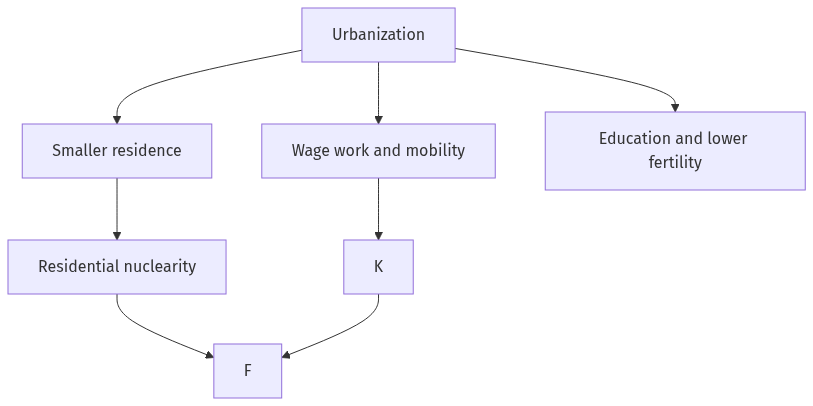
Conclusion
Urbanization changes where families live, who earns, when people marry and how care is negotiated. Its dominant effect is diversification and networked jointness, not a simple march from joint to nuclear. Indian families remain adaptive institutions inside unequal cities.
Quick related
Students also ask
-
Discuss the role of marriage regulations in traditional societies in India for strengthening social solidarity.
Next question on this syllabus topic (2023 · Q4(a)). View answer →
-
Does a nuclear household prove family individualisation?
No. It may still share property, care, ritual duties, marriage decisions and money with an extended kin network.
-
Has urbanization empowered women uniformly?
No. Education and income can improve bargaining power, while insecure work, unpaid care and patriarchal violence may persist or take new forms.
Same topic · past papers
UPSC has asked this before
These previous-year questions sit on the same topic. Open one to practise the earlier ask.
-
2016 · Q2(b) · Anthropology GS 1 · 15 marks
Discuss the impact of urbanization and feminist movements on family in India.
More from this topic
Q8(c) · UPSC Mains 2026 · Anthropology GS 1 · 20 marks · Solution
Discuss, with appropriate examples, how basic personality types may contribute towards building up of national character
Family
National character studies link childhood socialisation to a modal personality that shapes wider culture. Kardiner and Linton argued that primary institutions mould a basic personality type, which feeds secondary institutions. Benedict's Japan work (shame culture) and Mead's American individualism are classic culture-at-a-distance examples. The idea helps explain wartime morale and cultural style but risks homogenising a nation and recycling stereotypes. Modern anthropology treats national character as heuristic, not a fixed type for every citizen.
Q5(c) · UPSC Mains 2026 · Anthropology GS 1 · 10 marks · Solution
Feminist movement and family.
Family
* Feminists redefined the family from a natural, harmonious unit to a primary site of gender hierarchy and power struggles. * Early theorists like Friedan and Millett critiqued how the patriarchal nuclear model confines women strictly to the private sphere. * Marxist and radical feminists exposed how unpaid domestic labor and caregiving economically trap women and sustain capitalism. * Hochschild’s 'second shift' revealed that employed women still carry the disproportionate weight of household chores. * Feminist advocacy drives policy shifts toward shared parental leave and more balanced intra-household decision-making. * Critiques have normalized diverse family structures, including single-parent households, cohabitation, and same-sex unions. * Legal reforms in marriage, divorce, and property rights now better protect individual autonomy.
Q7(a) · UPSC Mains 2025 · Anthropology GS 1 · 20 marks · Solution
How the study of variation in forms of marriage led to rethinking on the concepts of social reproduction, kinship and family?
Family
Marriage forms include woman-marriage, ghost marriage, polyandry, visiting unions, same-sex marriage and medically assisted parenthood. Evans-Pritchard’s Nuer and Nayar ethnography already split sex, residence and legitimacy. Schneider and Strathern treated kinship as cultural assignment, not bare biology. Family is not universally the Parsons nuclear unit. Social reproduction is how children, labour and status are placed across generations, as Engels and later feminist anthropologists argued. Living examples include IVF, surrogacy debates and chosen families.