
Revision summary
Marriage forms include woman-marriage, ghost marriage, polyandry, visiting unions, same-sex marriage and medically assisted parenthood. Evans-Pritchard’s Nuer and Nayar ethnography already split sex, residence and legitimacy. Schneider and Strathern treated kinship as cultural assignment, not bare biology. Family is not universally the Parsons nuclear unit. Social reproduction is how children, labour and status are placed across generations, as Engels and later feminist anthropologists argued. Living examples include IVF, surrogacy debates and chosen families.
Model answer
Copper italics in this answer — like this — are the key facts. Each one is unpacked in the Facts & figures rail.
Introduction
If marriage were only one man, one woman and their legitimate children, kinship would be a simple household chart. Ethnography found woman-marriage, ghost marriage, walking marriage, polyandry, same-sex unions and chosen families. That variation forced anthropology to reopen what kinship, family and social reproduction mean.
Body
Variation in marriage and rethinking of social reproduction, kinship and family
The cross-cultural study of marriage variations showed that marriage has no single universal form. Purum prescriptive marriage, Nayar visiting marriage, Mosuo walking marriage, and Nuer ghost marriage challenged biological assumptions and led anthropology to rethink social reproduction, kinship, and family.
I. Rethinking Social Reproduction: From Descent to Alliance
Social Reproduction: It refers to the processes through which a society reproduces itself across generations by ensuring the continuation of its population, kinship relations, cultural values, social roles and institutions.
- Descent Theory: A. R. Radcliffe-Brown and Meyer Fortes explained social reproduction mainly through descent groups such as lineages and clans, which maintained property, inheritance, authority, and continuity.
- Alliance Theory: Claude Lévi-Strauss challenged the primacy of descent and argued that societies reproduce themselves through marriage alliances and exchange between groups.
- Purum example: Example: Among the Purum of Manipur, five patrilineal sibs are linked through a fixed cycle of wife-giving and wife-taking.
- Incest taboo: Example: Lévi-Strauss viewed the incest taboo as promoting exogamy and exchange, making marriage a mechanism of reciprocity and alliance-building.
- Matrilineal problem: Audrey Richards showed that matrilineal societies may face tensions because descent passes through women while authority often rests with the maternal uncle.
II. Rethinking Kinship: From Biology to Social Construction
- Biological determinism: Earlier approaches treated kinship mainly as a map of biological descent and blood relationships. Marriage variations showed that biological and social relationships need not be identical.
- Decoupling Biology from Paternity: In the Nayar system of Kerala, Kathleen Gough documented Thalikettu Kalyanam and Sambandham. Visiting husbands did not necessarily form permanent households, while children remained primarily connected to the maternal group.
- Example: Among the Mosuo of China, the Zouhun (walking marriage) involves no permanent cohabitation, and children are raised within the maternal household, making biological paternity socially less important.
- Social and Fictive Paternity: Among the Nuer of Sudan, E. E. Evans-Pritchard documented ghost marriage and woman-woman marriage, showing that social fatherhood can be separated from biological fatherhood.
- Example: In a ghost marriage, a deceased childless man could socially receive children fathered by a living male relative, while in woman-woman marriage, a woman could assume the social role of husband and establish a family through a male reproductive partner.
- Genitor and Pater: These practices distinguish the genitor (biological father) from the pater (socially recognised father), showing that paternity is not always determined by biological descent.
- Culture of Relatedness: David Schneider’s groundbreaking study of the Yap of Micronesia showed that kinship is not rooted in biology but in social action—specifically, the acts of caring, sharing food, and working the land together. This led Janet Carsten to formulate the "Culture of Relatedness," demonstrating that even "blood" is culturally manufactured through co-residence and eating together from a common hearth, liberating kinship from its rigid genetic definitions
III. Rethinking Family: Beyond the Universal Nuclear Family
- Nuclear family model: George P. Murdock considered the nuclear family a universal institution performing functions such as reproduction, economic cooperation, and socialisation.
- Challenge to universality: Marriage variations demonstrated that cohabitation, resident husbands, and nuclear households are not universal requirements for family life.
- Nayar Taravad: Example: The Taravad is a matrilineal extended family organised around the maternal line, showing that family continuity does not require a resident husband-wife unit.
- Duolocal residence: Example: In duolocal marriage, spouses maintain separate residences within their respective maternal households. Leela Dube's work on Kalpeni illustrates this pattern.
- Matrifocal family: Example: Matrifocal households organise everyday family life around mothers and children, showing that a resident husband is not essential for family functioning.
- Household vs family: A. M. Shah, through his study of Radhvanaj village, distinguished the household as a residential/co-dining unit from the wider family, which can continue through economic, ritual, and moral ties across separate households.
IV. Feminist and Postmodern Rethinking
- Gender and power: Feminist anthropology showed that marriage and kinship are also institutions of gender, property, status, and power, rather than merely systems of biological reproduction.
- Seed and Earth: Example: Leela Dube's Bija-Kshetra metaphor explains how patrilineal ideology gives greater importance to the male “seed” while representing the woman as the “earth”.
- Marriage and social control: Example: Caste endogamy, female chastity, and restrictions on women's marriage choices can regulate inheritance, status, property, and group boundaries.
- Pure relationship: Anthony Giddens described the “pure relationship”, where modern relationships increasingly depend on emotional intimacy and personal satisfaction rather than only reproduction, property, or tradition.
- Liquid love: Zygmunt Bauman used “liquid love” to describe increasingly flexible and uncertain relationships marked by greater individual choice and weaker long-term commitment.
Flow diagram
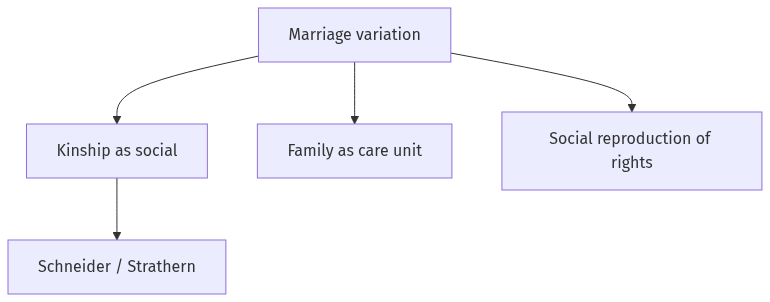
Conclusion
The cross-cultural study of marriage demonstrated that social reproduction, kinship, and family are not fixed biological destinies but flexible cultural institutions. From Purum alliance and Nayar visiting marriage to Nuer ghost marriage and modern relationships, anthropology shows that societies organise biological reproduction through diverse systems of descent, alliance, residence, gender, and social obligation. Thus, biology provides the capacity, but culture gives it social meaning and institutional form.
Quick related
Students also ask
-
Define urbanization and discuss its impact on family in India with examples.
Next question on this syllabus topic (2024 · Q3(b)). View answer →
-
Is this only about same-sex marriage?
No. Same-sex unions are one contemporary illustration. The theoretical file begins with Nuer, Nayar, polyandry and alliance theory.
-
What is social reproduction in one sentence?
The way a society replaces people, labour and legitimate status from one generation to the next, often organised through marriage and descent.
Same topic · past papers
UPSC has asked this before
These previous-year questions sit on the same topic. Open one to practise the earlier ask.
-
2025 · Q6(a) · Anthropology GS 1 · 20 marks
What are genetic markers? Discuss their applications in understanding population variation, disease association and forensics
More from this topic
Q8(c) · UPSC Mains 2026 · Anthropology GS 1 · 20 marks · Solution
Discuss, with appropriate examples, how basic personality types may contribute towards building up of national character
Family
National character studies link childhood socialisation to a modal personality that shapes wider culture. Kardiner and Linton argued that primary institutions mould a basic personality type, which feeds secondary institutions. Benedict's Japan work (shame culture) and Mead's American individualism are classic culture-at-a-distance examples. The idea helps explain wartime morale and cultural style but risks homogenising a nation and recycling stereotypes. Modern anthropology treats national character as heuristic, not a fixed type for every citizen.
Q5(c) · UPSC Mains 2026 · Anthropology GS 1 · 10 marks · Solution
Feminist movement and family.
Family
* Feminists redefined the family from a natural, harmonious unit to a primary site of gender hierarchy and power struggles. * Early theorists like Friedan and Millett critiqued how the patriarchal nuclear model confines women strictly to the private sphere. * Marxist and radical feminists exposed how unpaid domestic labor and caregiving economically trap women and sustain capitalism. * Hochschild’s 'second shift' revealed that employed women still carry the disproportionate weight of household chores. * Feminist advocacy drives policy shifts toward shared parental leave and more balanced intra-household decision-making. * Critiques have normalized diverse family structures, including single-parent households, cohabitation, and same-sex unions. * Legal reforms in marriage, divorce, and property rights now better protect individual autonomy.
Q3(b) · UPSC Mains 2024 · Anthropology GS 1 · 15 marks · Solution
Define urbanization and discuss its impact on family in India with examples.
Family
Urbanization combines population concentration with urban occupations and institutions. Housing and mobility favour smaller households, delayed marriage and lower fertility. Desai distinguishes residence from jointness; Shah highlights the household developmental cycle. Indian families may be residentially nuclear but functionally joint through property, care, ritual and remittance. Women’s paid work can increase autonomy while adding a domestic double burden. Class, caste and migration diversify outcomes, so urbanization does not mechanically destroy the joint family.