
Revision summary
Indian marriage rules combine caste endogamy with gotra and village exogamy. Karve mapped north–south differences, including Dravidian cross-cousin preference. Lévi-Strauss treats the rules as alliance that makes society. Dumont reads endogamy as the reproduction of hierarchy. Srinivas showed marriage as village politics and feast. Solidarity is group repair, including unequal hypergamy, not simple equality.
Model answer
Copper italics in this answer — like this — are the key facts. Each one is unpacked in the Facts & figures rail.
Introduction
Traditional Indian marriage is a set of rules about who may marry whom, and those rules build groups as much as they join spouses. Social solidarity here means the ties of caste, clan, village, and alliance that those rules keep in repair.
Body
The regulatory field
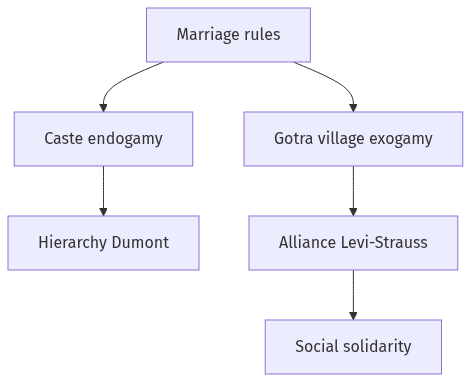
- Caste endogamy keeps occupation, ritual rank, and food rules inside a marriage circle, which Louis Dumont in Homo Hierarchicus treated as the reproduction of hierarchy.
- Clan and gotra exogamy, with sapinda limits, force a man to find a wife outside the closest patriline, so incest taboo becomes a positive rule of alliance.
- North Indian village exogamy and the four-clan rule, mapped by Irawati Karve in Kinship Organization in India, send women out and create a web of affines across villages.
- South Indian Dravidian rules, read by Thomas Trautmann and earlier by Karve, prefer cross-cousin marriage, which repeats alliance inside a known set of lineages rather than scattering brides as far as the north.
Solidarity through alliance
- Claude Lévi-Strauss argued that the incest taboo turns women into the first exchange, so marriage regulations create society as a system of groups, not as a pile of couples.
- North Indian hypergamy and kanyadana rank wife-givers below wife-takers, which is hierarchical solidarity, not equality, and still binds affines through gift and ritual.
- Repeated affinity, as in many south Indian and some tribal systems, makes mother’s brother a structural ally, which A. C. Mayer and village ethnography also found in practice.
- M. N. Srinivas showed that marriage feasts, factions, and village councils use these kin ties as the everyday staff of solidarity and conflict.
Other Indian patterns
- Muslim khandan and cousin preference, tribal bride-price systems of the middle Indian highlands, and polyandry in parts of the western Himalaya are other regulations, each making a different solidarity of property and labour.
- Verrier Elwin and later tribal ethnography recorded capture, service, and bride-price as lawful routes, still regulated, still about group reproduction.
- The joint household and patrilocality after marriage place the new wife under mother-in-law authority, which is domestic solidarity with a clear cost to the incoming woman.
Limits
- Solidarity for the caste or lineage can be exclusion for the Dalit, the widow, and the inter-caste couple.
- Émile Durkheim’s mechanical solidarity of likeness (endogamy) and organic solidarity of interdependence (alliance, jajmani, gift) both appear; the rules do both jobs.
- Contemporary law, court marriage, and live-in unions weaken some regulations without erasing caste endogamy in practice.
Flow diagram
Conclusion
Marriage regulations in traditional India organise endogamy and exogamy so that caste, clan, and village remain groups. Solidarity is the alliance and hierarchy those rules produce, not a romance of the couple, and it has always had a sharp edge of exclusion.
Quick related
Students also ask
-
Discuss how the rules of descent contradict the principles of residence in matrilineal society, mentioning suitable examples?
Next question on this syllabus topic (2022 · Q3(a)). View answer →
-
Do the same rules hold all over India?
No. North Indian village exogamy and south Indian cross-cousin preference are different alliance machines, as Karve showed.
-
Is solidarity the same as equality?
No. Hypergamy and caste endogamy bind groups while ranking them. Solidarity here is cohesion, not justice.
Same topic · past papers
UPSC has asked this before
These previous-year questions sit on the same topic. Open one to practise the earlier ask.
-
2021 · Q1(b) · Anthropology GS 1 · 10 marks
Marriage Regulations and Alliance Theory
More from this topic
Q8(c) · UPSC Mains 2026 · Anthropology GS 1 · 20 marks · Solution
Discuss, with appropriate examples, how basic personality types may contribute towards building up of national character
Family
National character studies link childhood socialisation to a modal personality that shapes wider culture. Kardiner and Linton argued that primary institutions mould a basic personality type, which feeds secondary institutions. Benedict's Japan work (shame culture) and Mead's American individualism are classic culture-at-a-distance examples. The idea helps explain wartime morale and cultural style but risks homogenising a nation and recycling stereotypes. Modern anthropology treats national character as heuristic, not a fixed type for every citizen.
Q5(c) · UPSC Mains 2026 · Anthropology GS 1 · 10 marks · Solution
Feminist movement and family.
Family
* Feminists redefined the family from a natural, harmonious unit to a primary site of gender hierarchy and power struggles. * Early theorists like Friedan and Millett critiqued how the patriarchal nuclear model confines women strictly to the private sphere. * Marxist and radical feminists exposed how unpaid domestic labor and caregiving economically trap women and sustain capitalism. * Hochschild’s 'second shift' revealed that employed women still carry the disproportionate weight of household chores. * Feminist advocacy drives policy shifts toward shared parental leave and more balanced intra-household decision-making. * Critiques have normalized diverse family structures, including single-parent households, cohabitation, and same-sex unions. * Legal reforms in marriage, divorce, and property rights now better protect individual autonomy.
Q7(a) · UPSC Mains 2025 · Anthropology GS 1 · 20 marks · Solution
How the study of variation in forms of marriage led to rethinking on the concepts of social reproduction, kinship and family?
Family
Marriage forms include woman-marriage, ghost marriage, polyandry, visiting unions, same-sex marriage and medically assisted parenthood. Evans-Pritchard’s Nuer and Nayar ethnography already split sex, residence and legitimacy. Schneider and Strathern treated kinship as cultural assignment, not bare biology. Family is not universally the Parsons nuclear unit. Social reproduction is how children, labour and status are placed across generations, as Engels and later feminist anthropologists argued. Living examples include IVF, surrogacy debates and chosen families.