
Revision summary
Foote’s handaxes opened the Indian palaeolithic. Soan choppers are often a raw-material or taphonomic problem, not a people. Hunsgi and Attirampakkam show Acheulian on local limestone and quartzite. Monsoon and stone, not Alpine glaciation, set the environmental frame. Use reduction sequences before importing European culture names.
Model answer
Copper italics in this answer — like this — are the key facts. Each one is unpacked in the Facts & figures rail.
Introduction
Indian palaeolithic tools were first sorted by European type-lists. Environment, raw stone, and local reduction sequences often refuse those labels.
Body
The typological problem
- Robert Bruce Foote at Pallavaram and Attirampakkam opened the Indian palaeolithic with handaxes. Later workers tried to fit Oldowan, Acheulian, and Mousterian names onto Indian assemblages.
- Many so-called chopper-chopping tools of the Soan, discussed by de Terra and Paterson, may be cores, river-rolled pieces, or raw-material expedients, not a separate culture.
- H. D. Sankalia, V. N. Misra, and K. Paddayya at Hunsgi–Baichbal showed that one landscape can yield Acheulian cleavers and simpler flakes from the same limestone.
Environment and technology
- Monsoon rivers, laterite, and Deccan basalt change what can be knapped. Quartzite at Attirampakkam holds bifaces; small chert nodules in central India favour flakes.
- Climate hypotheses that equate glacial Europe with Indian ‘cold’ stages do not travel. Indian Pleistocene is monsoon and arid pulse, as Attirampakkam dates now show a long Acheulian.
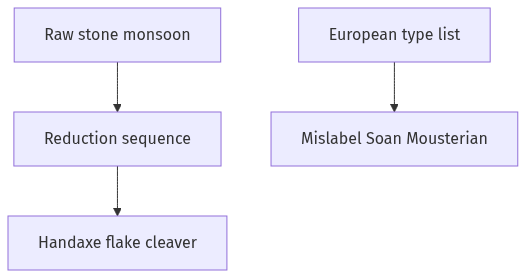
- Typo-technology should therefore start from reduction sequence and habitat, not from a forced match to St Acheul or Le Moustier.
Flow diagram
Conclusion
Indian palaeolithic industries are local answers to stone and monsoon. European type-names are a first sketch. They become a problem when they are treated as migrating tribes.
Quick related
Students also ask
-
Palaeolithic culture.
Next question on this syllabus topic (2015 · Q5(a)). View answer →
-
Did India have a true Mousterian?
Prepared-core flakes exist. Equating them with European Neanderthal Mousterian is the typological trap.
-
Why does environment matter to type?
Nodule size and hardness decide whether a biface is worth making. Climate also shifts which outcrops are open.
Same topic · past papers
UPSC has asked this before
These previous-year questions sit on the same topic. Open one to practise the earlier ask.
-
2026 · Q3(a) · Anthropology GS 1 · 20 marks
How do the concepts of power, authority, legitimacy and social control change with changing political organization? Discuss in detail giving suitable examples -
2026 · Q3(c) · Anthropology GS 1 · 15 marks
Numerical chromosomal aberrations can be due to abnormalities in autosomes as well as sex chromosomes. Elaborate in terms of the effects these have on human body, giving suitable examples -
2026 · Q6(a) · Anthropology GS 1 · 20 marks
How would you find out that a particular disease/disorder is inherited and, if so, in which manner? Elaborate with suitable examples -
2024 · Q6(b) · Anthropology GS 1 · 15 marks
Discuss the applications of forensic anthropology with suitable examples. -
2023 · Q2(c) · Anthropology GS 1 · 15 marks
Elucidate the different forms of malnutrition. Describe protein-calorie malnutrition with suitable examples.
More from this topic
Q4(b) · UPSC Mains 2026 · Anthropology GS 1 · 15 marks · Solution
Give the distribution of Palaeolithic sites around the Himalayan and Sub-Himalayan areas, highlighting the typo-technologies of the tools
Paleolithic
• Concentrated primarily in the Siwalik Hills, Kashmir valley, and Potwar Plateau along river terraces and intermontane valleys. • Key geographical locations include Chaontra, Toka, and the Soan, Beas, and Banganga river valleys. • Lower Palaeolithic features the Soanian pebble tool tradition with quartzite choppers, chopping tools, and crude flakes. • Middle Palaeolithic exhibits a shift to flake industries using prepared-core techniques like Levalloisian methods for scrapers and points. • Upper Palaeolithic is marked by advanced blade and burin industries reflecting specialized stone-working techniques. • Sites reflect hominin adaptations to altitudinal gradients and fluctuating Pleistocene climatic conditions in mountain-fringe zones.
Q1(c) · UPSC Mains 2025 · Anthropology GS 1 · 10 marks · Solution
Osteodontokeratik culture and its makers.
Paleolithic
Osteodontokeratic means a supposed bone–tooth–horn culture named by Raymond Dart at Makapansgat. The claimed makers were Australopithecus prometheus, now placed in Australopithecus africanus. Dart read clubs, saws and daggers from antelope parts, and inferred hunting and violence. C. K. Brain showed that leopards, hyenas and cave processes explain much of the assemblage. The idea survives as a taphonomy lesson, not as a real industry. Osteodontokeratic is defined by site, claimed maker, and the later critique.
Q4(b) · UPSC Mains 2024 · Anthropology GS 1 · 15 marks · Solution
Discuss the Acheulian and Oldowan traditions of Indian Paleolithic cultures with suitable illustrations.
Paleolithic
Oldowan/Mode 1 uses simple cores and sharp flakes; Acheulian/Mode 2 adds shaped large cutting tools. Indian Acheulian is rich in handaxes, cleavers and picks, often made on large quartzite flakes. Foote discovered a handaxe at Pallavaram in 1863. Attirampakkam has Acheulian occupation around 1.5 million years ago; Isampur preserves quarry-workshop behaviour. Riwat, Bori and Masol figure in early Mode 1 debates, but context and dating are contested. Soanian is not automatically Oldowan, and tools alone cannot identify the hominin maker.