
Revision summary
Oldowan/Mode 1 uses simple cores and sharp flakes; Acheulian/Mode 2 adds shaped large cutting tools. Indian Acheulian is rich in handaxes, cleavers and picks, often made on large quartzite flakes. Foote discovered a handaxe at Pallavaram in 1863. Attirampakkam has Acheulian occupation around 1.5 million years ago; Isampur preserves quarry-workshop behaviour. Riwat, Bori and Masol figure in early Mode 1 debates, but context and dating are contested. Soanian is not automatically Oldowan, and tools alone cannot identify the hominin maker.
Model answer
Copper italics in this answer — like this — are the key facts. Each one is unpacked in the Facts & figures rail.
Introduction
Oldowan and Acheulian name two Lower Palaeolithic technological organisations, not two fixed ethnic cultures. Oldowan or Mode 1 centres on flakes struck from simple cores; Acheulian or Mode 2 adds deliberately shaped large cutting tools. India has a rich Acheulian record, while claims for very early Oldowan-equivalent occupation are less secure.
Body
Oldowan or Mode 1
The African Oldowan begins about 2.6 million years ago and includes cores, choppers, polyhedrons, hammerstones and sharp flakes produced by direct hard-hammer percussion. The flake edge was often the principal tool; “crude chopper culture” understates planning and raw-material selection.
In South Asia, simple core-and-flake or pebble industries occur in Siwalik and peninsular contexts. Riwat and the Pabbi Hills in present-day Pakistan, Bori in Maharashtra and Masol in the Chandigarh Siwaliks have yielded claims of very early occupation, but artefact status, context or dating is disputed in important cases. The Soanian of the north-west is pebble-and-flake based, yet much of it is younger and should not automatically be equated with African Oldowan.
Acheulian or Mode 2 in India
Acheulian knappers prepared large flakes or cobbles into bifacial handaxes, cleavers and picks, with symmetry and edge maintenance. Indian assemblages often emphasise cleavers on large flakes. Quartzite is common, but limestone, dolerite and other local stones were used.
Robert Bruce Foote’s 1863 handaxe discovery at Pallavaram founded Indian prehistory and produced the old term “Madrasian”. Major localities include:
- Attirampakkam in Tamil Nadu, where cosmogenic burial dating places Acheulian occupation around 1.5 million years ago;
- the Hunsgi–Baichbal valley and Isampur quarry-workshop in Karnataka, showing raw-material procurement and manufacture;
- Bhimbetka, Didwana, the Narmada valley, Chirki-Nevasa and other riverine landscapes.
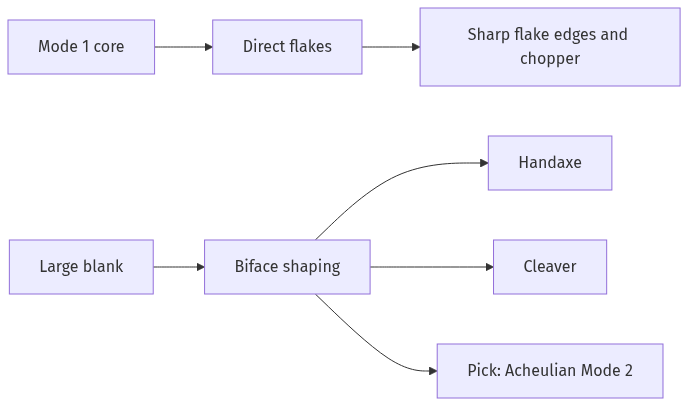
- Technological illustration: Mode 1 removes a few flakes from a core; Mode 2 first conceives a large blank, shapes both faces and regularises a durable cutting edge. Later Acheulian assemblages may become thinner and more symmetrical, but variation also reflects stone and task.
Interpretation and limits
Early Indian Acheulian implies rapid hominin dispersal across suitable corridors, probably by Homo erectus or related populations, but tools cannot name a species. India lacks maker fossils securely associated with these assemblages; the Narmada hominin is much later and taxonomically debated. Surface collections can mix periods, and absence of handaxes does not by itself prove an Oldowan age.
Flow diagram
Conclusion
India’s firm Lower Palaeolithic signature is a widespread, technologically varied Acheulian anchored by Attirampakkam and quarry-workshops such as Isampur. Mode 1 evidence exists, but its earliest claims require stratigraphic caution. Technology, context and dating—not apparent crudeness—must carry the classification.
Quick related
Students also ask
-
Discuss the Paleolithic environment in light of available evidences with special reference to India.
Next question on this syllabus topic (2023 · Q2(b)). View answer →
-
Is every chopper assemblage Oldowan?
No. Core form alone is insufficient; stratigraphy, dating, reduction sequence and the full assemblage must support Mode 1 classification.
-
What is the clearest distinction in a diagram?
Mode 1 primarily obtains usable flakes from a core; Mode 2 deliberately shapes a large blank on two faces into a handaxe, cleaver or pick.
Same topic · past papers
UPSC has asked this before
These previous-year questions sit on the same topic. Open one to practise the earlier ask.
-
2023 · Q3(a) · Anthropology GS 1 · 20 marks
What is hominization process? Discuss the major trends in human evolution with the help of suitable examples and illustrations.
More from this topic
Q4(b) · UPSC Mains 2026 · Anthropology GS 1 · 15 marks · Solution
Give the distribution of Palaeolithic sites around the Himalayan and Sub-Himalayan areas, highlighting the typo-technologies of the tools
Paleolithic
• Concentrated primarily in the Siwalik Hills, Kashmir valley, and Potwar Plateau along river terraces and intermontane valleys. • Key geographical locations include Chaontra, Toka, and the Soan, Beas, and Banganga river valleys. • Lower Palaeolithic features the Soanian pebble tool tradition with quartzite choppers, chopping tools, and crude flakes. • Middle Palaeolithic exhibits a shift to flake industries using prepared-core techniques like Levalloisian methods for scrapers and points. • Upper Palaeolithic is marked by advanced blade and burin industries reflecting specialized stone-working techniques. • Sites reflect hominin adaptations to altitudinal gradients and fluctuating Pleistocene climatic conditions in mountain-fringe zones.
Q1(c) · UPSC Mains 2025 · Anthropology GS 1 · 10 marks · Solution
Osteodontokeratik culture and its makers.
Paleolithic
Osteodontokeratic means a supposed bone–tooth–horn culture named by Raymond Dart at Makapansgat. The claimed makers were Australopithecus prometheus, now placed in Australopithecus africanus. Dart read clubs, saws and daggers from antelope parts, and inferred hunting and violence. C. K. Brain showed that leopards, hyenas and cave processes explain much of the assemblage. The idea survives as a taphonomy lesson, not as a real industry. Osteodontokeratic is defined by site, claimed maker, and the later critique.
Q2(b) · UPSC Mains 2023 · Anthropology GS 1 · 15 marks · Solution
Discuss the Paleolithic environment in light of available evidences with special reference to India.
Paleolithic
India’s Paleolithic climate is monsoon and drought inside global Pleistocene cycles. Attirampakkam shows early Acheulian in the south. Hunsgi–Isampur show factory sites on limestone. Didwana records Thar palaeolakes and dunes. Hathnora places a hominin in Narmada river fauna. Toba ash at Jwalapuram is a marker whose demographic effect is debated. Bhimbetka and Son–Belan track later shelter and valley use.