
Revision summary
Articles 153–162 make the Governor the constitutional head of Uttar Pradesh. Ordinary executive acts follow the Council of Ministers under Article 163. Summoning the House, assent, mercy, and Article 356 reports are the main formal powers. In a 403-seat State, hung Houses have tested the office. The head remains constitutional only when discretion is exceptional.
Model answer
Introduction
The Governor of Uttar Pradesh is the constitutional head of the State under Articles 153 to 162. A comment must separate the formal head from the rare discretionary acts, especially in India’s most populous State.
Body
Constitutional position
- Article 153 provides a Governor for each State; Article 155 says the President appoints the Governor.
- Article 154 vests the executive power of the State in the Governor, but Article 163 binds that power, in ordinary cases, to aid and advice of the Council of Ministers headed by the Chief Minister.
- Article 161 is the mercy power; Article 174 is the power to summon, prorogue, and dissolve the Assembly; Article 200 is assent to bills, including reservation for the President.
- Article 356 reports from the Governor can open President’s Rule, which is the sharpest Union lever over Lucknow.
Comment on the UP office
- As constitutional head, the Governor at Raj Bhavan, Lucknow, represents the Union, receives the budget, and installs a ministry after a hung House.
- In a State of 403 Assembly seats, government formation, floor tests, and bill reservation have often made the office politically visible.
- The Supreme Court’s advice-on-aid line means the Governor is not a parallel Chief Minister; discretion is the exception for hung verdicts, floor tests, and some bill files.
Limit
- If the Governor delays bills or picks a ministry without a clear majority, the office stops looking like a constitutional head and starts looking like a political actor.
Flow diagram
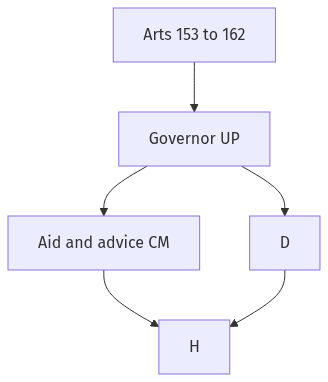
Conclusion
The Governor of Uttar Pradesh is the constitutional head under Articles 153–162, acting on ministerial advice in ordinary work. The comment is that the office stays legitimate only when discretion is rare and the floor of the House, not Raj Bhavan, decides government.
Quick related
Students also ask
-
Discuss the jurisdiction of Allahabad High Court and its role in upholding Constitutional values.
Next question in the 2025 paper (Q6). View answer →
-
Does the Governor run the UP government day to day?
No. Article 163 puts ordinary executive power with ministers responsible to the Assembly.
-
When is discretion real?
Hung Assemblies, choice of a Chief Minister to prove majority, some bill files, and reports under Article 356.
Same topic · past papers
UPPSC has asked this before
These previous-year questions sit on the same topic. Open one to practise the earlier ask.
-
2025 · Q15 · UPGS5 · 12 marks
Describe the Constitutional provisions related to Centre-State relations in Indian Constitution and throw light on its relevance in the context of Uttar Pradesh. -
2025 · Q6 · UPGS5 · 8 marks
Discuss the jurisdiction of Allahabad High Court and its role in upholding Constitutional values.
More from this paper
Q1 · UPSC Mains 2025 · UPGS5 · 8 marks · Solution
Describe the cultural significance of 'Ayodhya' on the basis of ancient literature.
UP history, civilisation and culture
The Ramayana makes Ayodhya the Kosalan capital of Rama. The Skanda Purana’s Ayodhya Mahatmya places it among the moksha-puris. Buddhist texts remember Saketa, and Jain books remember Tirthankara births at Vinita or Saketa. Together these books give Ayodhya its lasting cultural weight in Uttar Pradesh.
Q2 · UPSC Mains 2025 · UPGS5 · 8 marks · Solution
Agra's Indo-Islamic architecture has a blend of Indian, Persian and Islamic styles. Comment.
UP history, civilisation and culture
Agra’s Mughal buildings mix Indian craft, Persian gardens, and Islamic tombs. Agra Fort shows Akbar’s sandstone and Shah Jahan’s marble in one complex. The Taj Mahal is a Persian garden-tomb built by Indian workshops. Itimad-ud-Daulah is an early white-marble inlay tomb in Agra.
Q3 · UPSC Mains 2025 · UPGS5 · 8 marks · Solution
Discuss in short the contribution of Arya Samaj in education of Uttar Pradesh.
Health and education in UP
Arya Samaj treated Vedic and modern schooling as one programme in the United Provinces. DAV schools and colleges became the main urban chain. Gurukul Kangri and kanya gurukuls modelled residential and girls’ education. Hindi as a medium was a lasting Samaj mark in Uttar Pradesh. The spread was stronger in the west than in Purvanchal.