
Revision summary
Social media is internet platforms for user content and networks. In UP, forwarded rumour and deepfakes can become communal riots. Encrypted apps have been used for extremist propaganda and logistics. Cyber fraud and SIM farms from some UP towns fund wider crime. Police cells and the IT Act respond, but lawful speech must stay open.
Model answer
Introduction
Social media is a set of internet platforms on which users publish, share, and network in real time. A definition is not enough; the answer must name internal-security threats as they appear in Uttar Pradesh.
Body
Definition
- Social media includes apps and sites such as WhatsApp, Facebook, YouTube, Instagram, X, ShareChat, and similar tools where content is user-made and rapidly forwarded.
- The security problem is speed plus anonymity: a rumour can cross a district before the police statement does.
Threats, with UP reference
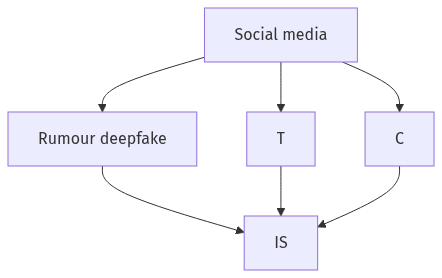
- Communal rumour and deepfake video have been used to inflame towns in western and other parts of UP, where dense settlement and mixed mohallas make a forwarded clip a law-and-order event.
- Terror and extremist modules have used encrypted chat for propaganda, recruitment, and logistics, including transit along the Nepal border districts.
- Organised cyber fraud, SIM farms, and investment scams run from UP towns target bank accounts nationwide and finance other crime.
- Mob mobilisation over cow slaughter rumours, exam leaks, or protest calls can shut highways and overwhelm local thanas.
- Child sexual content, trafficking ads, and radicalisation of isolated youth are quieter threats that still wound internal security.
State response
- UP Police social-media cells, the IT Act, and the UAPA sit beside ordinary IPC offences; the lasting task is fast fact-check without choking lawful speech.
Flow diagram
Conclusion
Social media is user-driven internet networking. In Uttar Pradesh it has generated communal rumour, extremist chat, cyber fraud, and flash mobs, which makes it an internal-security problem as well as a public platform.
Quick related
Students also ask
-
Underline the main challenges pertaining to health in rural areas of Uttar Pradesh in the light of latest rural health data.
Next question in the 2025 paper (Q9). View answer →
-
Is social media itself illegal?
No. The threat is misuse: rumour, fraud, and extremist organisation, not ordinary political speech.
-
Why is UP specially exposed?
Very large population, high WhatsApp use, mixed towns, and a long open border raise the speed of a viral lie.
Same topic · past papers
UPPSC has asked this before
These previous-year questions sit on the same topic. Open one to practise the earlier ask.
-
2023 · Q7 · UPGS5 · 8 marks
Identify the sites related to Harappan Civilization in Uttar Pradesh.
More from this paper
Q1 · UPSC Mains 2025 · UPGS5 · 8 marks · Solution
Describe the cultural significance of 'Ayodhya' on the basis of ancient literature.
UP history, civilisation and culture
The Ramayana makes Ayodhya the Kosalan capital of Rama. The Skanda Purana’s Ayodhya Mahatmya places it among the moksha-puris. Buddhist texts remember Saketa, and Jain books remember Tirthankara births at Vinita or Saketa. Together these books give Ayodhya its lasting cultural weight in Uttar Pradesh.
Q2 · UPSC Mains 2025 · UPGS5 · 8 marks · Solution
Agra's Indo-Islamic architecture has a blend of Indian, Persian and Islamic styles. Comment.
UP history, civilisation and culture
Agra’s Mughal buildings mix Indian craft, Persian gardens, and Islamic tombs. Agra Fort shows Akbar’s sandstone and Shah Jahan’s marble in one complex. The Taj Mahal is a Persian garden-tomb built by Indian workshops. Itimad-ud-Daulah is an early white-marble inlay tomb in Agra.
Q3 · UPSC Mains 2025 · UPGS5 · 8 marks · Solution
Discuss in short the contribution of Arya Samaj in education of Uttar Pradesh.
Health and education in UP
Arya Samaj treated Vedic and modern schooling as one programme in the United Provinces. DAV schools and colleges became the main urban chain. Gurukul Kangri and kanya gurukuls modelled residential and girls’ education. Hindi as a medium was a lasting Samaj mark in Uttar Pradesh. The spread was stronger in the west than in Purvanchal.