
Revision summary
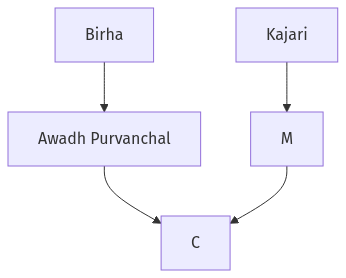
Birha is a viraha song of Awadh and Purvanchal, historically strong among herders. Kajari is a Sawan monsoon song of Mirzapur, Banaras, and Bundelkhand. Both still work at fairs, marriages, and night gatherings. Birha satires social life; kajari voices women’s monsoon waiting. They map two inner regions of Uttar Pradesh in sound.
Model answer
Introduction
Birha and Kajari are living folk songs of Uttar Pradesh, not museum pieces. Their significance is that they still mark work, monsoon, and separation in Awadh, Purvanchal, Mirzapur, and Bundelkhand.
Body
Birha
- Birha, from viraha, is the song of separation, traditionally strong among Ahir-Yadav herders of Awadh and eastern Uttar Pradesh.
- Khari and other birha forms use a lead singer and chorus, often with nagara or dholak, at night gatherings and fairs.
- The lyric carries cattle routes, caste honour, love, and social satire, so it is a rural newspaper as well as a melody.
- Singers such as Hiralal Yadav took birha from the village akhara onto the public stage without dropping the Purvanchal tongue.
Kajari
- Kajari or Kajali is a monsoon song of Sawan, strongest in the Mirzapur–Banaras belt and also heard in Bundelkhand.
- Women singing on swings, clouds, and absent husbands make kajari the seasonal voice of waiting and of the eastern plateau.
- Mirzapur kajari is the named local school; Banaras gharana thumri also absorbed kajri as a light-classical cousin.
- Temple and radio kept the form public after harvest labour declined in some blocks.
Significance in cultural life
- Together the two genres map UP’s inner cultural geography: birha for Awadh–Purvanchal herding plains, kajari for Mirzapur–Bundelkhand rains.
- They teach language, gender roles, and season without school, which is why they remain central to cultural life even when pop music competes.
- Festivals, marriages, and political rallies still borrow their tunes, so folk song here is civic as well as domestic.
Flow diagram
Conclusion
Birha holds Awadh and Purvanchal together through songs of viraha and herd life; Kajari holds Mirzapur and Bundelkhand together through Sawan. Their significance in UP cultural life is that they still organise season and belonging in the vernacular.
Quick related
Students also ask
-
Describe the Constitutional provisions related to Centre-State relations in Indian Constitution and throw light on its relevance in the context of Uttar Pradesh.
Next question in the 2025 paper (Q15). View answer →
-
Are birha and kajari the same song?
No. Birha is mainly a plains viraha-and-narrative form of Awadh–Purvanchal. Kajari is a monsoon lyric of Mirzapur–Bundelkhand.
-
Do they still matter in daily culture?
Yes. They are sung at fairs, Sawan, and marriages, and their tunes are reused on radio and in politics.
Same topic · past papers
UPPSC has asked this before
These previous-year questions sit on the same topic. Open one to practise the earlier ask.
-
2025 · Q4 · UPGS5 · 8 marks
Elucidate the cultural significance of literature and music in day-to-day life of people of Uttar Pradesh. -
2025 · Q1 · UPGS5 · 8 marks
Describe the cultural significance of 'Ayodhya' on the basis of ancient literature. -
2024 · Q1 · UPGS5 · 8 marks
Describe the cultural significance of 'Prayagraj' in ancient India.
More from this paper
Q1 · UPSC Mains 2025 · UPGS5 · 8 marks · Solution
Describe the cultural significance of 'Ayodhya' on the basis of ancient literature.
UP history, civilisation and culture
The Ramayana makes Ayodhya the Kosalan capital of Rama. The Skanda Purana’s Ayodhya Mahatmya places it among the moksha-puris. Buddhist texts remember Saketa, and Jain books remember Tirthankara births at Vinita or Saketa. Together these books give Ayodhya its lasting cultural weight in Uttar Pradesh.
Q2 · UPSC Mains 2025 · UPGS5 · 8 marks · Solution
Agra's Indo-Islamic architecture has a blend of Indian, Persian and Islamic styles. Comment.
UP history, civilisation and culture
Agra’s Mughal buildings mix Indian craft, Persian gardens, and Islamic tombs. Agra Fort shows Akbar’s sandstone and Shah Jahan’s marble in one complex. The Taj Mahal is a Persian garden-tomb built by Indian workshops. Itimad-ud-Daulah is an early white-marble inlay tomb in Agra.
Q3 · UPSC Mains 2025 · UPGS5 · 8 marks · Solution
Discuss in short the contribution of Arya Samaj in education of Uttar Pradesh.
Health and education in UP
Arya Samaj treated Vedic and modern schooling as one programme in the United Provinces. DAV schools and colleges became the main urban chain. Gurukul Kangri and kanya gurukuls modelled residential and girls’ education. Hindi as a medium was a lasting Samaj mark in Uttar Pradesh. The spread was stronger in the west than in Purvanchal.