
Revision summary
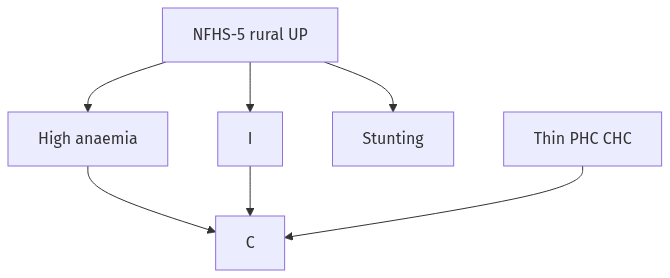
NFHS-5 is still the latest full comparable survey for rural UP. IMR improved but remained above the national average. Anaemia is high in women and very high in young children. Stunting is still near two in five children under five. Institutional birth rose; facility quality and staff gaps remain. Do not treat unpublished 2025 survey decimals as official.
Model answer
Introduction
NFHS-5 (2019–21) remains the latest comparable statewide snapshot for rural Uttar Pradesh. A 2025 answer should use those round facts and not invent unpublished 2025 rates.
Body
What the latest comparable data show
- Infant and neonatal mortality in UP improved on NFHS-4 but stayed clearly above the all-India average, so rural newborns remain the first challenge.
- Anaemia is high among women of reproductive age and among young children, in round terms affecting about half of women and a large majority of children under five.
- Child stunting still sits near two in five under-fives, which points to diet, infection, and care together, not only hospital beds.
- Institutional delivery and immunisation rose, yet quality of labour rooms, referral, and full immunisation in remote blocks is uneven.
System challenges behind the numbers
- Sub-centres, PHCs, and CHCs face doctor, specialist, and diagnostic gaps, so rural patients skip to private chemists or distant cities.
- High anaemia and maternal undernutrition sit with early marriage and many births in poorer districts, which NFHS-5 still flags.
- Water, sanitation, and indoor smoke add infection loads that no ASHA can cancel alone.
- Mental health, snakebite, and occupational injury are poorly counted in routine rural data.
Reading “latest” with care
- Sample Registration and HMIS updates after NFHS-5 show further movement, but they are not a full replacement survey; round NFHS-5 facts remain the honest base.
Flow diagram
Conclusion
Rural UP health, on NFHS-5 and later routine reports, is challenged by high anaemia, child undernutrition, an IMR still above the national line, and thin public facilities. The data improved, but they do not yet show a closed gap with India.
Quick related
Students also ask
-
Discuss innovation in the agricultural sector of Uttar Pradesh and analyze its impact on farmer's income and rural employment.
Next question in the 2025 paper (Q10). View answer →
-
Can we quote exact NFHS-5 percentages as 2025 data?
Quote them as NFHS-5 (2019–21). They are the latest full survey, not a new 2025 census of health.
-
Did rural UP health only worsen?
No. Institutional delivery and immunisation improved. Anaemia, stunting, and excess IMR remain the hard residue.
Same topic · past papers
UPPSC has asked this before
These previous-year questions sit on the same topic. Open one to practise the earlier ask.
-
2024 · Q14 · UPGS5 · 12 marks
Elucidate in detail the characteristics of major festivals and their socio-economic role in the rural areas of Uttar Pradesh. -
2024 · Q4 · UPGS5 · 8 marks
Critically explain the efforts of the State Government towards strengthening the health infrastructure in Uttar Pradesh. -
2023 · Q20 · UPGS5 · 12 marks
Examine state government’s efforts, initiatives and policy directions in the medical and healthcare sphere with reference to Uttar Pradesh Health Policy 2018.
More from this paper
Q1 · UPSC Mains 2025 · UPGS5 · 8 marks · Solution
Describe the cultural significance of 'Ayodhya' on the basis of ancient literature.
UP history, civilisation and culture
The Ramayana makes Ayodhya the Kosalan capital of Rama. The Skanda Purana’s Ayodhya Mahatmya places it among the moksha-puris. Buddhist texts remember Saketa, and Jain books remember Tirthankara births at Vinita or Saketa. Together these books give Ayodhya its lasting cultural weight in Uttar Pradesh.
Q2 · UPSC Mains 2025 · UPGS5 · 8 marks · Solution
Agra's Indo-Islamic architecture has a blend of Indian, Persian and Islamic styles. Comment.
UP history, civilisation and culture
Agra’s Mughal buildings mix Indian craft, Persian gardens, and Islamic tombs. Agra Fort shows Akbar’s sandstone and Shah Jahan’s marble in one complex. The Taj Mahal is a Persian garden-tomb built by Indian workshops. Itimad-ud-Daulah is an early white-marble inlay tomb in Agra.
Q3 · UPSC Mains 2025 · UPGS5 · 8 marks · Solution
Discuss in short the contribution of Arya Samaj in education of Uttar Pradesh.
Health and education in UP
Arya Samaj treated Vedic and modern schooling as one programme in the United Provinces. DAV schools and colleges became the main urban chain. Gurukul Kangri and kanya gurukuls modelled residential and girls’ education. Hindi as a medium was a lasting Samaj mark in Uttar Pradesh. The spread was stronger in the west than in Purvanchal.