
Revision summary
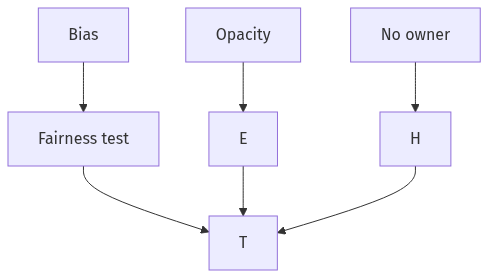
Digital tools can hide bias, a black box, and an empty chair when a citizen is denied. Bias often copies old inequality in training data. Opacity leaves both the claimant and the officer unable to explain a no. Accountability requires a named human owner of the order. Principles are legality, human review of high-stakes denial, fairness tests, plain appeal, data minimisation, open vendors, and redress.
Model answer
Introduction
Digital governance can speed a ration or a police list, and it can also hide a wrong in code. Bias, opacity, and no owner of the error are the three ethical failures that need principles, not only more software.
Body
The three problems
- Algorithmic bias is systematic skew: a credit, welfare, or policing model can punish a caste, gender, language, or neighbourhood because the training data already did.
- Opacity is the black box: a claimant cannot know why a portal said no, and often the officer cannot explain it either.
- Lack of accountability is the empty chair: vendor, department, and algorithm each point at the other when a widow loses a pension.
Harm in public office
- A facial mismatch at Aadhaar authentication can deny food without a human hearing.
- Predictive lists can stigmatise a locality as criminal without a charge.
- Automated moderation or targeting can silence a legitimate protest while leaving rumour untouched.
Guiding principles
- Legality first: no automated decision should exceed what statute allows a human officer to do.
- Human in the loop for high-stakes denial of life, liberty, livelihood, or reputation, with a spoken or written reason.
- Fairness by design: test models for disparate impact before scale, and keep a manual override that is itself audited.
- Explainability in plain language: the citizen gets the rule, the data used, and the appeal path, not a slogan about artificial intelligence.
- Data minimisation and purpose limitation, in line with the Digital Personal Data Protection Act, 2023.
- Public procurement transparency: the vendor, the training source, and the change log are on a file that RTI can reach, subject to lawful secrets.
- Audit and redress: independent technical audit, a named grievance officer, and compensation when the code was wrong.
- Dignity: no ranking of citizens as risk scores on a public wall.
Institutional habit
- The officer remains the moral owner of the order even when a screen suggested it.
- Digital India is a delivery tool; it is not a shield against Article 14 and Article 21.
Flow diagram
Conclusion
Bias, opacity, and no accountability are governance failures in code. The principles are law, a human hearing, fairness tests, plain reasons, data limits, open procurement, and a named owner of the error.
Quick related
Students also ask
-
Explain the 12 essential factors in ethical judgement. In case of ethical judgement being against the administrative decision, how would you harmonize them? Discuss with example.
Next question in the 2025 paper (Q13). View answer →
-
Does a portal error excuse the officer?
No. The order is still the State’s. The officer must offer a fallback hearing and record the system fault.
-
Should all algorithms be fully public?
Weights may be sensitive, but the rule, data categories, and appeal must be public enough for a citizen to contest a denial.
Same topic · past papers
UPPSC has asked this before
These previous-year questions sit on the same topic. Open one to practise the earlier ask.
More from this paper
Q1 · UPSC Mains 2025 · UPGS4 · 8 marks · Solution
Defining value; explain the distinctive features of human values and the role of the family in inculcating these values.
Civil Service aptitude and values
A value is a stable standard that guides worthy choice, not a passing mood. Human values are taught, claim universal worth, join conscience to conduct, and can be justified in public. The family is the first school of trust, empathy, and honour through daily example. A closed home can also plant prejudice, so the family’s power is not automatically ethical. Later schools and offices confirm or correct that first map.
Q2 · UPSC Mains 2025 · UPGS4 · 8 marks · Solution
Evaluate the contemporary relevance of Chanakya's life and thoughts in the context of ethical and people-centric governance.
Emotional Intelligence
Kautilya judges the ruler by the happiness and security of subjects. Yogakshema, a tested service, and honest accounts remain usable tests of ethical administration. Danda is lawful restraint of the strong, not personal cruelty. A democracy cannot import palace deceit; rights and publicity now bind the officer. The living lesson is welfare plus fiscal integrity under the Constitution.
Q3 · UPSC Mains 2025 · UPGS4 · 8 marks · Solution
Discuss the Aristotelian view of virtues and its application in administrative affairs.
Emotional Intelligence
Aristotle’s moral virtue is a stable habit of the mean, learned by practice. Courage, temperance, and justice are civic virtues an officer must show in files, not only in speech. Phronesis is practical wisdom that finds the right mean in a live case. Administration applies this as honest noting, fiscal restraint, and equal treatment. Office culture can train vice; example and rules can still rebuild the mean.