
Revision summary
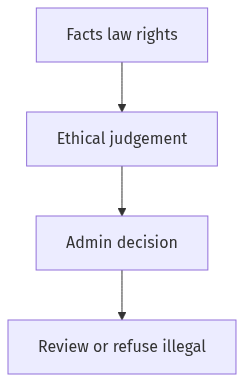
Ethical judgement uses twelve factors: facts, law, stakeholders, rights, consequences, justice, empathy, transparency, precedent, public interest, integrity, and courage. They stop a mood or a target from pretending to be a complete moral look. If a decision is illegal, the officer records and refuses the illegal part. If it is lawful but harsh, the officer seeks review, safeguards, and a less harmful lawful path. Harmonisation is a documented repair, not a silent private veto.
Model answer
Introduction
Ethical judgement is a structured look at a live case, not a mood. Twelve factors keep that look complete, and they also show how to repair a decision that has already gone wrong.
Body
Twelve factors
- Facts: what actually happened, including what is still unknown, so that rumour is not treated as a file.
- Law: the statute, rule, and binding court order that already frame the case.
- Stakeholders: who is helped or hurt, including those not in the room.
- Rights: fundamental and legal rights that cannot be bargained away as a convenience.
- Consequences: likely harm and benefit in the short and long run, including precedent for the next file.
- Justice: whether equals are treated equally and the worst-off are not used as a means.
- Empathy: the concrete experience of the weakest person affected, without replacing law with pity alone.
- Transparency: whether the reason can be shown to the citizen, the court, and the audit.
- Precedent: how similar cases were decided, so that today’s mercy is not tomorrow’s chaos.
- Public interest: the shared good, distinct from a loud faction or a minister’s impatience.
- Integrity: whether the officer’s private interest, gift, or fear is driving the pen.
- Courage: whether the right option is being avoided because it is costly to the career.
When ethical judgement is against the administrative decision
- First separate a truly illegal order from a lawful but harsh one.
- If the decision is illegal or unconstitutional, record dissent, ask for written orders, and refuse to implement the illegal part.
- If the decision is lawful but ethically poor, use review, stay within hierarchy, add safeguards, and propose a less harmful lawful alternative.
- Harmonisation is not a private veto; it is a documented attempt to bring the file back to rights, justice, and public interest.
- Example: a demolition notice that is legally served but timed before a festival and without rehabilitation can be paused for a hearing, shelter, and a speaking order, which keeps administration inside ethics.
- Example of refusal: an oral direction to register a false case must be declined; harmony here is law, not a compromise with the falsehood.
Flow diagram
Conclusion
The twelve factors force a complete look at facts, rights, and courage. When ethics and a live decision split, the officer documents, reviews, and, if needed, refuses the illegal piece rather than hiding the split.
Quick related
Students also ask
-
Can the "Right to Information (RTI) Act" be a moral basis for good governance? If so, does it create a moral dilemma regarding the protection of individual privacy? Evaluate.
Next question in the 2025 paper (Q14). View answer →
-
Must all twelve factors appear in every note?
In a short routine file some are light. In a rights-heavy file all twelve should be checked, even if only a few are written out.
-
Is harmonisation the same as obedience?
No. Harmony can mean correcting the decision. Blind obedience to an illegal order fails law and several of the twelve factors.
Same topic · past papers
UPPSC has asked this before
These previous-year questions sit on the same topic. Open one to practise the earlier ask.
More from this paper
Q1 · UPSC Mains 2025 · UPGS4 · 8 marks · Solution
Defining value; explain the distinctive features of human values and the role of the family in inculcating these values.
Civil Service aptitude and values
A value is a stable standard that guides worthy choice, not a passing mood. Human values are taught, claim universal worth, join conscience to conduct, and can be justified in public. The family is the first school of trust, empathy, and honour through daily example. A closed home can also plant prejudice, so the family’s power is not automatically ethical. Later schools and offices confirm or correct that first map.
Q2 · UPSC Mains 2025 · UPGS4 · 8 marks · Solution
Evaluate the contemporary relevance of Chanakya's life and thoughts in the context of ethical and people-centric governance.
Emotional Intelligence
Kautilya judges the ruler by the happiness and security of subjects. Yogakshema, a tested service, and honest accounts remain usable tests of ethical administration. Danda is lawful restraint of the strong, not personal cruelty. A democracy cannot import palace deceit; rights and publicity now bind the officer. The living lesson is welfare plus fiscal integrity under the Constitution.
Q3 · UPSC Mains 2025 · UPGS4 · 8 marks · Solution
Discuss the Aristotelian view of virtues and its application in administrative affairs.
Emotional Intelligence
Aristotle’s moral virtue is a stable habit of the mean, learned by practice. Courage, temperance, and justice are civic virtues an officer must show in files, not only in speech. Phronesis is practical wisdom that finds the right mean in a live case. Administration applies this as honest noting, fiscal restraint, and equal treatment. Office culture can train vice; example and rules can still rebuild the mean.