
Revision summary
The officer is both a parent and the district’s power, which is the core conflict. Social-media ethics here are truth, the child’s dignity, privacy of named minors, and due process. A calm correction of a forged clip can stop a hunt; naming alleged child perpetrators can become a public verdict. Silence can also harm if rumour turns violent. The better path is police and school process, recusal, and a nameless note about the fake clip.
Model answer
Introduction
The case is a district officer who answers a viral false video about his child by posting a named counter video. The ethics sit in the office’s power, the child’s dignity, and the public’s right to truth.
Body
(a) Ethical issues in social media use
- Truth versus speed: a counter video can correct a lie, and it can also freeze an untried accusation as a public verdict.
- Dignity of the child: repeating the bullying story, even to deny it, can re-traumatise an eleven-year-old and leave a permanent search trail.
- Privacy of the named children or parents: office power plus a public handle can look like the State branding minors as criminals.
- Conflict of interest: the officer is a parent and also the district’s coercive authority, so personal grief can look like official punishment.
- Impartiality: future files involving those families will be read as revenge unless the officer recuses from related inquiries.
- Due process: police and school processes exist; a viral naming skips the hearing that Article 21 still owes even to an alleged bully.
- Official voice: followers may treat the handle as an FIR, which is an ethical misuse of institutional trust.
- Proportionality: a district-wide audience is a heavy tool for a schoolyard harm, even a grave one.
- Record and retention: once posted, deletion rarely erases forwards, so the means are hard to recall.
- Staff imitation: subordinates may copy public shaming as a style of administration.
(b) Pros and cons of a counter video against fake propaganda
- Pro: silence can let a lie define the child and the office; a factual, calm correction can limit panic and copycat rumour.
- Pro: the public has an interest in not letting a forged clip set off a riot or a hunt.
- Pro: a short statement that the matter is with the school and the police can model lawful process.
- Con: naming alleged perpetrators on a personal-official hybrid handle can defame, especially if they are children.
- Con: the post can look like using the district’s fear to settle a family injury.
- Con: it may weaken later prosecution if the defence calls it extra-judicial.
- Con: it invites a pile-on that the officer cannot control, which is new harm.
- Better options: a written police complaint, school inquiry, a press note without names of minors, recusal from the investigation, and a request to platforms to tag the fake clip.
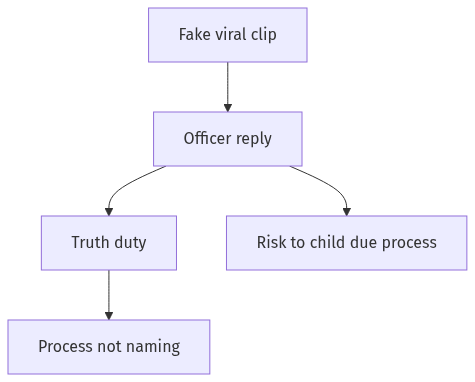
- If any public reply is unavoidable, keep it brief, unnamed as to accused children, and pointed at process, not at revenge.
Flow diagram
Conclusion
Social media here mixes a parent’s wound with the State’s megaphone. Truth may be owed, but naming alleged child perpetrators on a district handle fails dignity, due process, and impartiality.
Quick related
Students also ask
-
Must the officer stay silent forever?
No. A factual, nameless correction and a police complaint are legitimate. A named public trial is not.
-
Does being a parent cancel official duty?
Parenthood explains the wound. It does not cancel impartiality, recusal, or the duty not to use the district as a family weapon.
Same topic · past papers
UPPSC has asked this before
These previous-year questions sit on the same topic. Open one to practise the earlier ask.
More from this paper
Q1 · UPSC Mains 2025 · UPGS4 · 8 marks · Solution
Defining value; explain the distinctive features of human values and the role of the family in inculcating these values.
Civil Service aptitude and values
A value is a stable standard that guides worthy choice, not a passing mood. Human values are taught, claim universal worth, join conscience to conduct, and can be justified in public. The family is the first school of trust, empathy, and honour through daily example. A closed home can also plant prejudice, so the family’s power is not automatically ethical. Later schools and offices confirm or correct that first map.
Q2 · UPSC Mains 2025 · UPGS4 · 8 marks · Solution
Evaluate the contemporary relevance of Chanakya's life and thoughts in the context of ethical and people-centric governance.
Emotional Intelligence
Kautilya judges the ruler by the happiness and security of subjects. Yogakshema, a tested service, and honest accounts remain usable tests of ethical administration. Danda is lawful restraint of the strong, not personal cruelty. A democracy cannot import palace deceit; rights and publicity now bind the officer. The living lesson is welfare plus fiscal integrity under the Constitution.
Q3 · UPSC Mains 2025 · UPGS4 · 8 marks · Solution
Discuss the Aristotelian view of virtues and its application in administrative affairs.
Emotional Intelligence
Aristotle’s moral virtue is a stable habit of the mean, learned by practice. Courage, temperance, and justice are civic virtues an officer must show in files, not only in speech. Phronesis is practical wisdom that finds the right mean in a live case. Administration applies this as honest noting, fiscal restraint, and equal treatment. Office culture can train vice; example and rules can still rebuild the mean.