
Revision summary
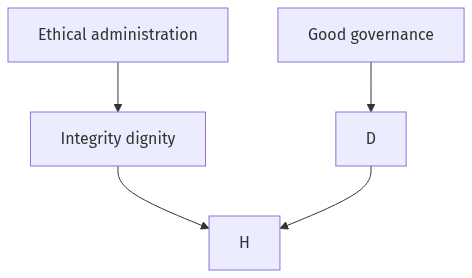
Ethical administration is integrity, impartiality, and care for dignity in the file. Good governance is participation, law, transparency, equity, and delivery. Efficiency without due process can look like governance and still be unethical. Ethics without delivery is a virtue the citizen never meets. Ethics is the foundation; good governance is the house; when they clash, dignity outweighs a cosmetic target.
Model answer
Introduction
Ethical administration is the inner standard of the office. Good governance is the outer performance of the State. They overlap, but they are not the same test.
Body
Ethical administration
- Ethical administration is conduct of office by integrity, impartiality, empathy, and courage when a rule is silent or a superior is loud.
- It asks whether a file respects dignity, truth, and the weak, not only whether a target was met.
- Its sources are conscience, service values, and the Constitution’s morality, not only a dashboard.
- A technically slow office can still be ethical if it refuses a communal shortcut.
Good governance
- Good governance is the World Bank and later Indian usage for participation, rule of law, transparency, responsiveness, equity, effectiveness, and accountability.
- It is seen in delivery: a working ration shop, a published tender, a hearing that ends in a reasoned order.
- India names it in citizen charters, RTI, social audit, and digital public services.
- An efficient demolition drive can look like good governance on a clock and still fail ethics if homes are razed without due process.
Distinction
- Ethics is the character of the decision; good governance is the quality of the system’s results and procedures.
- Ethics can exist in one honest officer inside a weak system; good governance needs institutions that repeat that honesty.
- Good governance without ethics becomes clever targeting and cooked numbers.
- Ethics without any delivery becomes a private virtue that the citizen never meets at the counter.
Which is more important
- For a constitutional State, ethical administration is the prior test, because a cruel efficiency is not a public good.
- In daily life the citizen needs both: a clean hand and a working counter.
- The fair ranking is that ethics is the foundation and good governance is the house built on it.
- Where they clash in a live file, due process and dignity outweigh a cosmetic target.
Flow diagram
Conclusion
Ethical administration is how power is used; good governance is how well the system serves. Ethics is more basic, and good governance is empty if that base is missing.
Quick related
Students also ask
-
In the age of digital governance and big data, public officials rely increasingly on algorithms and automated decision-making systems. Critically examine the ethical risks involved in algorithmic bias, opacity and lack of accountability and suggest guiding principles for responsible use of such technologies in public administration.
Next question in the 2025 paper (Q12). View answer →
-
Can a corrupt but punctual office be called good governance?
Punctuality is one mark. Cooked files and bribes fail rule of law and accountability, so the label does not hold.
-
Is ethics only personal?
Personal courage matters, but ethics in office also needs rules, audit, and protection for the honest officer.
Same topic · past papers
UPPSC has asked this before
These previous-year questions sit on the same topic. Open one to practise the earlier ask.
More from this paper
Q1 · UPSC Mains 2025 · UPGS4 · 8 marks · Solution
Defining value; explain the distinctive features of human values and the role of the family in inculcating these values.
Civil Service aptitude and values
A value is a stable standard that guides worthy choice, not a passing mood. Human values are taught, claim universal worth, join conscience to conduct, and can be justified in public. The family is the first school of trust, empathy, and honour through daily example. A closed home can also plant prejudice, so the family’s power is not automatically ethical. Later schools and offices confirm or correct that first map.
Q2 · UPSC Mains 2025 · UPGS4 · 8 marks · Solution
Evaluate the contemporary relevance of Chanakya's life and thoughts in the context of ethical and people-centric governance.
Emotional Intelligence
Kautilya judges the ruler by the happiness and security of subjects. Yogakshema, a tested service, and honest accounts remain usable tests of ethical administration. Danda is lawful restraint of the strong, not personal cruelty. A democracy cannot import palace deceit; rights and publicity now bind the officer. The living lesson is welfare plus fiscal integrity under the Constitution.
Q3 · UPSC Mains 2025 · UPGS4 · 8 marks · Solution
Discuss the Aristotelian view of virtues and its application in administrative affairs.
Emotional Intelligence
Aristotle’s moral virtue is a stable habit of the mean, learned by practice. Courage, temperance, and justice are civic virtues an officer must show in files, not only in speech. Phronesis is practical wisdom that finds the right mean in a live case. Administration applies this as honest noting, fiscal restraint, and equal treatment. Office culture can train vice; example and rules can still rebuild the mean.