
Revision summary
RTI treats the citizen as principal and the officer as agent, which is a moral basis for open government. Disclosure supports participation, cleaner notes, and equity between claimants. Exemptions show it is a basis, not a demand to paste every sheet. Puttaswamy and RTI section 8 protect personal information unless a larger public interest is shown. Harmony is to publish the official act and the rupee, not the intimate identifier.
Model answer
Introduction
RTI makes the file answerable to the citizen. That publicity is a moral basis for good governance, and it collides with privacy when the file is a person’s body, home, or reputation.
Body
RTI as a moral basis
- Good governance needs visibility; a secret ration list and a secret tender invite theft.
- RTI, 2005, turns that moral claim into a legal right to inspect, copy, and appeal.
- Morally it treats the citizen as principal and the officer as agent, which is the ethics of a republic rather than a palace.
- Second ARC and later practice link disclosure to less corruption and more trust, even when some offices still delay.
- Exemptions exist, so RTI is a basis, not a claim that every sheet must be on a wall.
Why it supports good governance
- Participation is empty if the budget is hidden.
- Accountability needs a paper trail that an applicant can demand.
- Equity is helped when a rejected claimant can see the rule that others received.
- Officials who expect a later RTI write cleaner notes today, which is prevention, not only remedy.
The privacy dilemma
- Puttaswamy holds privacy to be a fundamental right; personal data is not a public park.
- Section 8 of the RTI Act already protects some personal information unless larger public interest is shown.
- The dilemma is sharp in medical files, a child’s identity, a whistle-blower’s address, and a false allegation still under inquiry.
- Digital RTI and data dumps can re-identify a person even after a name is masked.
- The Digital Personal Data Protection Act adds duties that must be read with RTI so that transparency does not become doxxing.
Harmonising
- Disclose the official act, the public money, and the rule; withhold intimate identifiers unless a larger public interest is recorded.
- Give the third party a notice where the Act requires it.
- A speaking refusal is itself part of ethical transparency.
Flow diagram
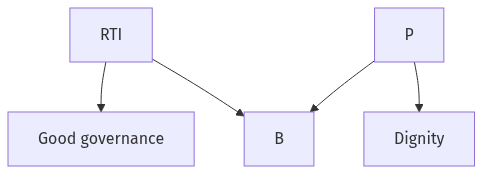
Conclusion
RTI is a moral and legal basis for good governance because the citizen owns the file of public power. Privacy is the matching right that keeps that ownership from becoming a hunt of the private person.
Quick related
Students also ask
-
Is adherence to a code of conduct sufficient for ethical governance or does ethical governance require values beyond codified rules? Explain critically.
Next question in the 2025 paper (Q15). View answer →
-
Does privacy defeat RTI?
No. Privacy limits intimate personal data. Public money, posts, and official reasons remain the core of RTI.
-
Can an officer refuse RTI to hide a mistake?
A mistake in a public act is not private life. Refusal needs a listed exemption, not embarrassment.
Same topic · past papers
UPPSC has asked this before
These previous-year questions sit on the same topic. Open one to practise the earlier ask.
-
2018 · Q20 · UPGS4 · 12 marks
A Public Information Officer has received an application under the Right to Information (RTI) Act. After gathering the required information, he finds that the information pertains to some of the decisions taken by him, which were not totally correct. Some other employees were also a party to these decisions. Disclosure of the information may lead towards disciplinary action against him and his other colleagues including probable punishment. Non-disclosure of information or partial disclosure of information may result in less or no punishment. The Public Information Officer is an honest and conscientious person but the particular decision regarding which an application under the RTI Act was lodged was a wrong decision. The officer comes to you for your advice. Under the above conditions what will be your advice to the officer? Explain logically. -
2022 · Q20 · UPGS4 · 12 marks
Sanjeev is an idealist. He believes that "truth is the greatest virtue and should never be compromised". One day he witnessed a person running away from a mob equipped with sticks and stones. He watched him hiding in a particular spot. The mob asked Sanjeev whether he saw the thief. Sanjeev tells the truth, pointing towards the spot where he saw the person hiding. The mob gets hold of the person and beats him to death. In light of the above circumstance, comment on the conduct of Sanjeev. -
2021 · Q15 · UPGS4 · 12 marks
Ram Murti is a Government servant and lives with his old aged parents in Indore. One day during a field-visit he meets an 11-year-old orphan boy. The boy was in a miserable condition and homeless, with no one to look after him. Ram Murti brings the boy home and proposes that if the boy takes care of his aged parents, Ram Murti will give him a daily wage according to his needs and will also arrange for his education. Evaluate Ram Murti’s conduct from an ethical perspective. -
2019 · Q20 · UPGS4 · 12 marks
Meenu keeps telling her friends that she is fond of social service, yet she never participates in any social-welfare activities. One of her friend’s father is associated with an NGO that frequently organises welfare programmes such as free distribution of clothes and medicines to the poor. Although Meenu was asked many times to devote some time to that NGO, she showed no interest. What probable explanations can be given for Meenu’s conduct? Justify psychologically. -
2025 · Q20 · UPGS4 · 12 marks
You hold a responsible position in district. One day in the morning you received a call from the school of your 11-year-old son that you are required to come and meet the principal. You proceed to the school and find your son in the principal's office. The principal informs you that your son had been found wandering aimlessly in the ground during the time classes were in progress. The class teacher further informs you that your son has lately become a loner and did not respond to the questions in the class, he has also been unable to perform well in the football trials held recently. You bring your son back from the school and in the evening along with your wife try to find out the reasons for your son's changed behaviour. After repeated cajoling your son shares that some children had been making fun of him in the class as well as in the WhatsApp group of the student by calling him stunted, stupid and frog. He tells you the names of a few children who were the main culprits but pleaded with you to let the matter rest. After a few days, during a sporting event, where you and your wife have gone to watch your son play, one of your colleague's son shows you a video in which students have caricatured your son. Further, he also points out to the perpetrators who were sitting in the stand. You purposefully walk past them with your son and go home. Next day you find on social media, a video denigrating you, your son and even your wife, stating that you were engaged in physical bullying of children on the sports field. The video became viral on social media. Your friends and colleagues began calling you to find out the details. One of your juniors advised you to make a counter video giving the background and explaining that nothing had happened on the field. You, in turn, posted a video which you had captured during the sports event, identifying the likely perpetrators who were responsible for your son's predicament. You have also narrated what has actually happened in the field and made attempts to bring out the adverse effects of the misuse of social media. (a) Based on the above case study, discuss the ethical issues involved in the use of social media. (b) Discuss the pros and cons of using social media by you to put across facts to counter the fake propaganda against your family.
More from this paper
Q1 · UPSC Mains 2025 · UPGS4 · 8 marks · Solution
Defining value; explain the distinctive features of human values and the role of the family in inculcating these values.
Civil Service aptitude and values
A value is a stable standard that guides worthy choice, not a passing mood. Human values are taught, claim universal worth, join conscience to conduct, and can be justified in public. The family is the first school of trust, empathy, and honour through daily example. A closed home can also plant prejudice, so the family’s power is not automatically ethical. Later schools and offices confirm or correct that first map.
Q2 · UPSC Mains 2025 · UPGS4 · 8 marks · Solution
Evaluate the contemporary relevance of Chanakya's life and thoughts in the context of ethical and people-centric governance.
Emotional Intelligence
Kautilya judges the ruler by the happiness and security of subjects. Yogakshema, a tested service, and honest accounts remain usable tests of ethical administration. Danda is lawful restraint of the strong, not personal cruelty. A democracy cannot import palace deceit; rights and publicity now bind the officer. The living lesson is welfare plus fiscal integrity under the Constitution.
Q3 · UPSC Mains 2025 · UPGS4 · 8 marks · Solution
Discuss the Aristotelian view of virtues and its application in administrative affairs.
Emotional Intelligence
Aristotle’s moral virtue is a stable habit of the mean, learned by practice. Courage, temperance, and justice are civic virtues an officer must show in files, not only in speech. Phronesis is practical wisdom that finds the right mean in a live case. Administration applies this as honest noting, fiscal restraint, and equal treatment. Office culture can train vice; example and rules can still rebuild the mean.