
Revision summary
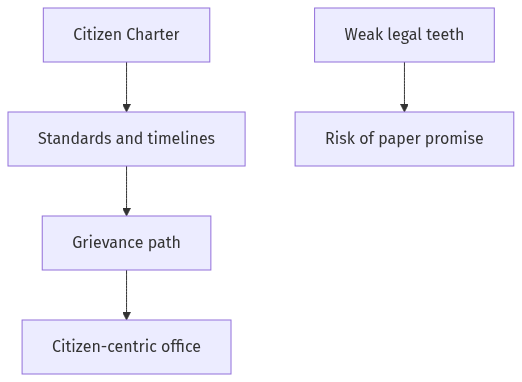
Citizen Charters grew in India after the 1997 Chief Ministers’ conference and DARPG guidance. They publish standards, timelines, and complaint routes for a service. They work with RTI and online grievance systems toward citizen-centric administration. Many Union charters are administrative, not self-executing rights. State public-service guarantee Acts give stronger legal force than a poster charter alone.
Model answer
Introduction
A Citizen Charter is a public promise of standards, time limits, and grievance paths for a service. It was a landmark because it named the citizen as a client of the office, not only as a petitioner.
Body
Why it was a landmark
- The 1997 Chief Ministers’ conference and the Department of Administrative Reforms spread charters across Union and State offices after the United Kingdom’s charter idea.
- A charter states what the office will deliver, in how many days, and where to complain, which older manuals rarely told the public in plain language.
- Sevottam and later public-service guarantee laws in several States built on that culture of time-bound service.
Citizen-centric administration
- Charters sit with the Right to Information Act, 2005, and CPGRAMS so that delay and quality can be asked for in writing.
- Front-line offices such as passports, railways, and municipal services used charters to display fees and timelines, which is a shift from opaque counters.
Limits of the comment
- Most Union charters are not statutes, so a missed deadline does not by itself give a court-ordered compensation in the way a State Right to Public Services Act may.
- Poor display, outdated promises, and no staff incentive can make a charter a poster, which is why the landmark is cultural more than always legal.
Flow diagram
Conclusion
The Citizen Charter was a landmark because it made service standards a public document. Citizen-centric administration still needs statute, staff, and grievance teeth, without which the charter remains a notice on the wall.
Quick related
Students also ask
-
Explain the main issues relating to Human Resource Development in India.
Next question in the 2025 paper (Q6). View answer →
-
Is a Citizen Charter a fundamental right?
No. It is an administrative commitment. Fundamental rights remain in Part III; some States add a statutory service guarantee.
-
Did the charter idea start in India?
The modern charter movement is associated with the United Kingdom in the 1990s; India adapted it to public offices after 1997.
Same topic · past papers
UPPSC has asked this before
These previous-year questions sit on the same topic. Open one to practise the earlier ask.
More from this paper
Q1 · UPSC Mains 2025 · UPGS2 · 8 marks · Solution
What role do Joint Parliamentary Committees (JPCs) play in the Indian legislative process? How do they contribute to effective law-making? Analyse.
Parliament and State legislatures
A JPC is an ad hoc joint committee used for complex bills or major controversies. It gathers evidence that floor debate cannot gather at the same depth. Reports have shaped later drafting after inquiries such as Bofors and 2G. The committee cannot enact law; the Houses may still ignore the report. Effective law-making follows only when Parliament uses that record to amend the bill.
Q2 · UPSC Mains 2025 · UPGS2 · 8 marks · Solution
How does Alternative Dispute Resolution (ADR) strengthen efficient governance and enhance the effectiveness of the justice delivery system in India? Analyze.
Separation of powers
Section 89 CPC and the 1996 Arbitration Act, with the 2023 Mediation Act, give ADR a legal base. Lok Adalats under the 1987 Legal Services Authorities Act clear compoundable claims in bulk. Governance gains when contracts and welfare complaints do not wait years for a trial. Justice delivery gains only if weaker parties are not forced into unfair bargains. Courts remain necessary for crime and for constitutional rights.
Q3 · UPSC Mains 2025 · UPGS2 · 8 marks · Solution
"Legislature is supreme within its domain, yet it is not sovereign." Examine this statement in the constitutional context with examples.
Indian Constitution
Articles 245 and 246 make a legislature supreme on its constitutional list. Kesavananda and Minerva Mills deny unlimited amending power. Articles 13, 32, and 226 allow courts to void unconstitutional statutes. The NJAC judgment is an example of a constitutional amendment falling to basic structure review. India follows constitutional supremacy, not British parliamentary sovereignty.