
Revision summary
HRD in India is education, skills, health, and fair access to work. Enrolment gains have not always produced strong learning outcomes. Skill systems are weakly tied to industry; NEP 2020 tries to join skill with schooling. Informal work and health gaps cut the return on education. Gender, region, caste, and disability still structure who receives good HRD.
Model answer
Introduction
Human Resource Development in India means schooling, skills, health, and the chance to work with dignity. The main issues are quality and mismatch, not only the size of the young population.
Body
Education and skills
- Learning outcomes in many schools remain weak even when enrolment has risen, which wastes the years of the child and of the state.
- Higher education is uneven in quality, and a large graduate pool still meets a thin market for formal skilled work.
- Vocational training is often poorly linked to industry, so the National Education Policy, 2020, treats skill as part of schooling rather than a side track.
Health and the labour market
- Nutrition, primary care, and women’s health decide whether education can turn into usable labour, so HRD is not only a classroom file.
- A large informal workforce has little on-the-job training or social security, which traps productivity.
Equity
- Gender gaps, rural–urban gaps, and caste and disability barriers keep talent off the same starting line.
- Regional concentration of good colleges and hospitals pulls youth out of poorer States and leaves local public services thin.
Policy frame
- NEP 2020, skill missions, and labour codes try to answer these issues, but implementation capacity at the State and panchayat level remains the binding constraint.
Flow diagram
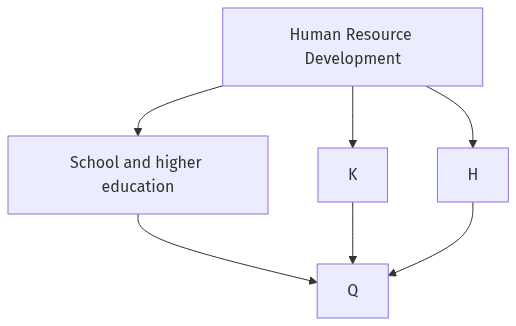
Conclusion
The main HRD issues in India are weak learning, skill mismatch, health gaps, informality, and unequal access. Numbers of students and workers will not become a dividend unless quality and equity move together.
Quick related
Students also ask
-
To what extent has Information and Communication Technology (ICT) been useful in policy implementation? Discuss.
Next question in the 2025 paper (Q7). View answer →
-
Is HRD only the Education Ministry’s file?
No. Skills, health, labour, and social justice ministries all shape whether a person can learn and work.
-
Does a young population automatically mean a dividend?
No. A dividend needs health, learning, and jobs. Without those, youth can mean unemployment and distress.
Same topic · past papers
UPPSC has asked this before
These previous-year questions sit on the same topic. Open one to practise the earlier ask.
-
2020 · Q7 · UPGS2 · 8 marks
Analyse various aspects relating to Management of Human Resources in India. -
2023 · Q16 · UPGS2 · 12 marks
Discuss the various aspects relating to the management of Health Services in the State of Uttar Pradesh.
More from this paper
Q1 · UPSC Mains 2025 · UPGS2 · 8 marks · Solution
What role do Joint Parliamentary Committees (JPCs) play in the Indian legislative process? How do they contribute to effective law-making? Analyse.
Parliament and State legislatures
A JPC is an ad hoc joint committee used for complex bills or major controversies. It gathers evidence that floor debate cannot gather at the same depth. Reports have shaped later drafting after inquiries such as Bofors and 2G. The committee cannot enact law; the Houses may still ignore the report. Effective law-making follows only when Parliament uses that record to amend the bill.
Q2 · UPSC Mains 2025 · UPGS2 · 8 marks · Solution
How does Alternative Dispute Resolution (ADR) strengthen efficient governance and enhance the effectiveness of the justice delivery system in India? Analyze.
Separation of powers
Section 89 CPC and the 1996 Arbitration Act, with the 2023 Mediation Act, give ADR a legal base. Lok Adalats under the 1987 Legal Services Authorities Act clear compoundable claims in bulk. Governance gains when contracts and welfare complaints do not wait years for a trial. Justice delivery gains only if weaker parties are not forced into unfair bargains. Courts remain necessary for crime and for constitutional rights.
Q3 · UPSC Mains 2025 · UPGS2 · 8 marks · Solution
"Legislature is supreme within its domain, yet it is not sovereign." Examine this statement in the constitutional context with examples.
Indian Constitution
Articles 245 and 246 make a legislature supreme on its constitutional list. Kesavananda and Minerva Mills deny unlimited amending power. Articles 13, 32, and 226 allow courts to void unconstitutional statutes. The NJAC judgment is an example of a constitutional amendment falling to basic structure review. India follows constitutional supremacy, not British parliamentary sovereignty.