
Revision summary
PIL relaxed standing so that bona fide third parties could move constitutional courts. Hussainara Khatoon, Bandhua Mukti Morcha, Olga Tellis, and Vishaka are standard examples. Articles 32 and 226, including letter petitions, carried marginalized claims into court. Misuse, delay, and judicial administration are the critical costs. PIL aids social justice; it cannot replace statute and the executive on the ground.
Model answer
Introduction
Public Interest Litigation relaxed locus standi so that a person acting bona fide could move the Supreme Court or a High Court for those who could not. It became a tool of social justice, and analysis must also name misuse and judicial overreach.
Body
How PIL opened the court
- Hussainara Khatoon and related undertrial cases showed that letters and third-party petitions could unlock Article 21 for prisoners who would never retain a senior advocate.
- S.P. Gupta and later cases treated a public-spirited petitioner as enough, provided the petition was not a private quarrel in disguise.
- Articles 32 and 226, with epistolary jurisdiction, made the court a forum for bonded labour, pavement dwellers, and undertrials.
Social justice and marginalized rights
- Bandhua Mukti Morcha used PIL to push the Bonded Labour System (Abolition) Act from paper into field directions.
- Olga Tellis protected pavement dwellers’ livelihood as part of Article 21, which is housing and work for the urban poor, not a luxury right.
- Vishaka laid down workplace sexual-harassment guidelines when statute was silent, which served women workers until the 2013 Act.
- MC Mehta environmental PILs, the right to food litigation, and forest-rights monitoring show how groups without market power reached the court.
Critical limits
- Frivolous and publicity PILs waste time and can stall projects without helping the poor; the Court has fined and discouraged such petitions.
- Continuing mandamus can look like administration from the Bench, which critics call a strain on separation of powers.
- Implementation still needs collectors, police, and budgets; a judgment does not by itself feed or free a person.
Balance
- PIL remains an important tool because marginalized communities often cannot buy adversarial litigation.
- It is a tool, not a substitute for legislation, panchayats, and welfare departments.
Flow diagram
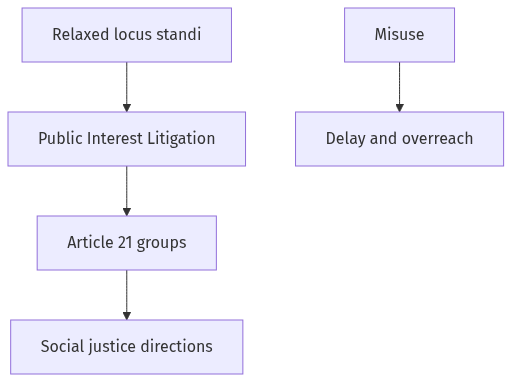
Conclusion
PIL advanced social justice by opening Articles 32 and 226 to bonded labour, undertrials, women workers, and the urban poor. The same tool fails when it becomes private interest, delay, or a second government, so discipline of standing and of remedies is part of the analysis.
Quick related
Students also ask
-
How does the Direct Benefit Transfer (DBT) system align with the objectives of Digital India and good governance? Analyze.
Next question in the 2025 paper (Q15). View answer →
-
Can any stranger file a PIL for any cause?
No. The petitioner must act bona fide. The Court rejects private disputes dressed as public interest and may impose costs.
-
Did Vishaka create a permanent substitute for Parliament?
No. It filled a gap until the Sexual Harassment of Women at Workplace Act, 2013. That is the proper sequence.
Same topic · past papers
UPPSC has asked this before
These previous-year questions sit on the same topic. Open one to practise the earlier ask.
-
2020 · Q11 · UPGS2 · 12 marks
"Every matter of Public Interest can not be a matter of Public Interest Litigation." Evaluate. -
2019 · Q11 · UPGS2 · 12 marks
What is meant by Digital India? Discuss its various pillars and challenges.
More from this paper
Q1 · UPSC Mains 2025 · UPGS2 · 8 marks · Solution
What role do Joint Parliamentary Committees (JPCs) play in the Indian legislative process? How do they contribute to effective law-making? Analyse.
Parliament and State legislatures
A JPC is an ad hoc joint committee used for complex bills or major controversies. It gathers evidence that floor debate cannot gather at the same depth. Reports have shaped later drafting after inquiries such as Bofors and 2G. The committee cannot enact law; the Houses may still ignore the report. Effective law-making follows only when Parliament uses that record to amend the bill.
Q2 · UPSC Mains 2025 · UPGS2 · 8 marks · Solution
How does Alternative Dispute Resolution (ADR) strengthen efficient governance and enhance the effectiveness of the justice delivery system in India? Analyze.
Separation of powers
Section 89 CPC and the 1996 Arbitration Act, with the 2023 Mediation Act, give ADR a legal base. Lok Adalats under the 1987 Legal Services Authorities Act clear compoundable claims in bulk. Governance gains when contracts and welfare complaints do not wait years for a trial. Justice delivery gains only if weaker parties are not forced into unfair bargains. Courts remain necessary for crime and for constitutional rights.
Q3 · UPSC Mains 2025 · UPGS2 · 8 marks · Solution
"Legislature is supreme within its domain, yet it is not sovereign." Examine this statement in the constitutional context with examples.
Indian Constitution
Articles 245 and 246 make a legislature supreme on its constitutional list. Kesavananda and Minerva Mills deny unlimited amending power. Articles 13, 32, and 226 allow courts to void unconstitutional statutes. The NJAC judgment is an example of a constitutional amendment falling to basic structure review. India follows constitutional supremacy, not British parliamentary sovereignty.