
Revision summary
Articles 148 to 151 create an independent CAG who reports to the legislatures. The 1971 Act sets duties and powers of audit of Union and State accounts. The CAG is the supreme auditor of public expenditure and receipts that the law assigns. The budget, appropriation, and day-to-day control of money remain with Parliament and the executive. Calling the CAG the supreme authority of all Indian finance overstates audit into fiscal sovereignty.
Model answer
Introduction
The Comptroller and Auditor General audits the Union and the States and reports to the legislatures. Calling the CAG the supreme financial authority is a strong phrase, and criticism must place the office below Parliament even while it stands above the spending departments.
Body
Constitutional position
- Article 148 creates an independent CAG, appointed by the President and removable like a Supreme Court judge, which is the mark of a constitutional auditor, not a ministry clerk.
- Articles 149 to 151 let Parliament fix duties by law, require reports to the President or Governor, and place those reports before the Houses.
- The CAG’s (Duties, Powers and Conditions of Service) Act, 1971, is the working statute for audit of accounts.
Functions that look supreme
- The CAG audits all expenditure from the Consolidated Fund, contingency funds, and public accounts of the Union and the States.
- Performance and compliance audits have named waste in defence deals, spectrum, and welfare, which can halt a government’s narrative.
- State CAG reports similarly discipline State finance, so the office is federal in reach.
Why the statement overreaches
- Parliament is supreme in money: the budget, appropriation, and the Public Accounts Committee sit above the audit paragraph.
- The CAG does not control the issue of public money day to day in the old British Comptroller sense; India is largely an auditor-general model.
- The executive compiles accounts; the Finance Ministry and the RBI run the live fisc; the CAG comes after the spend.
- Courts may read a CAG report as material, but they are not bound to treat it as a decree, and governments may dispute findings.
Critical balance
- The CAG is the supreme audit authority of public finance, which is the accurate title.
- Supreme authority of India’s finance as a whole would describe Parliament plus the executive fisc, with the CAG as the constitutional watchdog.
Flow diagram
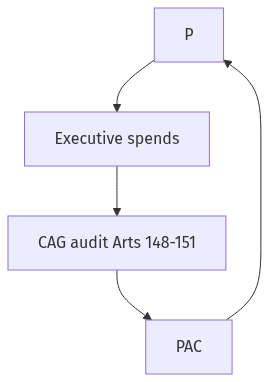
Conclusion
The CAG is independent, wide, and often feared, which explains the popular label of supremacy. Critically, that supremacy is of audit, not of the purse; the purse remains with the legislatures and the elected executive.
Quick related
Students also ask
-
Public Interest Litigation (PIL) is an important tool for promoting social justice and protecting the rights of marginalized communities. Analyse with suitable examples.
Next question in the 2025 paper (Q14). View answer →
-
Can the CAG stop a budget from being passed?
No. Passing the budget is a legislative act. The CAG reports after expenditure and on accounts.
-
Is the CAG a servant of the Finance Ministry?
No. The Constitution gives security of tenure similar to a Supreme Court judge so that audit is not a departmental inspection.
Same topic · past papers
UPPSC has asked this before
These previous-year questions sit on the same topic. Open one to practise the earlier ask.
-
2021 · Q17 · UPGS2 · 12 marks
Examine the role of the Comptroller and Auditor General (CAG) in India as the custodian of public money. -
2018 · Q10 · UPGS2 · 8 marks
Examine the constitutional position of the Comptroller and Auditor General of India.
More from this paper
Q1 · UPSC Mains 2025 · UPGS2 · 8 marks · Solution
What role do Joint Parliamentary Committees (JPCs) play in the Indian legislative process? How do they contribute to effective law-making? Analyse.
Parliament and State legislatures
A JPC is an ad hoc joint committee used for complex bills or major controversies. It gathers evidence that floor debate cannot gather at the same depth. Reports have shaped later drafting after inquiries such as Bofors and 2G. The committee cannot enact law; the Houses may still ignore the report. Effective law-making follows only when Parliament uses that record to amend the bill.
Q2 · UPSC Mains 2025 · UPGS2 · 8 marks · Solution
How does Alternative Dispute Resolution (ADR) strengthen efficient governance and enhance the effectiveness of the justice delivery system in India? Analyze.
Separation of powers
Section 89 CPC and the 1996 Arbitration Act, with the 2023 Mediation Act, give ADR a legal base. Lok Adalats under the 1987 Legal Services Authorities Act clear compoundable claims in bulk. Governance gains when contracts and welfare complaints do not wait years for a trial. Justice delivery gains only if weaker parties are not forced into unfair bargains. Courts remain necessary for crime and for constitutional rights.
Q3 · UPSC Mains 2025 · UPGS2 · 8 marks · Solution
"Legislature is supreme within its domain, yet it is not sovereign." Examine this statement in the constitutional context with examples.
Indian Constitution
Articles 245 and 246 make a legislature supreme on its constitutional list. Kesavananda and Minerva Mills deny unlimited amending power. Articles 13, 32, and 226 allow courts to void unconstitutional statutes. The NJAC judgment is an example of a constitutional amendment falling to basic structure review. India follows constitutional supremacy, not British parliamentary sovereignty.