
Revision summary
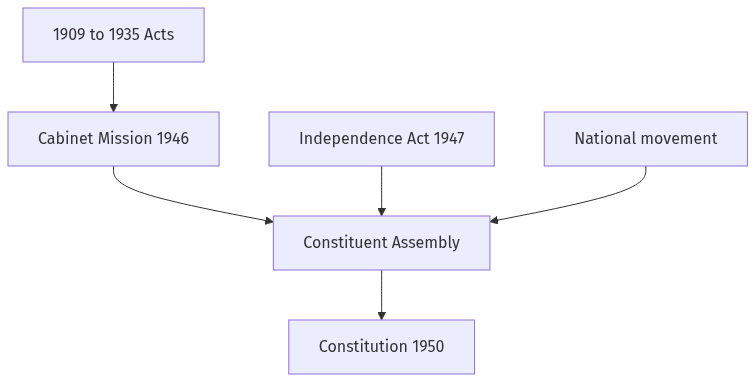
Colonial Councils Acts and the 1919 and 1935 Acts trained Indian legislators. The Cabinet Mission and the Indian Independence Act, 1947, gave the Assembly its legal sitting. Westminster procedure inside the Assembly shows continuity of parliamentary craft. Popular sovereignty, rights, and the end of British legislative power show a break. The statement is half-true: legal origin in colonial development, political origin in the national movement.
Model answer
Introduction
The Constituent Assembly sat because British statutes and the Cabinet Mission had opened a legal door. A critical examination must also show that the Assembly’s authority came from the national movement and from the people, not only from colonial Parliament.
Body
The colonial parliamentary chain
- The Indian Councils Acts and the Government of India Acts of 1919 and 1935 trained Indian members in legislative procedure, budgets, and provincial ministries.
- The 1935 Act even sketched a federation and a federal court, so constitution-making did not begin on a blank legal page.
- The Cabinet Mission Plan of 1946 provided the immediate legal method for electing an Assembly from provincial legislatures.
- The Indian Independence Act, 1947, then empowered the Assembly as the Dominion legislature and removed the British Parliament’s power to legislate for India.
Why the statement is partly true
- Without those Acts and the Mission, there would have been no recognised electoral college of provincial MLAs in 1946.
- Nehru, Prasad, Ambedkar, and others used Westminster forms—three readings, committees, a speaker’s chair—because they had practised them in colonial legislatures.
- In that narrow sense the Assembly was a legal outcome of parliamentary development under the Raj.
The critical break
- The Assembly was not a creature of the British Parliament in the way the 1935 federal legislature would have been; after 15 August 1947 it derived authority from the Independence Act and from Indian political will.
- Universal adult franchise, abolition of separate electorates in the new Constitution, fundamental rights, and the basic-structure later doctrine were not gifts of colonial parliamentary logic.
- Large parts of India had been princely, not provincial, so the Assembly also had to absorb accession politics that no 1935 schedule had finished.
- The Objectives Resolution and the Preamble claim popular sovereignty; that claim is a rupture with colonial legality, not its last clause.
Balance
- A fair examination therefore accepts the statutory ladder from 1909 to 1947 and still denies that the Constitution is only colonial parliamentary leftover.
Flow diagram
Conclusion
The Constituent Assembly was legally convened through colonial parliamentary machinery and the 1947 Act. It was politically a sovereign Indian body, so the statement is true as a starting ladder and false as a full description of the Constitution’s source.
Quick related
Students also ask
-
How does the provision of legislative powers granted to the Union under the Indian Constitution contribute to the centralized character of India's federal system? Examine.
Next question in the 2025 paper (Q12). View answer →
-
Was the Assembly elected by universal adult franchise?
No. Members were chosen by provincial legislatures elected on a limited franchise. The Constitution then provided universal adult franchise for future Lok Sabhas.
-
Did the British Parliament enact the Indian Constitution?
No. It enacted the Independence Act. The Constitution was adopted by the Constituent Assembly.
Same topic · past papers
UPPSC has asked this before
These previous-year questions sit on the same topic. Open one to practise the earlier ask.
-
2024 · Q1 · UPGS2 · 8 marks
Write a short note on the composition of the Constituent Assembly.
More from this paper
Q1 · UPSC Mains 2025 · UPGS2 · 8 marks · Solution
What role do Joint Parliamentary Committees (JPCs) play in the Indian legislative process? How do they contribute to effective law-making? Analyse.
Parliament and State legislatures
A JPC is an ad hoc joint committee used for complex bills or major controversies. It gathers evidence that floor debate cannot gather at the same depth. Reports have shaped later drafting after inquiries such as Bofors and 2G. The committee cannot enact law; the Houses may still ignore the report. Effective law-making follows only when Parliament uses that record to amend the bill.
Q2 · UPSC Mains 2025 · UPGS2 · 8 marks · Solution
How does Alternative Dispute Resolution (ADR) strengthen efficient governance and enhance the effectiveness of the justice delivery system in India? Analyze.
Separation of powers
Section 89 CPC and the 1996 Arbitration Act, with the 2023 Mediation Act, give ADR a legal base. Lok Adalats under the 1987 Legal Services Authorities Act clear compoundable claims in bulk. Governance gains when contracts and welfare complaints do not wait years for a trial. Justice delivery gains only if weaker parties are not forced into unfair bargains. Courts remain necessary for crime and for constitutional rights.
Q3 · UPSC Mains 2025 · UPGS2 · 8 marks · Solution
"Legislature is supreme within its domain, yet it is not sovereign." Examine this statement in the constitutional context with examples.
Indian Constitution
Articles 245 and 246 make a legislature supreme on its constitutional list. Kesavananda and Minerva Mills deny unlimited amending power. Articles 13, 32, and 226 allow courts to void unconstitutional statutes. The NJAC judgment is an example of a constitutional amendment falling to basic structure review. India follows constitutional supremacy, not British parliamentary sovereignty.