
Revision summary
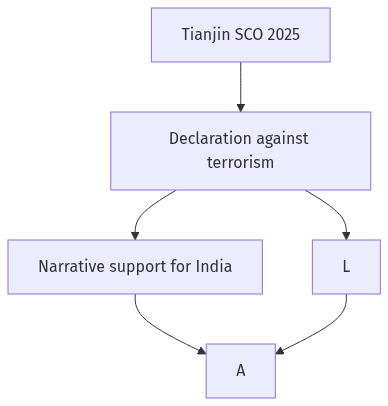
The 25th SCO summit was held in Tianjin in 2025. The declaration condemned terrorism and recorded support for concern over cross-border terrorism. That line helps India inside a forum that includes Pakistan and China. SCO consensus rarely produces hard enforcement against a member’s sensitivities. The gain is diplomatic narrative; operations still need national and UN instruments.
Model answer
Introduction
The twenty-fifth Shanghai Cooperation Organisation summit met in Tianjin in 2025. A declaration that condemns terrorism and records India’s concern on cross-border terrorism is a diplomatic text, and assessment must separate language from force.
Body
What the declaration does
- An SCO declaration that condemns terrorism, including cross-border terrorism, gives India a Eurasian multilateral line that Pakistan also sits inside as a member.
- Endorsement of India’s long-standing concern, even in general wording, raises the political cost of treating terrorism as a bilateral quarrel only.
- Tianjin placed India at a table with China, Russia, and Central Asia, so the terrorism paragraph is also a signal in a grouping India did not design.
Strategic significance
- Narrative win: India can cite a regional document rather than only Western or UN general statements when it speaks of cross-border terrorism.
- Limited operational teeth: SCO has no NATO-like command; consensus among rivals often waters language down to lowest common condemnation.
- China–Pakistan presence means the text is unlikely to name every Indian red line in the words New Delhi would draft alone.
Balanced assessment
- The significance is real as diplomacy and as a constraint on silence inside SCO.
- The significance is modest as counter-terror operations, FATF-type pressure, or a substitute for bilateral and UN tracks.
Flow diagram
Conclusion
The 2025 Tianjin SCO declaration matters because it put India’s terrorism concern into a Eurasian consensus document. It does not by itself stop cross-border attacks, so the strategic gain is political language, not a new security guarantee.
Quick related
Students also ask
-
"India's Constituent Assembly was the legal outcome of Parliamentary developments during the Colonial period." Critically examine this statement.
Next question in the 2025 paper (Q11). View answer →
-
Did the declaration replace India’s need for bilateral talks with Pakistan?
No. A multilateral paragraph is not a bilateral settlement or a ceasefire mechanism.
-
Should the exact sentences of the declaration be quoted from memory?
No. The safe reading is that the summit text condemned terrorism and backed concern on cross-border terrorism, without inventing wording.
Same topic · past papers
UPPSC has asked this before
These previous-year questions sit on the same topic. Open one to practise the earlier ask.
-
2022 · Q8 · UPGS2 · 8 marks
Energy security is the most important part of economic progress of India. Analyse India's energy policy cooperation with West Asian Countries. -
2022 · Q19 · UPGS2 · 12 marks
What are the areas of contention and cooperation in India-USA relations? Discuss.
More from this paper
Q1 · UPSC Mains 2025 · UPGS2 · 8 marks · Solution
What role do Joint Parliamentary Committees (JPCs) play in the Indian legislative process? How do they contribute to effective law-making? Analyse.
Parliament and State legislatures
A JPC is an ad hoc joint committee used for complex bills or major controversies. It gathers evidence that floor debate cannot gather at the same depth. Reports have shaped later drafting after inquiries such as Bofors and 2G. The committee cannot enact law; the Houses may still ignore the report. Effective law-making follows only when Parliament uses that record to amend the bill.
Q2 · UPSC Mains 2025 · UPGS2 · 8 marks · Solution
How does Alternative Dispute Resolution (ADR) strengthen efficient governance and enhance the effectiveness of the justice delivery system in India? Analyze.
Separation of powers
Section 89 CPC and the 1996 Arbitration Act, with the 2023 Mediation Act, give ADR a legal base. Lok Adalats under the 1987 Legal Services Authorities Act clear compoundable claims in bulk. Governance gains when contracts and welfare complaints do not wait years for a trial. Justice delivery gains only if weaker parties are not forced into unfair bargains. Courts remain necessary for crime and for constitutional rights.
Q3 · UPSC Mains 2025 · UPGS2 · 8 marks · Solution
"Legislature is supreme within its domain, yet it is not sovereign." Examine this statement in the constitutional context with examples.
Indian Constitution
Articles 245 and 246 make a legislature supreme on its constitutional list. Kesavananda and Minerva Mills deny unlimited amending power. Articles 13, 32, and 226 allow courts to void unconstitutional statutes. The NJAC judgment is an example of a constitutional amendment falling to basic structure review. India follows constitutional supremacy, not British parliamentary sovereignty.