
Revision summary
Indian industrial classes include owners, managers, a small formal workforce and a large informal majority. Recruitment, unions and job queues follow caste, kinship, language and sending villages. Breman, Holmström and Ramaswamy show particularism inside industry, not a pure proletariat. Owners too are often community-based business groups. Capitalism reworks these ties but has not replaced them with a casteless class structure.
Model answer
Copper italics in this answer — like this — are the key facts. Each one is unpacked in the Facts & figures rail.
Introduction
Industrial class structure is the pattern of owners, managers, regular workers and a vast irregular workforce around factories, mills and now platforms. In India that pattern is a function of the wider social structure, not a carbon copy of nineteenth-century Manchester. Caste, kinship, language and the village labour-sending household organise who stands on which shop floor.
Body
Why the statement is largely true
A. R. Desai expected industrialisation to push class contradiction forward. What arrived was a dual labour market. Jan Breman described footloose labour: circular migrants, contractors, and the absence of a stable proletariat. Mark Holmström showed how “the town” of organised industry still ran on particularistic ties. E. A. Ramaswamy and union studies found caste and region inside the union, not only against it. D. N. Dhanagare and others noted that the industrial working class was often upper-shudra or specific jatis in a given mill town, with Dalits in the hardest informal jobs.
Recruitment through sardars, kin chains from one district, and language clusters (Bhojpuri in Mumbai’s informal economy, Telugu in construction) is social structure at work. Women are concentrated in garments, electronics assembly and home-based piecework—gendered class. Public-sector “labour aristocracy” reproduced the old middle-caste/upper-caste schooling advantage. N. R. Sheth’s factory studies already showed that Indian industrial relations carry community and paternalism, not only a wage bargain.
- Platform gig work is a new chapter of the same book: algorithms look class-neutral; entry still runs on a smartphone, a deposit, and a caste-region network in the city. The unorganised majority (NCEUS) is the industrial class structure that census “workers in industry” understate.
Qualifications
Industry also reworks social structure. A badge, a PF number, and a strike can create class solidarity that caste forbids in the village well. Automobile and IMT unions have at times spoken a wage language across jati. New economic policy casualised even this: contract labour inside the factory wall blurs class. Capitalists themselves are not a casteless bourgeoisie; business communities (Marwari, Chettiar, Patel, new OBC capital) show social structure on the owners’ side too. Family firms use kinship as a trust technology that textbooks call “culture” and accountants call control.
Public-sector steel and coal towns created a more classical working class for a generation; privatisation and contract mining then re-informalised it. So the function of social structure is historically timed, not a timeless essence.
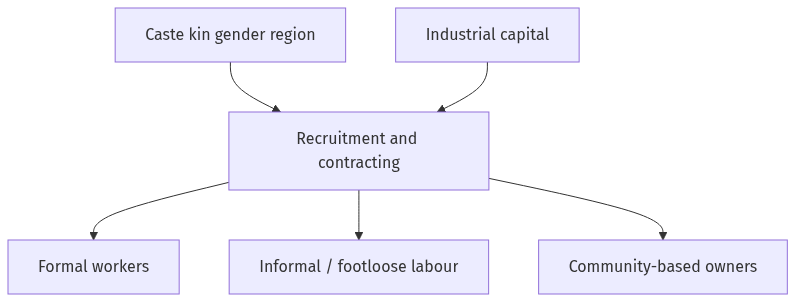
- So one should agree: Indian industrial classes are functions of caste-kin-region-gender structure and of capitalist accumulation. To say they are only a function of social structure would deny the factory’s own discipline. To say they are only Marxian classes would deny the contractor, the jati, and the village.
Flow diagram
Conclusion
- Yes, with a hinge: industrial class structure in India is produced by capitalism operating through caste, kinship, gender and migration. Formal workers, informal majority and community-based owners are the resulting map.
Quick related
Students also ask
-
Discuss the changes taking place in the industrial class structure in India.
Next question on this syllabus topic (2024 · Q1(b)). View answer →
-
Is the Indian working class a myth?
No. Strikes and unions are real. The myth is that most industrial workers are stable, formal and casteless.
-
Does caste disappear in the factory?
It weakens in some canteens and intensifies in housing, marriage and the contractor’s gang.
Same topic · past papers
UPSC has asked this before
These previous-year questions sit on the same topic. Open one to practise the earlier ask.
-
2024 · Q8(b) · Sociology GS 2 · 20 marks
Identify different forms of inequalities associated with agrarian social structure in India -
2022 · Q1(d) · Sociology GS 2 · 10 marks
In the context of changing Indian society, how do you view Andre Beteille's conceptions of harmonic and disharmonic social structures ?
More from this topic
Q3(b) · UPSC Mains 2026 · Sociology GS 2 · 20 marks · Solution
Explain the emergence of middle class in agrarian society in India. What have been the socio-structural implications of the emergence of this middle class?
Social Classes in India
This model answer examines the rise of the agrarian middle class in India, driven by post-independence land reforms, the Green Revolution, and market integration. It details their socio-structural implications, including shifting rural power dynamics, caste-class intersectionality, political mobilisation, and changing agrarian relations. The conclusion highlights the need for inclusive rural development and sustainable livelihoods to address emerging rural stratifications.
Q3(c) · UPSC Mains 2025 · Sociology GS 2 · 10 marks · Solution
Describe the main features of Indian new middle class. How is it different from the old middle class?
Social Classes in India
The old middle class grew from colonial education, law and bureaucracy and later staffed the Nehruvian state. The new middle class grew after 1991 around private services, IT and consumption. Béteille and Misra describe the older service stratum; Fernandes describes the consumer-citizen. Caste and English schooling shape entry into both. The new class is larger but still a minority; it has not absorbed the informal majority.
Q8(b) · UPSC Mains 2024 · Sociology GS 2 · 20 marks · Solution
Identify different forms of inequalities associated with agrarian social structure in India
Social Classes in India
Agrarian structure organises land, labour, caste and household. Class forms include owners, tenants, landless and new reverse tenancy. Caste maps onto field labour and honour in the village. Women’s farm work without title is a central inequality. Region and ecology split irrigated surplus growers from dryland and forest poor.