
Revision summary
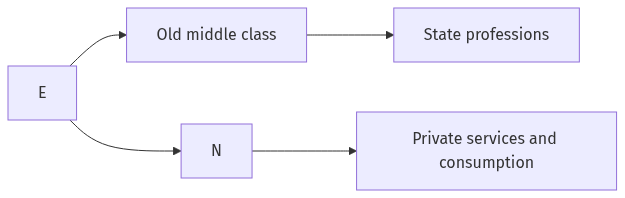
The old middle class grew from colonial education, law and bureaucracy and later staffed the Nehruvian state. The new middle class grew after 1991 around private services, IT and consumption. Béteille and Misra describe the older service stratum; Fernandes describes the consumer-citizen. Caste and English schooling shape entry into both. The new class is larger but still a minority; it has not absorbed the informal majority.
Model answer
Copper italics in this answer — like this — are the key facts. Each one is unpacked in the Facts & figures rail.
Introduction
- The old Indian middle class was largely a child of the colonial state: clerks, lawyers, doctors, teachers and the early ICS/IAS. The new middle class is a child of 1991, private services, and consumption. They share aspiration and English; they do not share the same employer or the same idea of the public good.
Body
Old middle class
B. B. Misra traced a professional and bureaucratic stratum created by English education and law courts. It led the national movement, staffed Nehruvian planning, and often spoke a language of austerity, science and secular office. Caste was not absent—Kayastha, Brahmin, Bhadralok, Tamil Brahmin over-representation—but the role model was the gazetted officer, not the mall. André Béteille stressed education and the service class as a relatively autonomous domain of inequality beside caste and land.
New middle class
- After liberalisation, Leela Fernandes and others describe a consumer-citizen: IT and BPO, finance, organised retail, private hospitals and coaching. Income is more private-sector and contractual. Culture is branded, gated, and media-saturated. Politics often leans toward order, anti-corruption spectacle and Hindu-majoritarian comfort, rather than the old socialist vocabulary—though this varies by city and caste. Reservation debates split this class: some see merit as a sacred scarce good; OBC and Dalit professional fractions are themselves a new middle class.
- Differences: employer (state vs private/global); security (pensioned vs flexible); spatial form (civil lines vs gated township); gender (a larger visible cohort of employed women in services); and relation to the poor (planning paternalism vs security-and-consumption distance). Continuity: both use education as the main elevator, both remain skewed by caste and metro location, and both fear falling into the informal majority.
The new class is numerically larger yet still a minority. Calling all smartphone users “middle class” is advertising, not sociology.
Flow diagram
Conclusion
The old middle class was professional-bureaucratic and state-facing. The new middle class is private, consuming and globally linked. Caste and schooling structure both. The shift is real; it is not the death of the old service class, which still sits in sarkari offices.
Quick related
Students also ask
-
"Industrial class structure is a function of social structure of Indian society." Do you agree with this statement? Analyze
Next question on this syllabus topic (2025 · Q4(b)). View answer →
-
Is the new middle class casteless?
No. It often performs caste-neutrality while using caste networks in marriage, housing and coaching.
-
Did the old middle class disappear?
No. Government service, public universities and PSU professionals remain; they now share the stage with private managers.
Same topic · past papers
UPSC has asked this before
These previous-year questions sit on the same topic. Open one to practise the earlier ask.
-
2026 · Q6(b) · Sociology GS 2 · 20 marks
Synchronise the developmental programmes and social change in India, and describe them through visible and lived experiences -
2025 · Q4(a) · Sociology GS 2 · 20 marks
Who is said to be the pioneer of village studies in India? Illustratively describe contributions of some Indian sociologists on village studies. How their approaches are distinct from each other? -
2025 · Q8(c) · Sociology GS 2 · 10 marks
What are the Indian government's schemes launched for poverty alleviation after the United Nation's Declaration of 'Sustainable Development Goals - 2015' ? Briefly describe -
2021 · Q8(c) · Sociology GS 2 · 10 marks
Does "economic empowerment" automatically bring about "substantive empowerment" for women ? Briefly describe the main issues in women empowerment in India -
2026 · Q3(b) · Sociology GS 2 · 20 marks
Explain the emergence of middle class in agrarian society in India. What have been the socio-structural implications of the emergence of this middle class?
More from this topic
Q3(b) · UPSC Mains 2026 · Sociology GS 2 · 20 marks · Solution
Explain the emergence of middle class in agrarian society in India. What have been the socio-structural implications of the emergence of this middle class?
Social Classes in India
This model answer examines the rise of the agrarian middle class in India, driven by post-independence land reforms, the Green Revolution, and market integration. It details their socio-structural implications, including shifting rural power dynamics, caste-class intersectionality, political mobilisation, and changing agrarian relations. The conclusion highlights the need for inclusive rural development and sustainable livelihoods to address emerging rural stratifications.
Q4(b) · UPSC Mains 2025 · Sociology GS 2 · 20 marks · Solution
"Industrial class structure is a function of social structure of Indian society." Do you agree with this statement? Analyze
Social Classes in India
Indian industrial classes include owners, managers, a small formal workforce and a large informal majority. Recruitment, unions and job queues follow caste, kinship, language and sending villages. Breman, Holmström and Ramaswamy show particularism inside industry, not a pure proletariat. Owners too are often community-based business groups. Capitalism reworks these ties but has not replaced them with a casteless class structure.
Q8(b) · UPSC Mains 2024 · Sociology GS 2 · 20 marks · Solution
Identify different forms of inequalities associated with agrarian social structure in India
Social Classes in India
Agrarian structure organises land, labour, caste and household. Class forms include owners, tenants, landless and new reverse tenancy. Caste maps onto field labour and honour in the village. Women’s farm work without title is a central inequality. Region and ecology split irrigated surplus growers from dryland and forest poor.