
Revision summary
The old economy combined peasant agriculture, artisan castes and layered trade, not a frozen idyll. Land settlements monetised revenue and strengthened landlord or state claims on the peasant. Nationalists argued deindustrialisation and drain; revisionists note regional survival and later mills. Socially, craft castes and towns lost patronage and many entered labour markets. Disruption is the right word: the old articulation of field and craft was broken even if not every loom stopped.
Model answer
Copper italics in this answer — like this — are the key facts. Each one is unpacked in the Facts & figures rail.
Introduction
Pre-colonial India was not an unchanging village republic, but it did have an old economic system: peasant agriculture, artisan castes, local exchange, and long-distance trade in cloth, spices and metals. British new economic reforms—permanent and other land settlements, one-way free trade, railways, and a gold-standard drain—did disrupt that system. The debate is about depth and regional variation, not about whether a shock occurred.
Body
Land and surplus
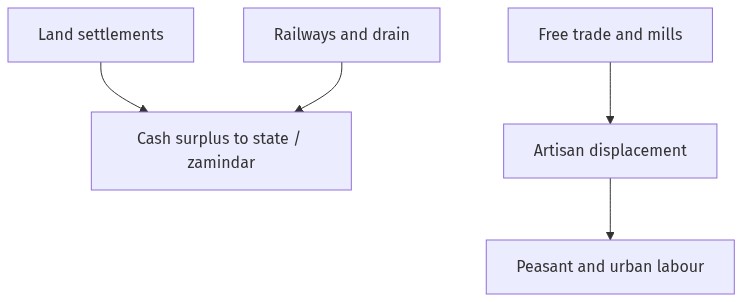
Permanent Settlement (Bengal, 1793), ryotwari and mahalwari turned revenue into a rigid claim. Zamindars and the colonial state captured surplus that had been negotiated in a more layered agrarian order. Peasants faced cash rent, debt and eviction. Commercial crops—indigo, opium, cotton, jute—tied the field to Manchester and China. A. R. Desai treated this as the making of a colonial social formation: agriculture subordinated to metropolitan industry.
Craft, town and drain
Deindustrialisation of handloom and urban craft is the classic thesis of R. C. Dutt and nationalist historians: Lancashire cloth, tariffs, and the destruction of courtly demand hollowed artisan towns. Revisionists note some regional weaving survival and later mill growth in Bombay and Ahmedabad. The sociological truth sits in between: occupational castes of weavers, spinners and metal workers lost secure patronage; many became agricultural labour or slum labour. Railways moved grain to ports in famine years (a Dadabhai Naoroji / later Mike Davis point about Victorian holocausts) even as they integrated markets.
The drain of wealth (unrequited exports, Home Charges) is a macro story with micro effects: thinner local demand for artisans, a new comprador and professional middle class, and a peasantry that met the world market without industrial absorption at home. Famine codes and grain exports in bad years made the new market morally visible to nationalists.
Disruption was not total erasure. Jajmani-like ties, village moneylenders, and caste-based crafts adapted. Dharma Kumar and later Tirthankar Roy warned against a golden-age village and stressed regional variation, credit, and some craft dynamism. That caution is useful. It does not cancel A. R. Desai’s point that the colonial state re-geared surplus toward the metropolis. Socially, weaving jatis, salt and forest communities, and tribal shifting cultivators met the Forest Act as an economic reform by another name.
Still, the direction of reform—private landed property, free trade in manufactures, forest enclosure—broke the old articulation of field, craft and little kingdom. A mill proletariat appeared in Bombay and Kanpur; it was too small to absorb those pushed off the loom and the occupancy holding.
Flow diagram
Conclusion
British economic reforms did disrupt India’s old agrarian-artisan system by monetising land, opening the market on unequal terms, and draining surplus. Mills and some crafts survived in spots; the social structure of occupation and village still bears the scar.
Quick related
Students also ask
-
Who is said to be the pioneer of village studies in India? Illustratively describe contributions of some Indian sociologists on village studies. How their approaches are distinct from each other?
Next question on this syllabus topic (2025 · Q4(a)). View answer →
-
Did the British invent land revenue?
No. They standardised and hardened it, often raising the cash claim and alienability of land.
-
Is deindustrialisation a myth?
The strongest form is overstated, but artisan decline in many textile regions is well attested and sociologically decisive for caste-occupation.
Same topic · past papers
UPSC has asked this before
These previous-year questions sit on the same topic. Open one to practise the earlier ask.
-
2019 · Q3(b) · Sociology GS 2 · 20 marks
Is industrial development in India a bane or a born to agrarian class structure ? Substantiate your answer with suitable examples -
2023 · Q1(e) · Sociology GS 2 · 10 marks
Discuss the main features of Land Reforms in post-independence India -
2022 · Q4(b) · Sociology GS 2 · 15 marks
Explain how land reforms brought about desired agrarian transformation. -
2026 · Q3(c) · Sociology GS 2 · 10 marks
When land reform was a paradigm shift, then what type of land reforms would you recommend to make India a more equitable society? -
2025 · Q2(a) · Sociology GS 2 · 20 marks
Do you think that in a society like India orthogenetic changes take place through differentiation? Do you observe continuities in the orthogenetic process ? Elaborate your answer with suitable examples
More from this topic
Q3(a) · UPSC Mains 2026 · Sociology GS 2 · 20 marks · Solution
Examine the challenges of applying micro-level village studies to macro-level village structure of Indian society
Rural and Agrarian Social Structure
This model answer examines the inherent difficulties in scaling micro-level village studies to macro-level Indian social structures. It highlights issues of regional diversity, caste variations, the impact of globalisation, and methodological limitations. It demonstrates why early sociological attempts to view the Indian village as a self-sufficient 'little republic' fail in contemporary reality. The response uses classical and modern sociological perspectives to bridge the gap between microscopic ethnography and macroscopic generalisation.
Q4(a) · UPSC Mains 2025 · Sociology GS 2 · 20 marks · Solution
Who is said to be the pioneer of village studies in India? Illustratively describe contributions of some Indian sociologists on village studies. How their approaches are distinct from each other?
Rural and Agrarian Social Structure
Srinivas is the pioneer of intensive village fieldwork in Indian sociology, with Rampura and the dominant caste. Dube’s Shamirpet offered a holistic community study; Majumdar mixed survey and anthropology. Marriott and Dumont–Pocock insisted the village be read through civilisational and ideological categories. Béteille separated caste, class and power as no longer symmetrical. Marxist and political-anthropological village studies further shifted the master variable to surplus and faction.
Q1(a) · UPSC Mains 2025 · Sociology GS 2 · 10 marks · Solution
'Textual perspective is important in understanding of Indian Social System.' Discuss.
Rural and Agrarian Social Structure
The textual perspective explains Indian society through Dharmashastra, epics and related canons. Ghurye and Dumont used that archive to theorise caste as a hierarchical whole. The approach is strong on civilisational categories and weak on labour, gender and local power. Srinivas’s field view and Desai’s Marxism correct the book without discarding it. Texts remain part of the social system because groups still quote them in law and ritual.