
Revision summary
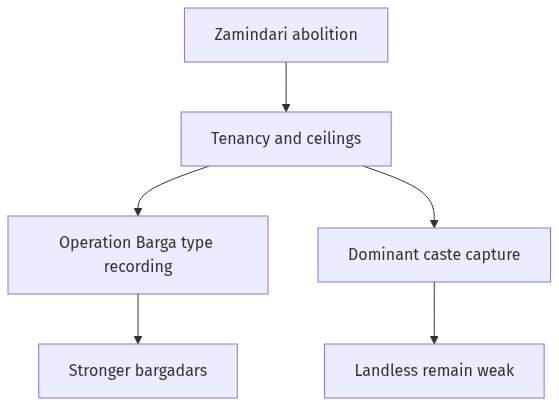
Post-independence land reform abolished intermediaries and legislated tenancy security and ceilings. Implementation was a state subject and followed local class-caste power. Desai treated the package as incomplete agrarian reform. Operation Barga in West Bengal recorded sharecroppers and improved their position. Landless labourers often gained least.
Model answer
Copper italics in this answer — like this — are the key facts. Each one is unpacked in the Facts & figures rail.
Introduction
Post-independence land reform tried to break intermediary landlordism, protect tenants, and cap large holdings. The laws were national in aim and state in design, so the social result followed regional class and caste power.
Body
Legal features
- Abolition of zamindari, jagirdari, and similar intermediaries transferred superior rights toward the state and, on paper, toward the tiller.
- Tenancy reform sought security, fair rent, and in some states a path to ownership for recorded tenants.
- Land ceilings, consolidation of holdings, and Bhoodan–Gramdan added redistribution and farm-size arguments to the package.
- Tribal land alienation laws and later computerised records tried to stop transfer out of vulnerable groups.
Sociological pattern
- A. R. Desai read the package as incomplete bourgeois reform: intermediaries fell, but rich peasants and dominant castes often captured the surplus.
- Andre Beteille’s Tanjore work showed that land, caste, and power overlap without being identical, which is why a ceiling on paper need not equalise a village.
- Operation Barga in West Bengal recorded sharecroppers and raised their bargaining power, a rare case where organisation plus the Left Front state changed tenancy in fact.
Limits
- Benami transfers, poor records, and weak local implementation left landless labourers, many of them Dalit, still land-poor.
- Ceiling surplus was small where holdings were already fragmented or hidden.
- Reform redistributed some rights without ending agrarian class structure, which later globalisation further recast.
Flow diagram
Conclusion
Land reform’s features were abolition of intermediaries, tenancy protection, ceilings, and consolidation. Its sociology is regional: Operation Barga shows what recording rights can do; much of India shows capture by the already strong.
Quick related
Students also ask
-
Explain how land reforms brought about desired agrarian transformation.
Next question on this syllabus topic (2022 · Q4(b)). View answer →
-
Did land reform end landlordism?
It ended many legal intermediaries. Large effective control often passed to rich peasants and dominant castes.
-
Why is Operation Barga cited?
It combined political mobilisation with recording of bargadars, so tenancy rights became usable, not only textual.
Same topic · past papers
UPSC has asked this before
These previous-year questions sit on the same topic. Open one to practise the earlier ask.
-
2025 · Q3(b) · Sociology GS 2 · 20 marks
Do you think that new economic reforms of British rule have disrupted the old economic system of India? Substantiate your answer with suitable examples -
2022 · Q4(b) · Sociology GS 2 · 15 marks
Explain how land reforms brought about desired agrarian transformation. -
2026 · Q3(c) · Sociology GS 2 · 10 marks
When land reform was a paradigm shift, then what type of land reforms would you recommend to make India a more equitable society?
More from this topic
Q3(a) · UPSC Mains 2026 · Sociology GS 2 · 20 marks · Solution
Examine the challenges of applying micro-level village studies to macro-level village structure of Indian society
Rural and Agrarian Social Structure
This model answer examines the inherent difficulties in scaling micro-level village studies to macro-level Indian social structures. It highlights issues of regional diversity, caste variations, the impact of globalisation, and methodological limitations. It demonstrates why early sociological attempts to view the Indian village as a self-sufficient 'little republic' fail in contemporary reality. The response uses classical and modern sociological perspectives to bridge the gap between microscopic ethnography and macroscopic generalisation.
Q4(a) · UPSC Mains 2025 · Sociology GS 2 · 20 marks · Solution
Who is said to be the pioneer of village studies in India? Illustratively describe contributions of some Indian sociologists on village studies. How their approaches are distinct from each other?
Rural and Agrarian Social Structure
Srinivas is the pioneer of intensive village fieldwork in Indian sociology, with Rampura and the dominant caste. Dube’s Shamirpet offered a holistic community study; Majumdar mixed survey and anthropology. Marriott and Dumont–Pocock insisted the village be read through civilisational and ideological categories. Béteille separated caste, class and power as no longer symmetrical. Marxist and political-anthropological village studies further shifted the master variable to surplus and faction.
Q3(b) · UPSC Mains 2025 · Sociology GS 2 · 20 marks · Solution
Do you think that new economic reforms of British rule have disrupted the old economic system of India? Substantiate your answer with suitable examples
Rural and Agrarian Social Structure
The old economy combined peasant agriculture, artisan castes and layered trade, not a frozen idyll. Land settlements monetised revenue and strengthened landlord or state claims on the peasant. Nationalists argued deindustrialisation and drain; revisionists note regional survival and later mills. Socially, craft castes and towns lost patronage and many entered labour markets. Disruption is the right word: the old articulation of field and craft was broken even if not every loom stopped.