
Revision summary
Sustainable development meets needs now without wrecking future needs and requires equity, not only green technology. In India, forest, mine, Green Revolution and coastal conflicts show livelihood versus protection as class conflict. Guha and Gadgil’s ecosystem people versus omnivores is a usable map. FRA, PESA and Gram Sabha consent are tools to join conservation with rights. Costs should shift toward high consumption and corporate externalities, not only toward the poor.
Model answer
Copper italics in this answer — like this — are the key facts. Each one is unpacked in the Facts & figures rail.
Introduction
Sustainable development, in the Brundtland sense, meets present needs without destroying the ability of future generations to meet theirs. In India the same phrase is used in NITI documents and in protest. The hard part is that today’s livelihood—fuelwood, fish, factory jobs, paddy—often is the pressure on soil, forest, air and water. Sociology treats that as a conflict of classes and regions, not as a misunderstanding that a slogan can dissolve.
Body
What sustainability means here
It is not only carbon accounting. It includes livelihood security, equity, and ecological limits. A. R. Desai would ask who owns the resource. Ramachandra Guha and Madhav Gadgil distinguished omnivores and ecosystem people: urban-industrial India consumes what forest and coastal communities inhabit. Chipko, Narmada, and later Niyamgiri made that distinction political.
Where livelihood conflicts with protection
Forest dwellers need NTFP, shifting cultivation or grazing; the Forest Department and tiger reserves need exclusion. Miners and the treasury need bauxite and coal; Dongria Kondh and Hasdeo Arand communities need the hill. Green Revolution Punjab needs water and fertiliser; downstream and future soils pay. Coastal fishers need the sea; ports and SEZs need the same shore. Urban poor need cheap housing; wetlands that flood-buffer the city get built on. A blanket ban without alternatives is conservation against the poor. Unregulated extraction is livelihood for contractors and loss for the next generation of the same poor.
How sustainability can be approached
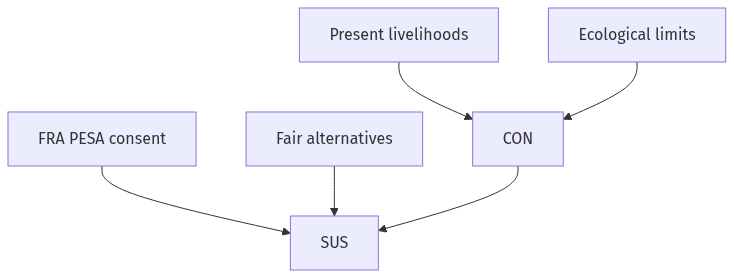
- First, rights-based access: the Forest Rights Act, 2006, PESA, and community forest management, so protection is not alienation. Second, livelihood substitution that people accept: MNREGA on local ecology, non-timber enterprises, fisheries co-management, not only tourist photography. Third, technology and agronomy that cut poison and water waste—but these fail if prices and MSP keep pushing monoculture. Fourth, urban sustainability as housing and public transport for labour, not only solar rooftops on gated colonies. Fifth, democratic planning: Gram Sabha consent, social impact under land-acquisition law, and the right to say no, as in Niyamgiri’s Gram Sabhas.
Sustainability in a poor, unequal country is a bargain among classes mediated by the state. It cannot be a museum forest beside hungry villages, and it cannot be growth that treats air and groundwater as free. The 2020–21 farmers’ movement, Chipko’s memory, and FRA struggles are parts of that bargain. Education (NEP’s environmental aims) and women’s groups in Chipko-type mobilisations matter because women often carry the daily fuel-and-water load.
Urban middle-class environmentalism (clean air, lakes, plastic bans) can conflict with waste-picker and street-vendor livelihoods. That is the same trilogy in the city: development as a world-class aesthetic, environment as amenity, and the identity of informal workers who live from the discarded city. A sociological sustainability answer must keep that urban conflict beside Chipko and Niyamgiri, or it will sound like a ministry pamphlet.
There will remain conflict. The sociological task is to shift costs upward—to luxury consumption, corporate externalities, and wasteful public projects—rather than to Adivasi and slum livelihoods.
Flow diagram
Conclusion
Sustainable development is development within ecological limits and across generations. In India it collides with livelihoods because the poor live inside the resources that the powerful want to fence or extract. FRA, democratic consent, and fair alternatives are the practical path. A pure ban and a pure extractive growth both fail the definition.
Quick related
Students also ask
-
To what extent have the legal provisions been effective in curbing violence against women in India? Give your argument
Next question on this syllabus topic (2024 · Q7(b)). View answer →
-
Can India industrialise and still be sustainable?
Only if energy, waste and land costs are paid and locally consented. A coal-and-eviction path is growth, not sustainability.
-
Is Chipko anti-development?
It was a claim to a different development: local forest use against commercial felling, using a Gandhian public method.
Same topic · past papers
UPSC has asked this before
These previous-year questions sit on the same topic. Open one to practise the earlier ask.
-
2021 · Q7(b) · Sociology GS 2 · 20 marks
Rising 'ethnocentricism' is leading to conflict in our society. Assess this statement with appropriate reasons
More from this topic
Q7(b) · UPSC Mains 2026 · Sociology GS 2 · 20 marks · Solution
Give a sociological explanation of violence against women in India. What suggestions would you give to mitigate these violences?
Challenges of Social Transformation
• Rooted in structural patriarchy, unequal socialization, and institutionalized gender roles within public and private spheres. • Sustained by family, marriage, and religion, which normalize male dominance and control over women's autonomy. • Intersecting factors like class, caste, and religion expose marginalized women to multiple layers of structural violence. • Requires rigorous legal enforcement and gender-sensitizing law enforcement to improve justice delivery. • Demands stronger institutional support, including one-stop crisis centers, helplines, and accessible legal aid. • Calls for educational reforms and community engagement to dismantle toxic masculinity and promote gender equality. • Grounded in Articles 14 and 21, demanding a shift toward transformative social engineering and substantive equality.
Q8(b) · UPSC Mains 2025 · Sociology GS 2 · 20 marks · Solution
Do you think that forced displacement of labourers has caused their deprivation and resultant inequalities during the recent past years? Elaborate
Challenges of Social Transformation
Forced displacement strips land, commons and urban foothold, then cheapens labour. Cernea’s impoverishment risks and Fernandes’s undercounting still describe Indian projects. Recent drivers include mining, highways, city beautification, conflict, climate and COVID reverse migration. Women, ST, SC and migrants lose most; land-value winners gain. R&R law exists; deprivation remains the modal outcome when consent and livelihoods are thin.
Q8(a) · UPSC Mains 2025 · Sociology GS 2 · 20 marks · Solution
Is it possible to have sustainable development in India? Cite major environmental issues and suggest a few measures to achieve the sustainability
Challenges of Social Transformation
Sustainable development is possible in India only if growth is decoupled from dumping costs on the poor. Main issues are climate risk, air and water stress, forest loss, land conversion and inequality. Guha–Gadgil’s sociology of ecosystem people versus omnivores still explains who suffers. Measures include just energy transition, FRA, crop and city reform, and SDG-consistent budgets. Possibility is a political path, not a technical guarantee.