
Revision summary
India’s VAW law includes 498A, the DV Act, post-Nirbhaya rape reform and POSH. Law has changed norms and created institutions. Conviction, investigation and informal-sector reach remain weak. Caste, honour and digital abuse show competing patriarchal jurisdictions. Effectiveness is partial: stronger as recognition than as daily protection.
Model answer
Copper italics in this answer — like this — are the key facts. Each one is unpacked in the Facts & figures rail.
Introduction
- India has a thick file of laws against violence that women face: cruelty in marriage (498A), dowry death provisions, the Protection of Women from Domestic Violence Act, 2005, reformed rape law after Nirbhaya (2012–13), POSH (2013), PCPNDT, and the Trafficking and POCSO statutes where girls are concerned. Effectiveness is partial. Law has named the violence and opened institutions. It has not brought the social rate of violence under control, because patriarchy, police practice and delayed courts still organise the field.
Body
What law has achieved
Law created a public language. Dowry death and domestic violence are not only ‘family matters’ in statute. Vishaka to POSH made the workplace a site of state duty. Fast-track rhetoric and the 2013 criminal amendments widened the definition of sexual assault. Protection officers and shelter homes exist on paper and, in some districts, in fact. Panchayat women members and movements (after Mathura, after Nirbhaya, after Hathras) use these texts. That is effectiveness as norm change and institutional presence.
Some deterrence is real for visible public employees and for families that fear a 498A FIR. POSH committees in universities and firms, where they function, alter everyday behaviour.
Where law is thin
NCRB numbers are not a simple map of violence; they mix reporting and incidence. Conviction rates for rape and domestic cruelty remain low. Investigation is hostile; two-finger myths died slowly. Informal ‘compromise’ and village panchayats send women home. 498A is contested as misuse; the contest itself can chill genuine complaints. The DV Act is civil-protection oriented and under-resourced. POSH barely reaches informal labour, which is where most women work. Caste atrocity against Dalit women is sexual violence plus untouchability; PoA and rape law both apply and both fail in many trials.
Honour killings, khap orders, and communal targeting of women show extra-legal patriarchal law competing with the Constitution. Digital violence outruns IT and criminal provisions. During COVID, domestic violence rose while movement to a thana fell.
- Extent: moderately effective as recognition, weakly effective as everyday protection, least effective for informal, rural, Dalit, Adivasi and disabled women. Legal provisions are a necessary condition of curb, not a sufficient one. Police reform, forensic capacity, shelters, and a change in household power (property, wages, education) are the missing half.
Informal workplaces remain the largest hole. A domestic worker, farm labourer or vendor faces violence with almost no POSH committee and with a police station that may send her back to the employer or husband. Legal provisions written for offices and for ‘cruelty in marriage’ do not automatically travel there. Effectiveness must therefore be measured by class of work, not only by the elegance of the statute.
- A sociological argument therefore refuses two slogans: that law is useless, and that law has solved VAW. Ambedkar’s insight that rights need social conscience still holds. Uma Chakravarti’s Brahmanical patriarchy explains why the same family that uses a smartphone still polices a daughter.
Flow diagram
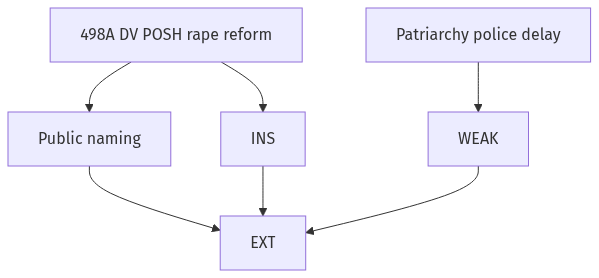
Conclusion
Legal provisions have partly curbed violence against women by naming it, creating POSH and DV machinery, and widening sexual-assault law. They have been limited by police-court practice, informal work, caste, and household patriarchy. The extent of effectiveness is real at the level of norms and uneven at the level of safety.
Quick related
Students also ask
-
Citing some case studies, expand the concept of Development-induced Displacement?
Next question on this syllabus topic (2023 · Q5(a)). View answer →
-
Has 498A been mainly misused?
Misuse exists and is litigated. The larger pattern remains under-reporting of cruelty, not a flood of false cases explaining all FIRs.
-
Can more death penalties curb rape?
Sociology of law points to reporting, trial quality and gender power. Penalty severity alone has a weak record.
Same topic · past papers
UPSC has asked this before
These previous-year questions sit on the same topic. Open one to practise the earlier ask.
-
2025 · Q1(c) · Sociology GS 2 · 10 marks
According to you, which social reform movement has played the most effective role in uplifting the status of women? Explain. -
2026 · Q7(b) · Sociology GS 2 · 20 marks
Give a sociological explanation of violence against women in India. What suggestions would you give to mitigate these violences? -
2017 · Q5(a) · Sociology GS 2 · 10 marks
What are the reason for the escalation of violence against women in the public domain ? -
2015 · Q6(c) · Sociology GS 2 · 15 marks
How serious is the problem of trafficking against women and children in India?
More from this topic
Q7(b) · UPSC Mains 2026 · Sociology GS 2 · 20 marks · Solution
Give a sociological explanation of violence against women in India. What suggestions would you give to mitigate these violences?
Challenges of Social Transformation
• Rooted in structural patriarchy, unequal socialization, and institutionalized gender roles within public and private spheres. • Sustained by family, marriage, and religion, which normalize male dominance and control over women's autonomy. • Intersecting factors like class, caste, and religion expose marginalized women to multiple layers of structural violence. • Requires rigorous legal enforcement and gender-sensitizing law enforcement to improve justice delivery. • Demands stronger institutional support, including one-stop crisis centers, helplines, and accessible legal aid. • Calls for educational reforms and community engagement to dismantle toxic masculinity and promote gender equality. • Grounded in Articles 14 and 21, demanding a shift toward transformative social engineering and substantive equality.
Q8(b) · UPSC Mains 2025 · Sociology GS 2 · 20 marks · Solution
Do you think that forced displacement of labourers has caused their deprivation and resultant inequalities during the recent past years? Elaborate
Challenges of Social Transformation
Forced displacement strips land, commons and urban foothold, then cheapens labour. Cernea’s impoverishment risks and Fernandes’s undercounting still describe Indian projects. Recent drivers include mining, highways, city beautification, conflict, climate and COVID reverse migration. Women, ST, SC and migrants lose most; land-value winners gain. R&R law exists; deprivation remains the modal outcome when consent and livelihoods are thin.
Q8(a) · UPSC Mains 2025 · Sociology GS 2 · 20 marks · Solution
Is it possible to have sustainable development in India? Cite major environmental issues and suggest a few measures to achieve the sustainability
Challenges of Social Transformation
Sustainable development is possible in India only if growth is decoupled from dumping costs on the poor. Main issues are climate risk, air and water stress, forest loss, land conversion and inequality. Guha–Gadgil’s sociology of ecosystem people versus omnivores still explains who suffers. Measures include just energy transition, FRA, crop and city reform, and SDG-consistent budgets. Possibility is a political path, not a technical guarantee.