
Revision summary
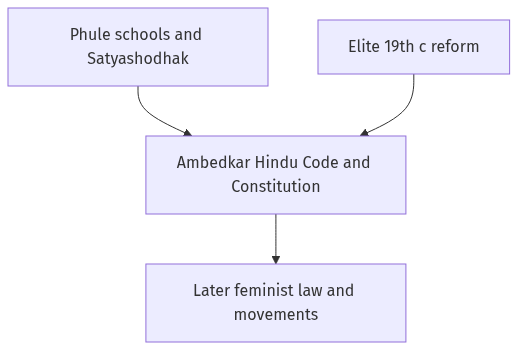
The most effective women’s social reform is the Phule–Ambedkar anti-caste line, not only bhadralok campaigns. It tied girls’ education, a critique of endogamy, and constitutional legal personhood. Sati abolition and widow remarriage opened the public question but had a narrower class-caste base. Hindu Code, later feminist litigation and Shah Bano debates inherit that citizenship frame. Patriarchy continues; effectiveness means a changed legal and educational grammar, not a finished utopia.
Model answer
Copper italics in this answer — like this — are the key facts. Each one is unpacked in the Facts & figures rail.
Introduction
- Many campaigns touched women’s lives: Brahmo reform, widow remarriage, temple entry, the Hindu Code, and post-1970s feminism. The most effective single movement, in structural reach, is the anti-caste educational and legal reform begun by Jotirao and Savitribai Phule and carried into the Constitution by B. R. Ambedkar. It treated women’s uplift as inseparable from caste, labour and the right to learn, not as a polite correction of custom.
Body
Why this line, not only bhadralok reform
Nineteenth-century elite reform—Rammohan on sati (1829), Vidyasagar on widow remarriage (1856), the Age of Consent debate (1891)—mattered. It made the “women’s question” public. Its social base was often upper-caste and urban. Savitribai Phule’s school (1848) and the Satyashodhak attack on Brahmanical marriage rules reached labouring and Dalit-Bahujan women whom the Brahmo salon did not organise. Ambedkar made that programme constitutional: Article 15, the Hindu Code Bills (1955–56) on marriage, succession and adoption, and a politics that named endogamy as the engine of caste (Castes in India, 1916).
Effectiveness is measured by durable rights and institutions. Girls’ schooling as a public duty, legal personhood in marriage and property, and the idea that the state may override custom are now common sense. Later feminism—towards equality, against dowry, Shah Bano (1985) and the contested 1986 Act, Vishaka (1997), POSH, and the demand to reform personal laws—walks on that floor. Without Phule–Ambedkar, reform remains charity to “our women.”
Limits
Law did not abolish patriarchy. Female labour-force participation is uneven; sex ratio and unpaid care persist. Muslim, Christian and customary personal laws still fragment rights. Elite feminist NGOs can speak past rural and Adivasi women. The claim is not that suffering ended. The claim is that this movement changed the terms: education plus legal equality plus a critique of endogamy, rather than a plea to restore a golden shastric womanhood.
Flow diagram
Conclusion
The Phule–Ambedkar reform movement is the most effective because it joined women’s education to anti-caste democracy and to statute. Nineteenth-century elite reform opened the file; this line made women’s status a question of citizenship. Later judgments and movements extend it; they do not replace it.
Quick related
Students also ask
-
How Dalit movements in India have facilitated their Identity formation? Analyze
Next question on this syllabus topic (2025 · Q7(c)). View answer →
-
Why not name only the 19th century reform movement?
It was necessary but socially thin. Phule–Ambedkar reached the majority of women who were also caste-subordinated, and it wrote rights into the Republic.
-
Did Ambedkar ignore Muslim and Christian women?
The Hindu Code’s first round was community-specific. The wider method—constitutional equality and a uniform civil horizon—still frames minority women’s claims.
Same topic · past papers
UPSC has asked this before
These previous-year questions sit on the same topic. Open one to practise the earlier ask.
-
2024 · Q7(b) · Sociology GS 2 · 20 marks
To what extent have the legal provisions been effective in curbing violence against women in India? Give your argument -
2024 · Q8(a) · Sociology GS 2 · 20 marks
Highlight the major contributions of the reform movements in pre-independent India
More from this topic
Q8(b) · UPSC Mains 2026 · Sociology GS 2 · 20 marks · Solution
How have the women's movements made the presence of women in every moment felt and more women participation in various fields? Discuss
Social Movements in Modern India
• 19th-century social reformers initiated the women's movement by targeting regressive practices like sati and child marriage. • The nationalist freedom struggle successfully pulled women out of households into public satyagrahas and political forums. • Post-independence autonomous movements in the 1970s–80s fiercely protested dowry, price rises, and custodial violence. • Constitutional amendments (73rd and 74th) reserved one-third of local governance seats, drawing millions into grassroots leadership. • Grassroots unions like SEWA successfully organized informal female labourers to secure fair wages and basic social security. • Sustained public advocacy and PILs compelled historic criminal law reforms against domestic violence and workplace harassment. • Modern agitations continue to push for structural equality, demanding legislative reservation in Parliament and state assemblies.
Q5(b) · UPSC Mains 2026 · Sociology GS 2 · 10 marks · Solution
Examine the transiting social movements from physical movements to virtual movements in 21st century India.
Social Movements in Modern India
• 21st-century Indian social movements have shifted from physical street protests to digital and virtual mobilisation. • Virtual platforms provide borderless reach, instant information sharing, and bypass traditional gatekeepers. • Movements like #MeToo India show a shift toward decentralised, network-centric leadership without rigid hierarchies. • Digital tools lower transaction costs and enable real-time narration to counter official state narratives. • Severe limitations remain, including the digital divide, gender gaps in internet access, and superficial "slacktivism." • True democratic dissent requires blending fast digital outreach with deep, durable grassroots solidarity for marginalised voices.
Q1(c) · UPSC Mains 2026 · Sociology GS 2 · 10 marks · Solution
In the context of women's movements and laws do you think that matriarchy is the need of the hour? Discuss in detail.
Social Movements in Modern India
This answer evaluates the proposition of matriarchy as a remedy for patriarchal oppression in modern India. It traces the historical trajectory of women's movements and legal reforms from social reform acts to contemporary rights-based frameworks. It analyses the distinction between matrilineal systems and matriarchy, noting that true matriarchy involves institutionalized female authority rather than mere descent tracking. The discussion highlights the limitations of replacing one power hierarchy with another, advocating instead for gender-egalitarian models. Constitutional provisions like Article 15 and statutory measures such as the Protection of Women from Domestic Violence Act, 2005 are integrated to ground the analysis in Indian jurisprudence. Finally, a policy-oriented conclusion emphasizes substantive equality and shared governance over inverted power structures.